Usually yes, if the shutter changes the appearance of the frontage. In England and Wales, shutters on a shop front are expressly outside permitted development, and in Scotland and Northern Ireland we would treat them under the general appearance test. Councils generally prefer perforated or internal shutters, and a solid external shutter is often the hardest to get approved.
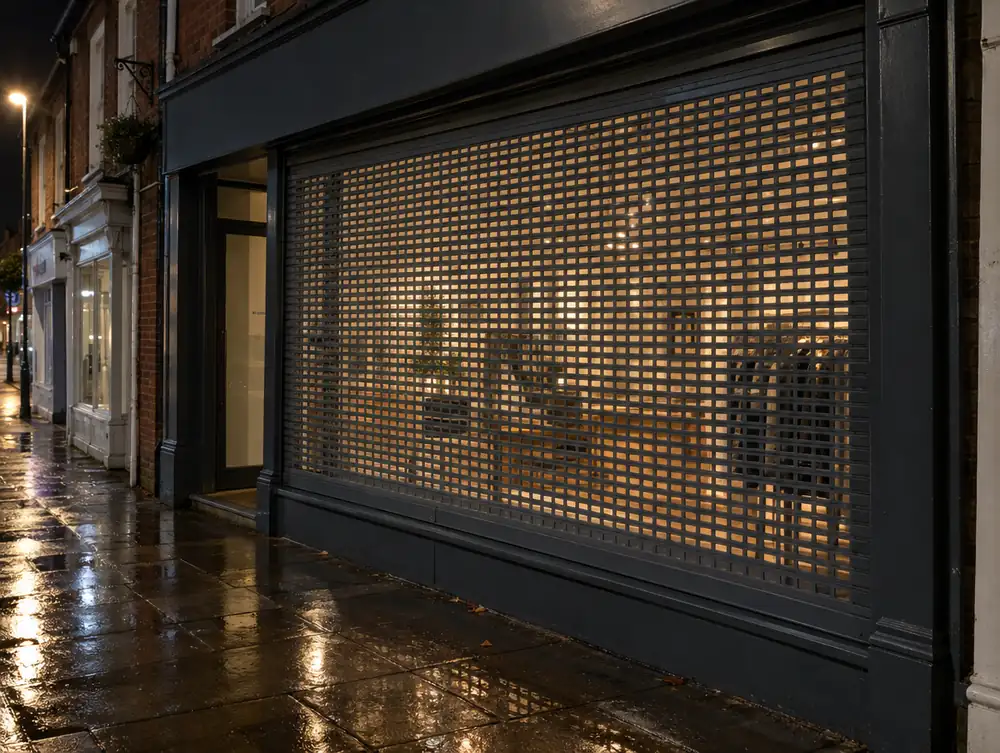
Do roller shutters need planning permission?
Roller shutters need planning permission wherever they materially affect the appearance of the building, and most external ones do. England and Wales go further than the other nations: the permitted development classes for shops expressly exclude installing or replacing a security grill or shutter on a shop front.
Scotland's Class 9A doesn't name shutters, and we found no permitted development route at all in Northern Ireland, so on our reading both fall to the appearance test. Whichever nation you are in, the council's answer is the one that matters, and it is worth asking before buying.
The fees below are the closest category for an alteration with no new floorspace, since no schedule names shutters or shopfronts. Your council confirms the figure. Handling the application is £395 to £1,295 plus VAT per application, plus the council's fee if you would like us to do it.
| Nation | Position for shutters | Closest fee | From |
|---|---|---|---|
| England | Outside PD: GPDO 2015 Sch 2 Pt 7 Class A | £309 | 1 April 2026 |
| Wales | Outside PD: GPDO 1995 Pt 42 Class A | £383 | 1 December 2025 |
| Scotland | Not named; appearance test | £371 | 1 April 2026 |
| Northern Ireland | No PD route found; appearance test | £220 | 1 April 2025 |
Why do councils object to solid shutters?
Councils object because a solid shutter turns a lit window into a blank wall for half of every day. One of them on a street is a minor loss. A whole row, closed at 6pm, makes a place feel unsafe and unused, and it is exactly the outcome that design policies are written to prevent.
Boxes are the other complaint. A shutter box bolted to the face of a fascia adds a heavy horizontal bar across the frontage, often hiding the fascia and the sign. Guide channels fixed to the face of pilasters do similar damage to an older front, and graffiti on solid laths tends to make the street look worse still.
Expect the council to think about the street at night as well as your security. Many will ask you to show why a shutter is needed, and evidence of past break-ins or an insurer's letter can help that case.
Which shutter types are easiest to get approved?
Internal grilles are usually the easiest, followed by perforated or open-lattice external shutters, with solid shutters the hardest. Each step towards the solid end adds security and costs you some light and appearance, so be honest about the risk you actually face.
Perforated shutters are £1,695 to £4,495 plus VAT per shutter. A perforated curtain lets the display and interior lighting read through at night, and that small amount of glow makes a real difference from across the street. Colour matters too, since a shutter powder-coated to match the frame reads as part of the design, whereas bare galvanised steel always looks like an afterthought. Leave some display lighting on a timer, or the benefit of those perforations is lost.
| Type | Night appearance | Security | Planning fit |
|---|---|---|---|
| Solid external | Blank | Strong, hides the display | Hardest |
| Perforated external | Dim view through | Good | Often acceptable |
| Open-lattice external | Clear view | Moderate | Often acceptable |
| Internal grille | Window stays visible | Protects stock, glass exposed | Easiest |
Where should the shutter box and guides go?
The box should sit behind the fascia or inside the shop, and the guides should sit in the reveal. Designed in from the beginning, a shutter almost disappears when it is open, which is why it should be drawn alongside the glass and sign and not added afterwards.
Allow around 200mm to 300mm of depth for the box, depending on the height of the opening, since the curtain gets thicker as it rolls up. If the fascia void can't take it, stepping the ceiling inside the shop may. Leave a removable panel so that the motor can be reached, and make sure that panel doesn't sit behind your new sign.
Fit the guides before the stallriser finish wherever possible, so that the channel runs neatly to the ground. Bottom-rail locks need a proper housing in the threshold or the stallriser, and a retrofitted lock fixed into loose paving slabs will be the first thing to fail.
Can a replacement shutter avoid an application?
Only if the appearance doesn't materially change, because no permitted development class helps. Swapping a worn shutter for an identical one in the same position is likely to pass that test, but moving the box, or changing solid for perforated, is a change even if it is an improvement.
Check the history as well. If the old shutter was never approved, replacing it may not put you in as strong a position as you assumed, so ask the council before relying on it. Keep dated photographs of the existing shutter open and closed.
A shutter on a listed building has its own consent to consider, and external ones are rarely accepted there.
What else must a shutter design allow for?
A shutter has to allow for fire escape, safety in use and regular servicing. Where a shutter crosses an exit, nobody must be able to lock people in: fire law in all four nations says exit doors must not be locked against immediate use, so the shutter must be open whenever the building is occupied, or designed so that it can't trap anyone.
BS EN 13241 is the product standard for commercial doors and gates, including retail rolling shutters, so ask for the declaration and the safety information with the product. If you need rated resistance, LPS 1175 and BS EN 1627 are the usual references for attack testing.
Powered shutters need a proper supply and a manual override, along with an annual service. We service shutters at £145 plus VAT per shutter as a charged visit.
Common questions
Are perforated shutters always approved?
No. They are often more acceptable than solid ones, but a council can still refuse them in a sensitive street or on a building with a good older frontage. Internal protection is the usual fallback.
My insurer wants a shutter. Does that override planning?
No, an insurer's requirement doesn't replace consent, although it can support your case. Ask the insurer whether laminated glass or an internal grille would satisfy it if the council refuses an external shutter.
Does a shutter inside the shop need permission?
Usually not, if it doesn't materially affect the appearance from outside. A listed building is different, because internal work can need listed building consent as well.
Can the shutter stay down during trading hours?
Read the planning decision first, because some councils attach conditions about when a shutter may be closed. Any lease matters too, since landlords often have views about closed frontages.