Automatic shop doors are designed to BS EN 16005:2023 for safety in use, with BS 7036-0:2014 covering risk assessment. England's Approved Document K says powered doors must not trap people and must open on power failure, and Scotland expects BS 7036 design and fail-safe conditions. Ask for the risk assessment, and for the certificate with the product where that applies.
What standards apply to automatic shop doors?
The main reference is BS EN 16005:2023, covering safety in use of power-operated pedestrian doorsets. Supporting it, BS 7036-0:2014 is a code of practice for risk assessment and risk reduction, and a revision of that document has been proposed, so check the current edition before you specify.
Other standards deal with the rest of the door. BS EN 14351-1 is the product standard for external pedestrian doorsets, and the glass in a leaf has to meet its safe-breakage class like any other door glass. For accessible design, BS 8300-2:2018 gives guidance that often shapes how a door is set up, even though it isn't a regulation.
A door isn't made safe by a label on the operator. The standard is about the finished installation in its real position, with its real users, which is why a door moved to a new entrance needs a fresh look.
| Reference | Covers |
|---|---|
| BS EN 16005:2023 | Safety in use of power-operated pedestrian doorsets |
| BS 7036-0:2014 | Risk assessment and risk reduction |
| BS EN 14351-1:2006+A2:2016 | External pedestrian doorsets |
| BS EN 12600:2002 | Impact classification of the glass |
| BS 8300-2:2018 | Accessible and inclusive buildings |
What do building regulations say about powered doors?
Building regulations set the outcome, and the wording varies by nation. England's Approved Document K requires that powered doors don't trap people and that they open on power failure. Scotland expects revolving and automatic doors to follow BS 7036 design and fail-safe conditions.
We haven't quoted specific powered door wording for Wales or Northern Ireland, so ask building control there. Wales still has Part N for the glazing and its own Approved Document M for access, and Northern Ireland uses Booklets R and V. Clear width and threshold figures come from the access guidance in each nation, so a door must satisfy those as well.
Revolving doors need separate thought. England's Approved Document M says they are not accessible, so a conventional or sliding door has to sit alongside any revolving one.
| Nation | Powered door position | Also check |
|---|---|---|
| England | AD K: must not trap, must open on power failure | AD M, AD B |
| Wales | Ask building control | AD N, AD M, AD B |
| Scotland | BS 7036 design, fail-safe conditions | Standards 4.1, 4.8, 2.9 |
| Northern Ireland | Ask Building Control | Booklets R, V, E |
How is an automatic door kept safe in use?
Safety comes from a site risk assessment, sensors set up for that entrance and sensible opening speeds. The detector that opens the door is only half the job. Separate safety sensors watch the path of the leaf, so that it stops or reverses if someone is in the way.
Installers look for specific hazards. Gaps between a moving leaf and a fixed screen can trap fingers, so they need to be guarded or kept small. A child running in beside the leaf, a guide dog ahead of its owner, or someone with a stick moving slowly through the opening all test the settings in different ways. Set the hold-open time for the slowest person likely to use the door.
Low-energy swing doors are worth knowing about for small shops. They move slowly and with limited force, which can reduce the need for some of the sensing and suits an entrance where people arrive one at a time.
Which automatic door suits a shop entrance?
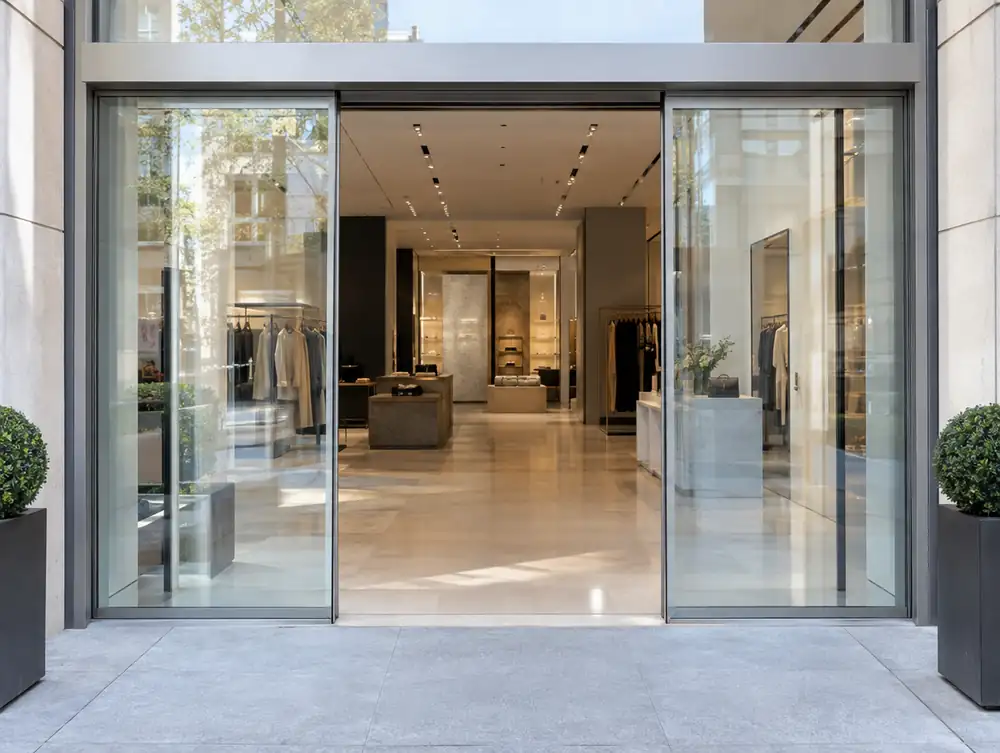
Sliding doors suit most busy shops, swing operators suit small entrances, and revolving doors suit large lobbies with wind problems. Wall space is the catch with sliding: a bi-parting door needs roughly as much fixed screen beside the opening as the opening itself, so a 2m clear doorway wants about 4m of frontage.
Each has a point where it stops making sense. A sliding door on a narrow unit eats the display window, a swing door takes floor space and needs guarding on its swing side, and a revolving door costs far more and needs a second accessible door next to it.
| Type | Guide price | Wrong when |
|---|---|---|
| Automatic sliding | £3,895 to £11,995 plus VAT per entrance | No wall space beside the opening |
| Revolving | £19,995 to £59,995 plus VAT per door | Small lobby, no second door |
| Swing operator | £995 to £6,995 plus VAT depending on the work | Heavy traffic in both directions |
Can an automatic door form part of an escape route?
It can be part of a route but not a dedicated fire exit, and the fire risk assessment decides the rest. Sliding and revolving doors are excluded from dedicated exits under fire law, so an alternative is needed if your only exit would otherwise be automatic.
Break-out leaves can help a sliding door open outward under pressure, though they add cost and need clear floor space on the swing side. Think about the power cut as well: a door that simply stops is a problem, so ask how yours behaves when the supply fails and whether it relies on a battery, a spring or something else.
How often should an automatic door be serviced?
A planned visit every six months is a common pattern, and busier doors may need more, so follow the maker's instructions. Between visits, staff should check each morning that the door opens, stops when challenged and runs smoothly.
Most faults are simple. Grit in a floor track slows a leaf until the operator throws an error, and a window cleaner's ladder can knock a sensor out of alignment. Sliding doors that start to drag usually need rollers adjusting, and a door left to run with a scraping noise will wear out far sooner.
Keep a service log. It shows that the door has been looked after, which matters to insurers and to anyone investigating an accident, and it helps an engineer spot a recurring fault.
What should I get at handover?
Ask for the risk assessment, the commissioning sheet, the operating instructions and any declaration or certificate that comes with the product. Have someone show your staff how to change between automatic, hold-open and locked modes, and how to free the door when the power is off.
Those simple handover steps are often skipped. A door nobody knows how to reset is the door that ends up wedged open by a stack of boxes, so make sure the instructions stay on site and not in a folder at head office.
Common questions
Can my existing manual door be automated?
Often, yes. A swing operator can be fitted if the door, frame and hinges are sound, but a heavy or worn door may need replacing first.
Why does wind stop my automatic door closing?
Wind pressure on a large leaf can overcome the operator's force settings, and the sensors can read a moving mat or hanging display as a person. A lobby, a recess or adjusted settings usually help.
Can I lock an automatic door at night?
Yes, most have a locked mode with a bolt on the drive. Check how it behaves when the power fails, and never leave anyone inside with no other way out.
Do automatic doors need a separate electrical supply?
They need a safe supply and a local means of isolation, which should be planned at drawing stage. Say early who will provide it, as a missing supply is a common cause of delay.