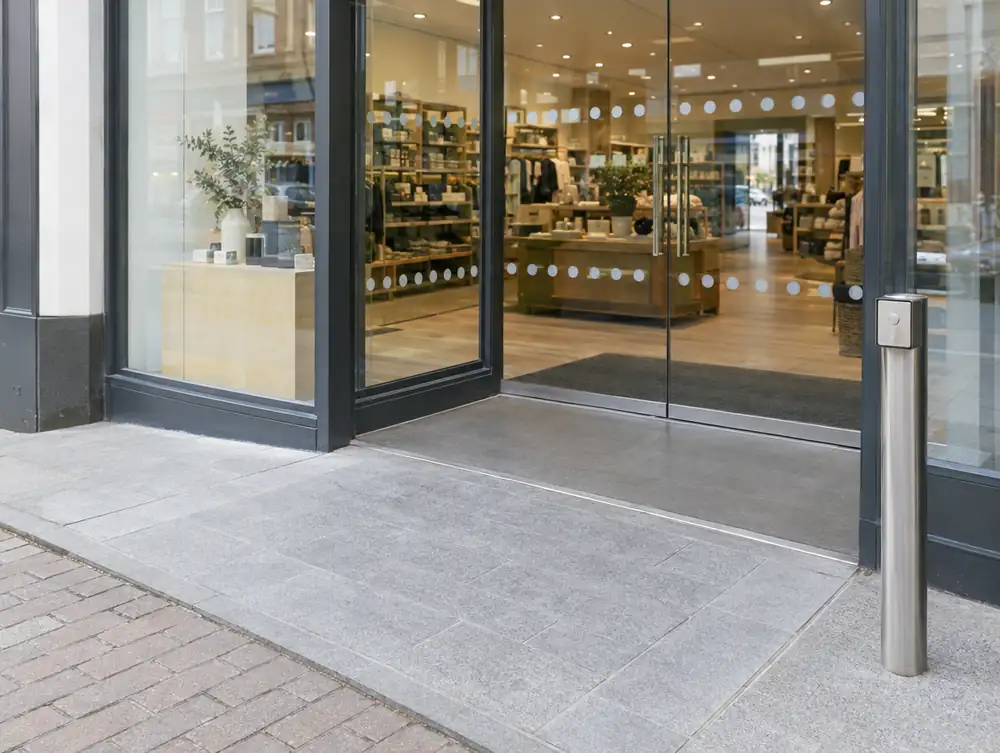
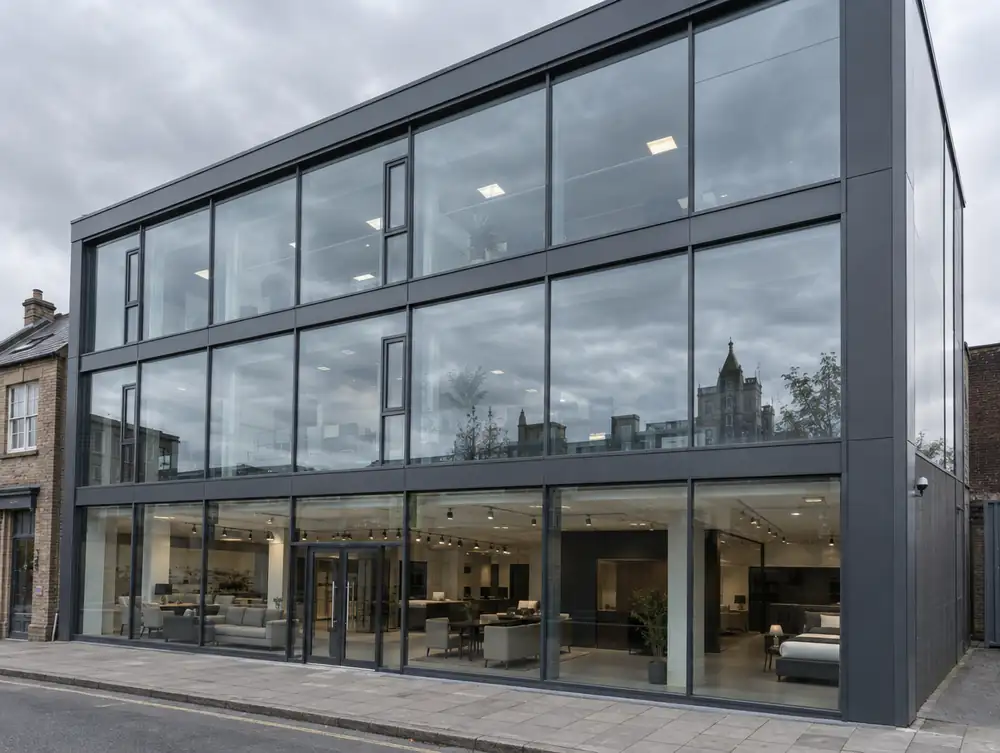
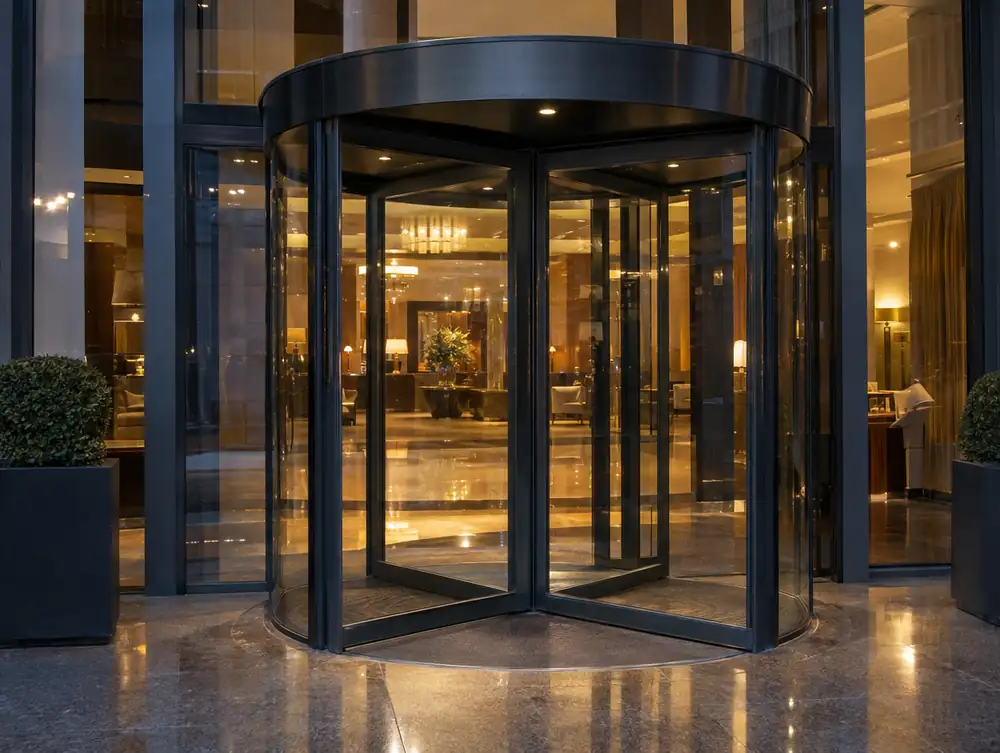
A revolving door is a set of glass wings turning inside a curved drum, keeping inside and outside air apart while people pass through. It suits hotels, office lobbies, department stores and flagship shops with steady footfall, a deep enough entrance and room for an accessible door alongside.
| Configuration | Three or four wings, manual with speed control or fully powered |
|---|---|
| Diameter | Typically 2.1 to 3m, with 2.1m a common four-wing size |
| Drum | Curved laminated or toughened glass walls with a metal or glass canopy |
| Drive | Overhead in the canopy, or below the floor where the ceiling line matters |
| Finish | Powder coat, anodised aluminium, stainless steel or bronze-look cladding |
| Typical lead time | Typically 10 to 16 weeks after drawings are signed off, then 3 to 7 days on site |
| Designed to meet | BS EN 16005:2023 for power-operated sets, with a BS 7036-0:2014 risk assessment |
| Comes with | Free site survey, floor and canopy drawings, itemised quotation and a 10-year workmanship guarantee on written terms |
When does a revolving door make sense?
When footfall is steady and the entrance has to hold heat or keep out wind. The drum works like an airlock, with the wings keeping inside and outside air apart, so a lobby on a windy corner stays calm where a sliding door would pour warm air into the street.
It also makes an arrival, which is why hotels and flagship stores like them. The slow turn gives a doorway some ceremony, and a glass drum lit from within becomes a landmark on the elevation after dark.
Space is the limit. A 2.1m drum needs around 2.4m of clear width and depth once the walls and canopy are counted, and you still need an accessible door beside it. On most shop units, only a wide frontage or a deep lobby can offer that.
How does a revolving door fit into a frontage?
As the centrepiece, because nothing else on the elevation has its mass. We centre the drum on a bay or on the architecture above, keep the canopy within the fascia band and line the top of the drum up with the head of the glass, so the door reads as part of the front.
The curved wall runs down to the floor, so the stallriser has to stop at a clean post on each side. A drum that projects over the pavement needs a licence in England, Wales and Northern Ireland, and in Scotland the roads authority should be asked first, so we normally keep it behind the building line.
What rules apply to revolving doors?
Access, escape and approval matter most, and the detail differs by nation.
- Access: England's Approved Document M says revolving doors are not accessible, so treat a level side door as essential everywhere.
- Escape: fire law in all four nations rules out revolving doors on a dedicated fire exit.
- Scotland: BS 7036 design and fail-safe conditions apply to a drum on an escape route.
- Approval: in England and Wales, the self-certification route for replacement doors excludes revolving doors, so expect to involve building control.
Where do revolving doors go wrong?
At the floor, before anything else. Wings sweep within a few millimetres of the finished surface, so a slab that is slightly out of level leaves seals scraping on one side and gapping on the other. We check levels across the full diameter, and a basement below can rule out an under-floor drive altogether.
Sizing is the other classic fault. A small drum passes people singly, and anyone with a case, a pushchair or shopping bags stalls inside. If the compartments are too tight, a queue forms on the pavement and people stop using the door.
Stock needs thinking about as well. A drum takes no trolleys or deliveries, so the side door or a rear entrance has to cover that, and book-fold wings are worth considering if furniture ever has to come through.
What does a revolving door cost to run?
More than a slider, offset by what it saves in heat. Budget for two to four service visits a year on a powered drum, plus sweep seals, which wear first at the floor. Curved drum walls need cleaning on both faces, and staff should clear grit from the threshold daily. Any fault with a safety edge or sensor must be fixed before the door goes back into use, because those parts protect people inside the drum.
Which options can you choose from?
Manual with speed control
Pushed by hand, with a governor to limit speed. Simple and quiet where footfall is steady.
Fully powered drum
Starts when someone steps in and turns at a set speed. The usual choice for hotels and larger diameters.
Three-wing door
Larger compartments for a given diameter, which helps with luggage and pushchairs.
Four-wing door
Smaller compartments and a more constant air seal, suited to steady flows of people on foot.
Book-fold wings
Wings that fold flat, so the drum can be cleared for moving furniture or for events.
Metal-clad drum
Canopy, posts and wing frames in bronze-look, brushed stainless or anodised finishes to match the front.
How much does it cost?
Guide price: £19,995 to £59,995 plus VAT per door. This is a budget figure, and your free survey gives you the real one.
Work out a guide price or see all our prices.
Common questions
How much does a revolving door cost?
A revolving door costs £19,995 to £59,995 plus VAT per door. Diameter, drive type, finish and canopy set the price, and floor or structural work sits on top. The accessible door beside it usually has its own line on the quotation.
How long does a revolving door take?
Typically 10 to 16 weeks from signed-off drawings to delivery, then 3 to 7 days on site. Floor preparation has to finish first, and the door needs setting up before it opens to the public. Allow for consent ahead of that.
Does a revolving door need planning permission?
Usually, since a drum and canopy materially change how a frontage looks. Expect an application unless the door replaces a similar one like for like. Building approval is separate, and in England and Wales this work can't use the self-certification route for replacement doors.
How often does a revolving door need servicing?
Two to four times a year for a powered door, and at least twice for a manual one. Seals, bearings, sensors and floor tracks are the main items. Keep a log of each visit, and act on any safety edge fault straight away.
Are revolving doors accessible?
Not on their own. England's Approved Document M says they are not accessible, so plan a level, wide-enough door beside the drum. Treat that as the baseline in every nation, and make the side door just as easy to find.
Can a revolving door be a fire exit?
No, not as a dedicated fire exit. Fire law in England, Wales, Scotland and Northern Ireland rules out revolving doors there. Keep a proper swing door near the drum, and have the escape route confirmed by the responsible person in England and Wales or the dutyholders elsewhere.
Should I choose three wings or four?
Three wings give bigger compartments, which helps hotels and anywhere with luggage. Four wings keep a more constant seal and suit a steady stream of people on foot at a typical 2.1m diameter. The right answer comes from your footfall, your diameter and what people carry.