Every enquiry for revolving doors in County Antrim begins with a measured survey at the premises, because a price taken from a photograph is only a guess. That visit gives you real dimensions before anyone draws a line or orders a thing.
Most frontages share something with someone, be that a door to the flats above, a meter cupboard or a pilaster on the boundary. We pick those up early on revolving doors in County Antrim, because they are far easier to design around than to discover on the day.
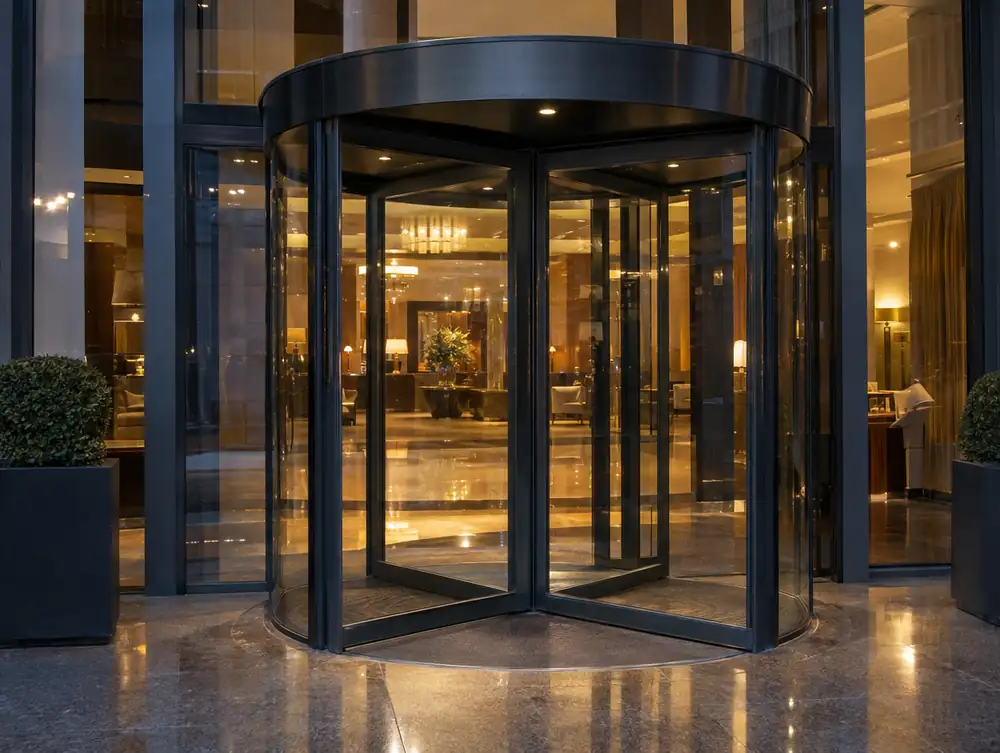
What should you settle before committing to revolving doors in County Antrim?
Hotels, offices and flagship stores all use a drum differently. For a lobby in Belfast or elsewhere in County Antrim, we size the compartments for the people arriving, including their luggage, so the door never becomes the slowest part of the welcome.
A side door is part of the design. Across County Antrim, we treat the door beside the drum as an equal, with matching finishes and the same clear approach, so nobody feels sent round the back.
What consents apply to revolving doors in County Antrim?
Section 23 of the Planning Act (Northern Ireland) 2011 sets the test: work that doesn't materially affect the external appearance isn't development. That makes appearance the deciding point for revolving doors at premises in the County Antrim area, so planning permission is needed if it is materially affected and usually not for a true like-for-like replacement. The council confirms the position for the particular premises.
How much do revolving doors cost in County Antrim?
Allow £19,995 to £59,995 plus VAT per door. Size and specification set most of that figure for revolving doors, and the rest depends on what the survey finds on site.
| Area | County Antrim |
|---|---|
| Nation | Northern Ireland |
| Towns covered | 10 |
| Main town | Belfast |
| Planning regime | Northern Ireland: Planning Act 2011 and the 2015 Advertisement Regulations |
| Building approval | Building Control (Technical Booklets) |
| Survey | Free for new work, from our Great Barr base |
Does Belfast City Council publish shopfront guidance?
Yes, Supplementary Planning Guidance: Advertising and Signage (2023). It deals with advertising and signage, not with shopfronts generally. A few of the things it asks for:
- Where an original fascia exists it should be used, with no advertising below fascia level or on pilasters or columns.
- Halo lighting of letters is preferred, and internally lit lightboxes should be avoided.
- Projecting signs should extend about 1m at most including fixings and sit at least 2.25m above ground.
Questions about revolving doors in County Antrim
Do you install revolving doors in County Antrim?
Yes. We travel from Great Barr to survey the entrance, and the floor, structure and door are coordinated under one contract.
Can a lobby in County Antrim stay open during installation?
Usually, with the side door or another entrance in use while the drum goes in. We'd agree the sequence with you before the floor work starts.
Will a revolving door cut heating bills at premises in County Antrim?
It can, especially on an exposed entrance, because the wings stop through-draughts. The saving depends on footfall and on how the drum compares with the door you have now.
Does a shop sign in the County Antrim area need advertisement consent?
Not always. Under Northern Ireland's 2015 Regulations, an unlit sign within Class 5 generally needs no application, with a 5m top height and 0.3m letters, and neither does a lit sign within Class 4(2). That lit class isn't available in conservation areas, Areas of Outstanding Natural Beauty or National Parks, so ask first.
What rules apply to a fire exit door through a shopfront in the County Antrim area?
It must open in the direction of escape, it can't be locked against immediate use, and a dedicated fire exit can't be sliding or revolving. In Northern Ireland that comes from regulation 13(2) of the Fire Safety Regulations (Northern Ireland) 2010, and duties sit with dutyholders, meaning the employer and any person with control of the premises, whom the Fire and Rescue Service calls the appropriate person. An outward door may also need Department consent under Article 56 of the Roads (Northern Ireland) Order 1993.