For revolving doors across County Down, we draw first and order later. You see a scale drawing with signed-off dimensions before anything is made, so the frontage on paper is the frontage you get.
Openings are rarely square or level, so the survey for revolving doors records diagonals, pavement fall and head height at several points. Those few millimetres decide whether the finished front sits true against the building.
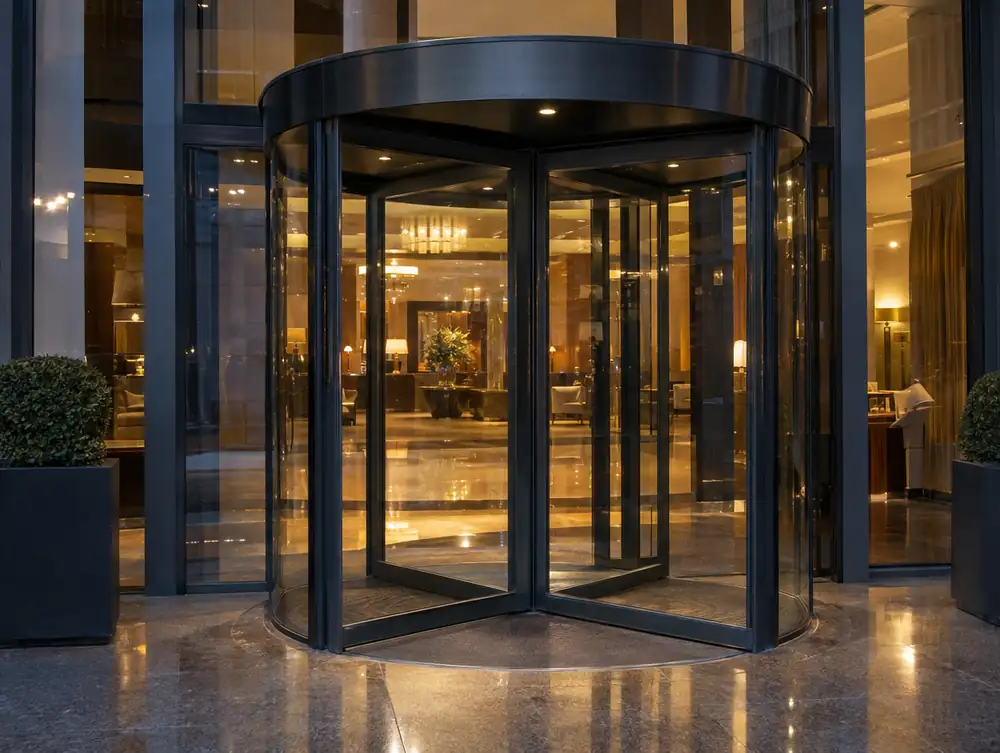
How do we handle revolving doors for premises in County Down?
Getting a drum into the building takes some thought. For addresses in County Down, we check how the curved panels and canopy reach the opening, since large pieces may need lifting gear or a delivery outside trading hours.
A side door is part of the design. Across County Down, we treat the door beside the drum as an equal, with matching finishes and the same clear approach, so nobody feels sent round the back.
What consents apply to revolving doors in County Down?
Northern Ireland appears to have no permitted development route for a shopfront, as its 2015 Order mentions shops only in the Part 4 changes of use. For revolving doors at premises in the County Down area, expect a planning application unless the external appearance isn't materially affected. Ask the council to confirm the position.
How much do revolving doors cost in County Down?
The guide for revolving doors is £19,995 to £59,995 plus VAT per door. Expect the lower end for simple work with clear access, and the upper end where detail, finish or awkward conditions add hours.
| Area | County Down |
|---|---|
| Nation | Northern Ireland |
| Towns covered | 8 |
| Main town | Bangor |
| Planning regime | Northern Ireland: Planning Act 2011 and the 2015 Advertisement Regulations |
| Building approval | Building Control (Technical Booklets) |
| Survey | Free for new work, from our Great Barr base |
Does Newry, Mourne and Down District Council publish shopfront guidance?
Yes, Advice Guide 8 - General Principles of Good Shop Front Design. It tells applicants what the council expects from new and altered shopfronts. A few of the things it asks for:
- Stall risers should be at least 500mm high, or reach the top of the pilaster base, with a moulded projecting sill below the glazing.
- Ground-floor fascias should be about 600mm high, and acrylic or fluorescent materials are not acceptable.
- Surface-mounted shutters will not receive planning permission, and unpainted galvanised shutters will not be permitted.
Questions about revolving doors in County Down
Is my entrance in Bangor big enough for a revolving door?
It may be, if the frontage or lobby is generous. A 2.1m drum takes around 2.4m each way, and you'll need room for a side door as well.
Can you replace an old revolving door in Bangor?
Often, yes. We'd measure the existing drum and floor, then advise on refurbishing or replacing it, and a like-sized drum keeps the building work down.
Can a lobby in County Down stay open during installation?
Usually, with the side door or another entrance in use while the drum goes in. We'd agree the sequence with you before the floor work starts.
What rules apply to a fire exit door through a shopfront in the County Down area?
It must open in the direction of escape, it can't be locked against immediate use, and a dedicated fire exit can't be sliding or revolving. In Northern Ireland that comes from regulation 13(2) of the Fire Safety Regulations (Northern Ireland) 2010, and duties sit with dutyholders, meaning the employer and any person with control of the premises, whom the Fire and Rescue Service calls the appropriate person. An outward door may also need Department consent under Article 56 of the Roads (Northern Ireland) Order 1993.
Who decides listed building consent for a shopfront in the County Down area?
The council decides, under section 85 of the Planning Act (Northern Ireland) 2011. The Department for Communities' Historic Environment Division is a statutory consultee on applications. Unauthorised works are a criminal offence, so ask before anything is removed.