Few businesses can shut for a week, so any time on site for bi-folding shopfronts in County Down is planned around the hours you trade. Closed-day or out-of-hours installation can be arranged.
What sits behind the existing fascia often decides the job. Old beams, abandoned cable runs and earlier frames are common finds, which is why our visit to County Down premises looks past the surface before anything is drawn or priced for bi-folding shopfronts.
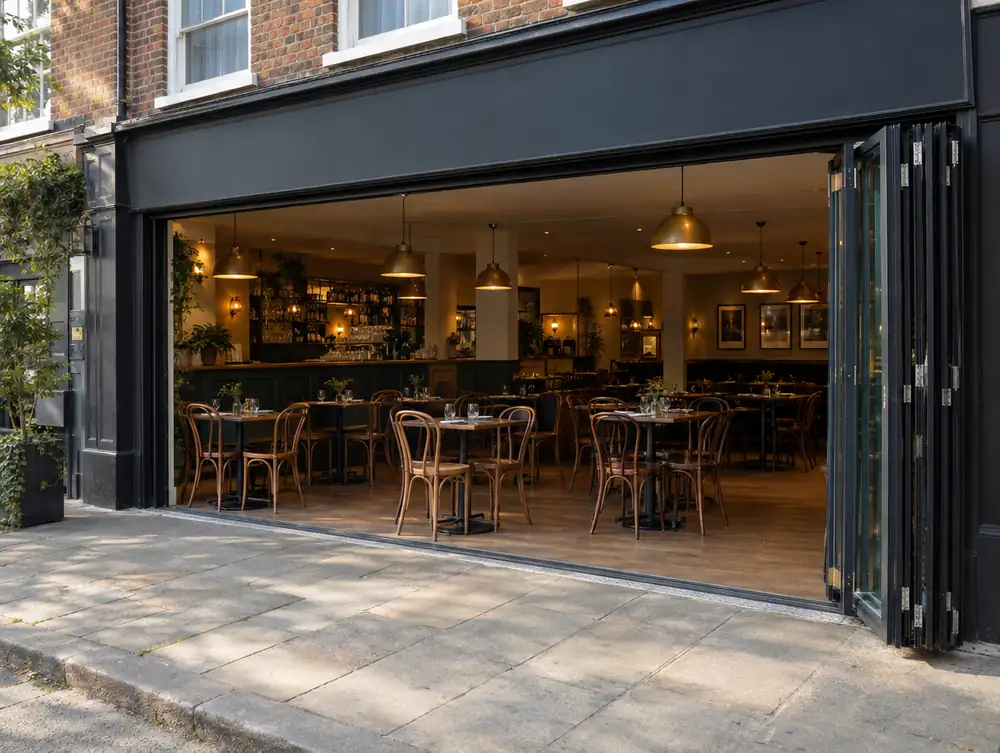
What should you settle before committing to bi-folding shopfronts in County Down?
Floors vary more than people expect. If your premises in County Down are older, a level track can mean cutting into a slab, a stone threshold or a cellar head, so we find out what's under the floor before deciding between top-hung and bottom-rolling.
Wind decides how a folding front behaves. If your unit in County Down sits near the coast or on an open corner, we'd specify stronger stays and check panel heights, because a light leaf caught in a gust is hard on hinges.
What consents apply to bi-folding shopfronts in County Down?
Section 23 of the Planning Act (Northern Ireland) 2011 sets the test: work that doesn't materially affect the external appearance isn't development. That makes appearance the deciding point for bi-folding shopfronts at premises in the County Down area, so planning permission is needed if it is materially affected and usually not for a true like-for-like replacement. The council confirms the position for the particular premises.
How much do bi-folding shopfronts cost in County Down?
We would budget £5,195 to £13,995 plus VAT for a typical opening. Scope sets most of the figure, so a clear brief at the start does more for the budget than any later change of detail.
| Area | County Down |
|---|---|
| Nation | Northern Ireland |
| Towns covered | 8 |
| Main town | Bangor |
| Planning regime | Northern Ireland: Planning Act 2011 and the 2015 Advertisement Regulations |
| Building approval | Building Control (Technical Booklets) |
| Survey | Free for new work, from our Great Barr base |
Does Newry, Mourne and Down District Council publish shopfront guidance?
Yes, Advice Guide 8 - General Principles of Good Shop Front Design. It tells applicants what the council expects from new and altered shopfronts. A few of the things it asks for:
- Stall risers should be at least 500mm high, or reach the top of the pilaster base, with a moulded projecting sill below the glazing.
- Ground-floor fascias should be about 600mm high, and acrylic or fluorescent materials are not acceptable.
- Surface-mounted shutters will not receive planning permission, and unpainted galvanised shutters will not be permitted.
Questions about bi-folding shopfronts in County Down
Do you install bi-folding shopfronts in County Down?
Yes. We travel from Great Barr to survey the opening, check the head and floor, and fit the set with a vetted team.
Will a bi-fold work on a sloping street in County Down?
Usually, with the right threshold. We take levels across the opening, then step the track, add a low upstand or set the frame back so water stays outside.
Do bi-folds suit the weather in County Down?
Yes, as long as the threshold, seals and panel sizes match the exposure. Sheltered streets get more open days, but closed performance is what counts through winter.
Do I need planning permission to change a shopfront in the County Down area?
Usually yes, when the work materially affects the external appearance. Northern Ireland's 2015 Order appears to offer no permitted development route for a shopfront. The council confirms the position, and a true like-for-like replacement usually needs no application.
Does the Disability Discrimination Act apply to a shop entrance in the County Down area?
Yes. The Disability Discrimination Act 1995 applies in Northern Ireland, and section 21 deals with physical features that make a service hard for disabled people to use. Regulations made in 2007 (SR 2007/473) add detail on features, third-party consent and design standards.