Seen a frontage you admire? Bring the picture to our first talk about perforated roller shutters in County Down, and we will work out what makes it succeed, from fascia depth to glass line, and what that means for your building.
Openings are rarely square or level, so the survey for perforated roller shutters records diagonals, pavement fall and head height at several points. Those few millimetres decide whether the finished front sits true against the building.
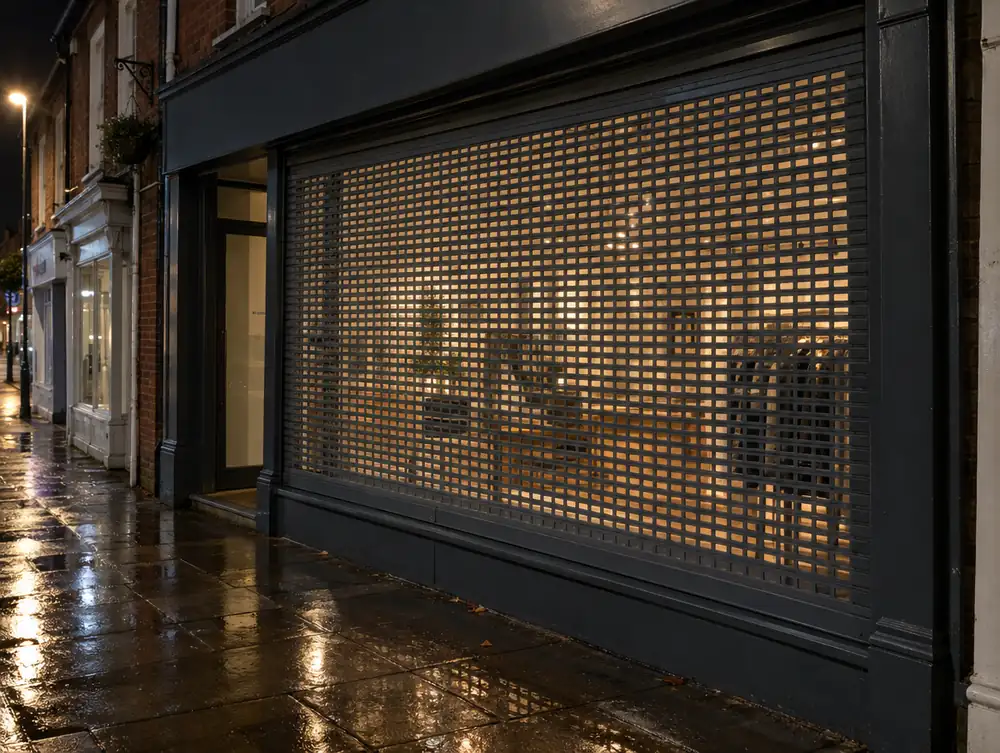
What makes perforated roller shutters work well for premises in County Down?
Your lighting does half the work of a perforated curtain. For a unit in County Down we look at what stays on overnight, so the display still reads from the pavement after you lock up.
Footfall after dark shapes the choice. If your premises in County Down sit where people walk past in the evening, a dark perforated curtain keeps the frontage alive, while a site that goes quiet may need a stronger specification.
What consents apply to perforated roller shutters in County Down?
Shutters in Northern Ireland are treated like the rest of the frontage: as no permitted development route appears to exist, they usually fall to the appearance test. Building work that materially affects the external appearance needs planning permission, for perforated roller shutters at premises in the County Down area as for anything else on the frontage, while a true like-for-like usually doesn't. Ask the council where a particular job stands.
How much do perforated roller shutters cost in County Down?
Until the survey is done, plan on £1,695 to £4,495 plus VAT per shutter. Unusual sizes, fine detail and phased working push the figure up, while a simple brief and clear access keep it toward the lower end.
| Area | County Down |
|---|---|
| Nation | Northern Ireland |
| Towns covered | 8 |
| Main town | Bangor |
| Planning regime | Northern Ireland: Planning Act 2011 and the 2015 Advertisement Regulations |
| Building approval | Building Control (Technical Booklets) |
| Survey | Free for new work, from our Great Barr base |
Does Newry, Mourne and Down District Council publish shopfront guidance?
Yes, Advice Guide 8 - General Principles of Good Shop Front Design. It tells applicants what the council expects from new and altered shopfronts. A few of the things it asks for:
- Stall risers should be at least 500mm high, or reach the top of the pilaster base, with a moulded projecting sill below the glazing.
- Ground-floor fascias should be about 600mm high, and acrylic or fluorescent materials are not acceptable.
- Surface-mounted shutters will not receive planning permission, and unpainted galvanised shutters will not be permitted.
Questions about perforated roller shutters in County Down
Do you service shutters across County Down?
Yes. A planned yearly service covers the curtain, guides, motor and safety devices. Repairs are charged call-outs, so a yearly visit usually saves money.
Can an existing shopfront in County Down take an internal shutter?
Often, yes, if there is room for the box and guides behind the frame. We check the ceiling, window bed and any display fittings at survey.
Will a shutter stop the need for laminated glass in County Down?
Not if it sits inside the glass, because the pane stays exposed. Many shops combine a good laminate with an internal shutter, which protects both the frontage and the stock.
What rules apply to a fire exit door through a shopfront in the County Down area?
It must open in the direction of escape, it can't be locked against immediate use, and a dedicated fire exit can't be sliding or revolving. In Northern Ireland that comes from regulation 13(2) of the Fire Safety Regulations (Northern Ireland) 2010, and duties sit with dutyholders, meaning the employer and any person with control of the premises, whom the Fire and Rescue Service calls the appropriate person. An outward door may also need Department consent under Article 56 of the Roads (Northern Ireland) Order 1993.
What building approval does a shopfront in the County Down area need?
Usually a full plans application to Building Control in Northern Ireland, because building notices are for single dwellings. The Technical Booklets set the detail, with Booklet V for glass and Booklet R for access. Only dwelling windows and doors are exempt, so ask Building Control before assuming a like-for-like job falls outside the rules.