Our quotation for projecting signs in County Down is written, itemised and valid for 90 days. Nothing is ordered until you accept it, which gives you time to take it to a landlord, a partner or a board.
Your frontage is read alongside its neighbours, so we note the fascia line, stallriser height and pilasters on either side before drawing projecting signs for County Down premises. Matching those lines or breaking them on purpose can both work, whereas doing it by accident never does.
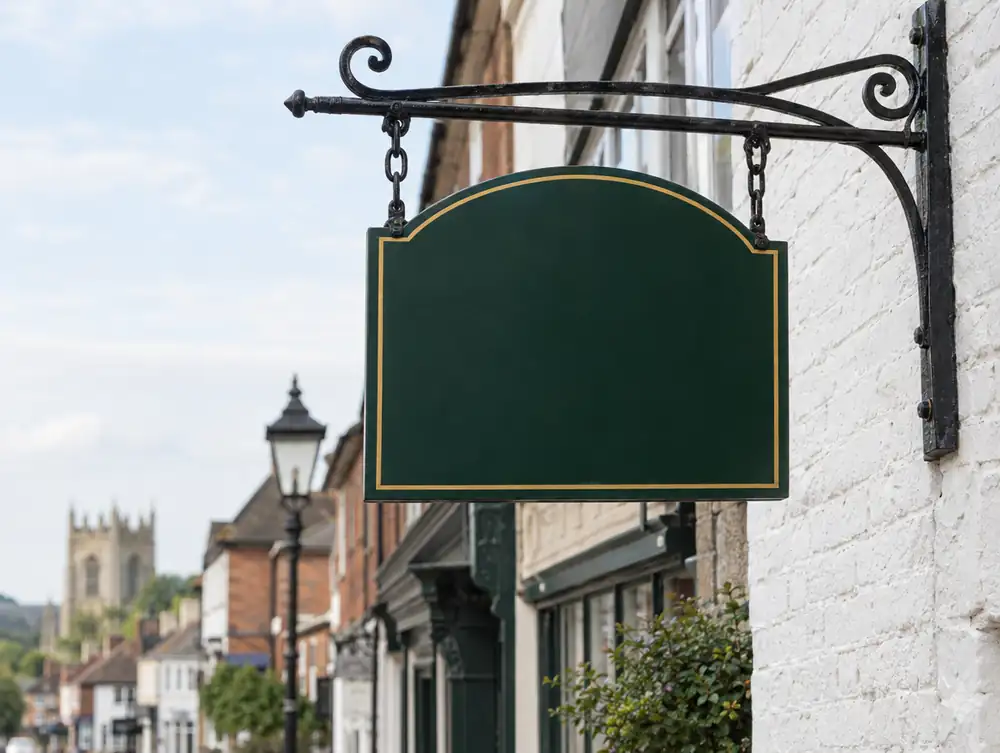
How do we handle projecting signs for premises in County Down?
Exposure can change the bracket design. Where a frontage in County Down faces into the prevailing wind, a fixed blade may be a better choice than a free-swinging panel, as it has no shackles to wear.
Sightlines along the street decide the position. On premises across County Down we walk the pavement from both directions at survey, because a lamp post, tree or neighbouring sign can hide a sign from the side people arrive.
What consents apply to projecting signs in County Down?
Northern Ireland appears to have no permitted development route for a shopfront, as its 2015 Order mentions shops only in the Part 4 changes of use. For projecting signs at premises in the County Down area, expect a planning application unless the external appearance isn't materially affected. Ask the council to confirm the position.
A lit projecting sign in Northern Ireland can generally reach 1m² per surface and 1m high under Class 4(2). Projection is limited to 1m or two-thirds of the footway, so work to the smaller figure. At premises in the County Down area, anything bigger needs advertisement consent, and so does a lit sign in a conservation area.
How much do projecting signs cost in County Down?
Guide price: £395 to £1,295 plus VAT per sign. Materials, finish and the amount of drawing and coordination involved all move it, and your itemised quotation shows where the money goes on projecting signs.
| Area | County Down |
|---|---|
| Nation | Northern Ireland |
| Towns covered | 8 |
| Main town | Bangor |
| Planning regime | Northern Ireland: Planning Act 2011 and the 2015 Advertisement Regulations |
| Building approval | Building Control (Technical Booklets) |
| Survey | Free for new work, from our Great Barr base |
Does Newry, Mourne and Down District Council publish shopfront guidance?
Yes, Advice Guide 8 - General Principles of Good Shop Front Design. It tells applicants what the council expects from new and altered shopfronts. A few of the things it asks for:
- Stall risers should be at least 500mm high, or reach the top of the pilaster base, with a moulded projecting sill below the glazing.
- Ground-floor fascias should be about 600mm high, and acrylic or fluorescent materials are not acceptable.
- Surface-mounted shutters will not receive planning permission, and unpainted galvanised shutters will not be permitted.
Questions about projecting signs in County Down
Can you fit a projecting sign to a stone or brick wall in County Down?
Yes. Hard stone and sound brick both take resin anchors well, and soft brick needs a longer, wider fixing. We drill into mortar joints or discreet positions where the wall needs protecting.
Is a hanging sign better than a fixed one for premises around Bangor?
It depends on the building and the exposure. Hanging signs suit traditional frontages and give a bit of movement, while fixed signs need less upkeep. On a windy elevation we usually suggest fixed.
Can a new panel go on my existing bracket in County Down?
Often, yes, once we have checked the bracket and fixings. Old ironwork can be stripped and repainted, and the panel can be made to fit it. A loose or corroded bracket has to come down first.
What rules apply to a fire exit door through a shopfront in the County Down area?
It must open in the direction of escape, it can't be locked against immediate use, and a dedicated fire exit can't be sliding or revolving. In Northern Ireland that comes from regulation 13(2) of the Fire Safety Regulations (Northern Ireland) 2010, and duties sit with dutyholders, meaning the employer and any person with control of the premises, whom the Fire and Rescue Service calls the appropriate person. An outward door may also need Department consent under Article 56 of the Roads (Northern Ireland) Order 1993.
Do I need planning permission to change a shopfront in the County Down area?
Usually yes, when the work materially affects the external appearance. Northern Ireland's 2015 Order appears to offer no permitted development route for a shopfront. The council confirms the position, and a true like-for-like replacement usually needs no application.