Every enquiry for stallrisers and cladding in County Down begins with a measured survey at the premises, because a price taken from a photograph is only a guess. That visit gives you real dimensions before anyone draws a line or orders a thing.
Access gets as much attention as appearance at survey. Where a vehicle can stop, how long sections reach the opening and how the pavement stays safe for the public all shape the programme for stallrisers and cladding in County Down.
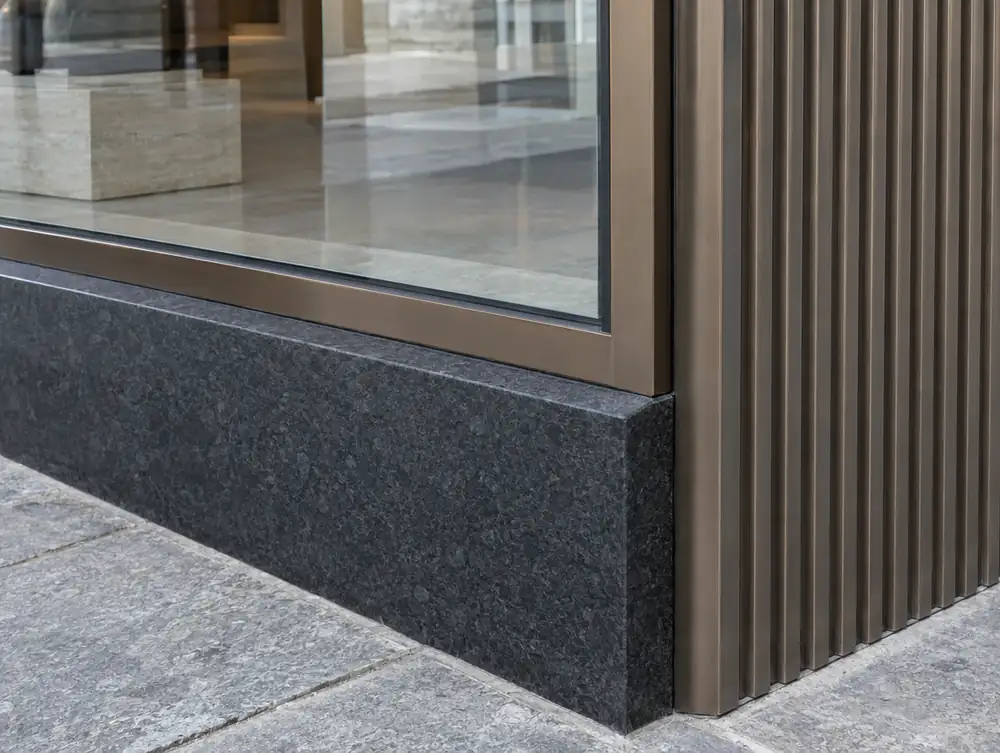
How should you approach stallrisers and cladding in County Down?
Road grit does the most damage at this level. On premises across County Down that take winter salt or regular pavement washing, we fit a replaceable plinth so the lowest edge can be changed without disturbing the facing.
Stripping an old facing can reveal what the building had first. If original tile or timber turns up on your premises in County Down, we stop and talk to you, since repairing it may cost less than cladding over it.
What consents apply to stallrisers and cladding in County Down?
Section 23 of the Planning Act (Northern Ireland) 2011 sets the test: work that doesn't materially affect the external appearance isn't development. That makes appearance the deciding point for stallrisers and cladding at premises in the County Down area, so planning permission is needed if it is materially affected and usually not for a true like-for-like replacement. The council confirms the position for the particular premises.
How much do stallrisers and cladding cost in County Down?
Allow £195 to £495 plus VAT per m². Size and specification set most of that figure for stallrisers and cladding, and the rest depends on what the survey finds on site.
| Area | County Down |
|---|---|
| Nation | Northern Ireland |
| Towns covered | 8 |
| Main town | Bangor |
| Planning regime | Northern Ireland: Planning Act 2011 and the 2015 Advertisement Regulations |
| Building approval | Building Control (Technical Booklets) |
| Survey | Free for new work, from our Great Barr base |
Does Newry, Mourne and Down District Council publish shopfront guidance?
Yes, Advice Guide 8 - General Principles of Good Shop Front Design. It tells applicants what the council expects from new and altered shopfronts. A few of the things it asks for:
- Stall risers should be at least 500mm high, or reach the top of the pilaster base, with a moulded projecting sill below the glazing.
- Ground-floor fascias should be about 600mm high, and acrylic or fluorescent materials are not acceptable.
- Surface-mounted shutters will not receive planning permission, and unpainted galvanised shutters will not be permitted.
Questions about stallrisers and cladding in County Down
Can you reclad only the stallriser on my premises in County Down?
Yes. It is one of the simplest ways to lift a tired frontage, provided the frame above is sound. We check the sill detail first, because a new facing must not trap water beneath it.
How do I pick a stallriser finish for a unit in County Down?
Start with the brick, stone or render above the shop, then bring in the brand colour. Samples held against the building in daylight will tell you more than a screen, so try them in the morning and the evening.
Do you fit natural stone stallrisers across County Down?
Yes. Stone is templated from the measured survey, then fixed with mechanical restraints and a ventilated cavity. Heavier stone may need a check of the wall behind before we confirm the thickness.
Does the Disability Discrimination Act apply to a shop entrance in the County Down area?
Yes. The Disability Discrimination Act 1995 applies in Northern Ireland, and section 21 deals with physical features that make a service hard for disabled people to use. Regulations made in 2007 (SR 2007/473) add detail on features, third-party consent and design standards.
Do I need planning permission to change a shopfront in the County Down area?
Usually yes, when the work materially affects the external appearance. Northern Ireland's 2015 Order appears to offer no permitted development route for a shopfront. The council confirms the position, and a true like-for-like replacement usually needs no application.