From Bangor to the furthest corner of County Down, the sequence for frameless glass doors stays the same: survey, drawings, written price, then work on site. We travel from Great Barr in Birmingham and use vetted teams working under S&K Glazing.
Finishes behave differently at full size. Any sample we show you for frameless glass doors is better judged at the premises in daylight, since a colour that looks quiet on a desk can read much louder across a whole elevation.
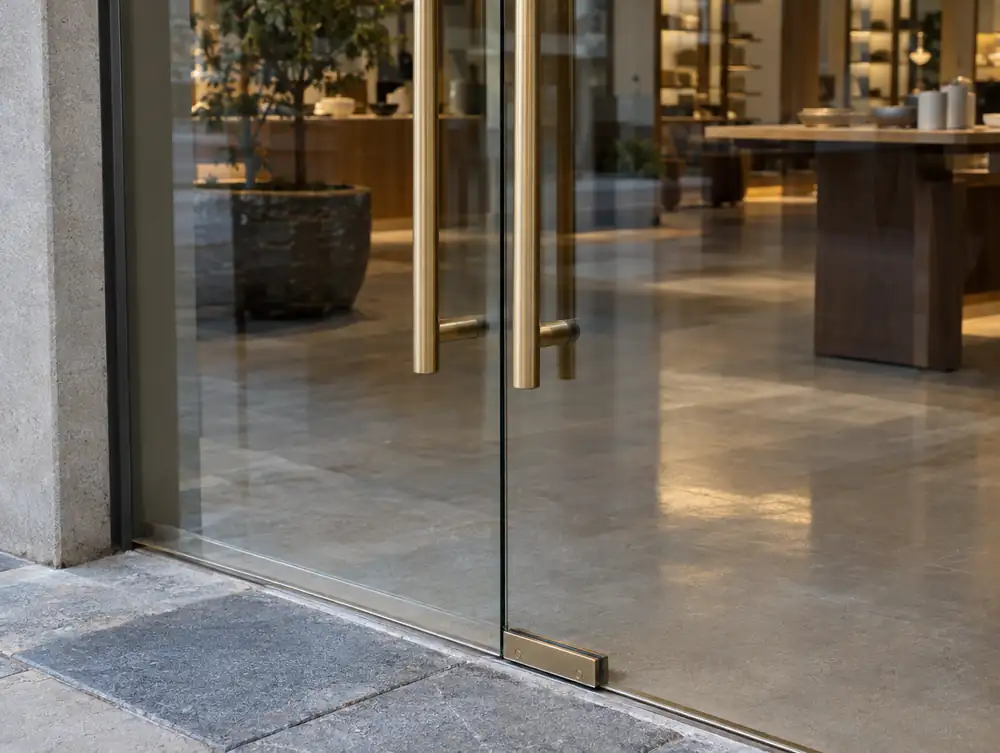
How should you approach frameless glass doors in County Down?
Wind can hold a glass door open or slam it shut. If your entrance in County Down sits on an exposed corner or a straight street, we'd choose a stronger spring, a delayed close or a lobby, so the leaf stays under control.
Security after hours shapes the hardware. For premises in County Down that close early or sit on a quiet street, we'd look at the lock position, floor socket and any internal shutter together, so the door is secure without looking heavy.
What consents apply to frameless glass doors in County Down?
A true like-for-like replacement usually needs no planning permission in Northern Ireland, since the external appearance isn't materially affected. Altered materials, proportions or sightlines usually do count, so for frameless glass doors at premises in the County Down area, planning permission is then likely to be needed. The council confirms where a job sits.
How much do frameless glass doors cost in County Down?
A sensible starting budget is £1,495 to £4,495 plus VAT per door set. What shifts the figure is whatever can't be seen yet, such as the condition behind the old frontage or the services running through it.
| Area | County Down |
|---|---|
| Nation | Northern Ireland |
| Towns covered | 8 |
| Main town | Bangor |
| Planning regime | Northern Ireland: Planning Act 2011 and the 2015 Advertisement Regulations |
| Building approval | Building Control (Technical Booklets) |
| Survey | Free for new work, from our Great Barr base |
Does Newry, Mourne and Down District Council publish shopfront guidance?
Yes, Advice Guide 8 - General Principles of Good Shop Front Design. It tells applicants what the council expects from new and altered shopfronts. A few of the things it asks for:
- Stall risers should be at least 500mm high, or reach the top of the pilaster base, with a moulded projecting sill below the glazing.
- Ground-floor fascias should be about 600mm high, and acrylic or fluorescent materials are not acceptable.
- Surface-mounted shutters will not receive planning permission, and unpainted galvanised shutters will not be permitted.
Questions about frameless glass doors in County Down
Do you fit frameless glass doors across County Down?
Yes. We travel from Great Barr to survey, make a final check measure and fit each door set.
Do you match door fittings to our other premises in County Down?
Yes. Fittings come in several finishes, and we'd use your existing door as the reference so every entrance feels the same.
How much notice does a glass door need at premises in County Down?
Allow typically 2 to 4 weeks from the check measure, as the glass is made to order, and about a day on site for each door set.
Does the Disability Discrimination Act apply to a shop entrance in the County Down area?
Yes. The Disability Discrimination Act 1995 applies in Northern Ireland, and section 21 deals with physical features that make a service hard for disabled people to use. Regulations made in 2007 (SR 2007/473) add detail on features, third-party consent and design standards.
What rules apply to a fire exit door through a shopfront in the County Down area?
It must open in the direction of escape, it can't be locked against immediate use, and a dedicated fire exit can't be sliding or revolving. In Northern Ireland that comes from regulation 13(2) of the Fire Safety Regulations (Northern Ireland) 2010, and duties sit with dutyholders, meaning the employer and any person with control of the premises, whom the Fire and Rescue Service calls the appropriate person. An outward door may also need Department consent under Article 56 of the Roads (Northern Ireland) Order 1993.