What should your premises say from across the road? We open every conversation about revolving doors in Merseyside with that question, then treat sightlines and proportion as seriously as the budget.
Your frontage is read alongside its neighbours, so we note the fascia line, stallriser height and pilasters on either side before drawing revolving doors for Merseyside premises. Matching those lines or breaking them on purpose can both work, whereas doing it by accident never does.
What should you settle before committing to revolving doors in Merseyside?
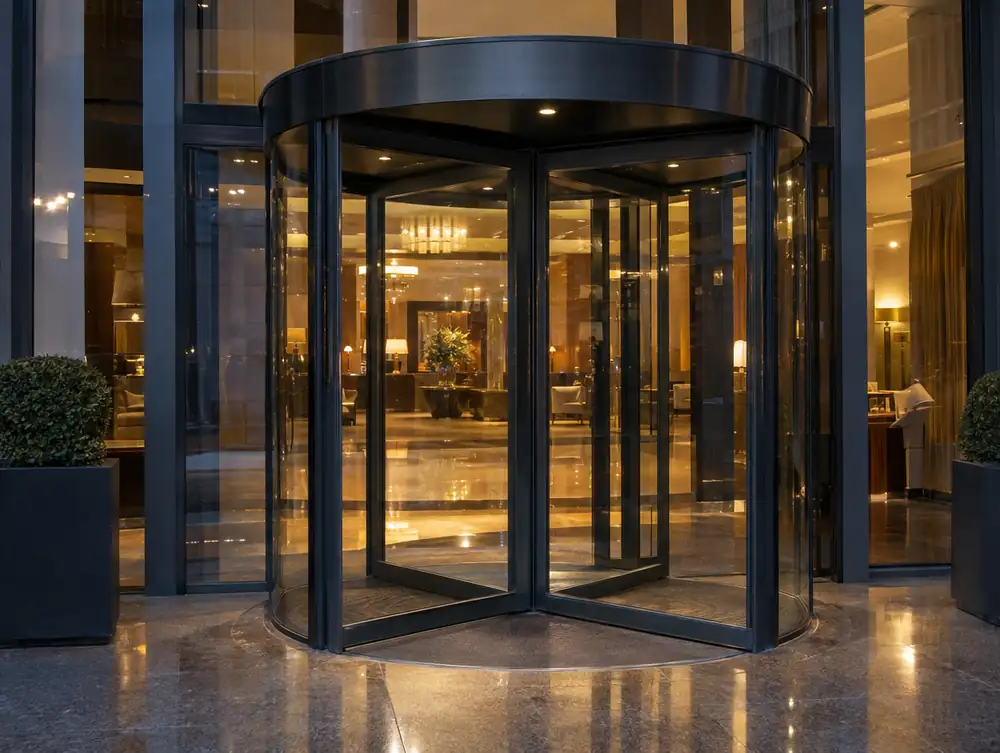
Wind is usually the reason to choose a drum. For premises across Merseyside, we look at how the entrance is exposed, because a corner that funnels weather into a lobby gains more from a revolving door than a sheltered street does.
Measure the floor before falling for the drum. If your building in Merseyside is an older one, the slab may fall toward the street, so we check levels across the full diameter and find out what lies beneath before choosing a drive.
What consents apply to revolving doors in Merseyside?
A true like-for-like replacement usually needs no planning permission in England, because the external appearance isn't materially affected. New materials, a different glass line or altered proportions usually do count as material, so for revolving doors at premises in the Merseyside area, an application is then likely. The council confirms which side of that line a job falls on.
How much do revolving doors cost in Merseyside?
As a working budget, use £19,995 to £59,995 plus VAT per door. Your place inside that range for revolving doors depends mostly on how much of the existing frontage can stay and how much has to be put right first.
| Area | Merseyside |
|---|---|
| Nation | England |
| Towns covered | 41 |
| Main town | Liverpool |
| Planning regime | England: TCPA 1990 and the 2007 Advertisement Regulations |
| Building approval | Building Regulations (Approved Documents) |
| Survey | Free for new work, from our Great Barr base |
Does Knowsley Metropolitan Borough Council publish shopfront guidance?
Yes, Shopfront and Signage Design Supplementary Planning Document (2023). It tells applicants what the council expects from new and altered shopfronts. A few of the things it asks for:
- The stallriser should generally be no more than 20% of the shopfront's overall height.
- The fascia should be no more than 20% of the shopfront's height and generally no deeper than 400mm.
- Solid external roller shutters are unacceptable, and internal grilles or shutters are preferred.
Questions about revolving doors in Merseyside
Can you replace an old revolving door in Liverpool?
Often, yes. We'd measure the existing drum and floor, then advise on refurbishing or replacing it, and a like-sized drum keeps the building work down.
Will a revolving door cut heating bills at premises in Merseyside?
It can, especially on an exposed entrance, because the wings stop through-draughts. The saving depends on footfall and on how the drum compares with the door you have now.
Is my entrance in Liverpool big enough for a revolving door?
It may be, if the frontage or lobby is generous. A 2.1m drum takes around 2.4m each way, and you'll need room for a side door as well.
Does a shop sign in the Merseyside area need advertisement consent?
Not always. In England, an unlit sign within Class 5 of the 2007 Advertisement Regulations generally needs no application, and neither does a lit sign within Class 4B. Anything outside those classes needs consent, and Class 4B isn't available in conservation areas, so check before ordering.
Do I need listed building consent for a shopfront in the Merseyside area?
Usually yes, if the building is listed. In England the local planning authority decides, and Historic England is notified of Grade I and II* works and specified Grade II works. Like-for-like repair may not need consent, so ask the council before work starts.