From Liverpool to the furthest corner of Merseyside, the sequence for stallrisers and cladding stays the same: survey, drawings, written price, then work on site. We travel from Great Barr in Birmingham and use vetted teams working under S&K Glazing.
Finishes behave differently at full size. Any sample we show you for stallrisers and cladding is better judged at the premises in daylight, since a colour that looks quiet on a desk can read much louder across a whole elevation.
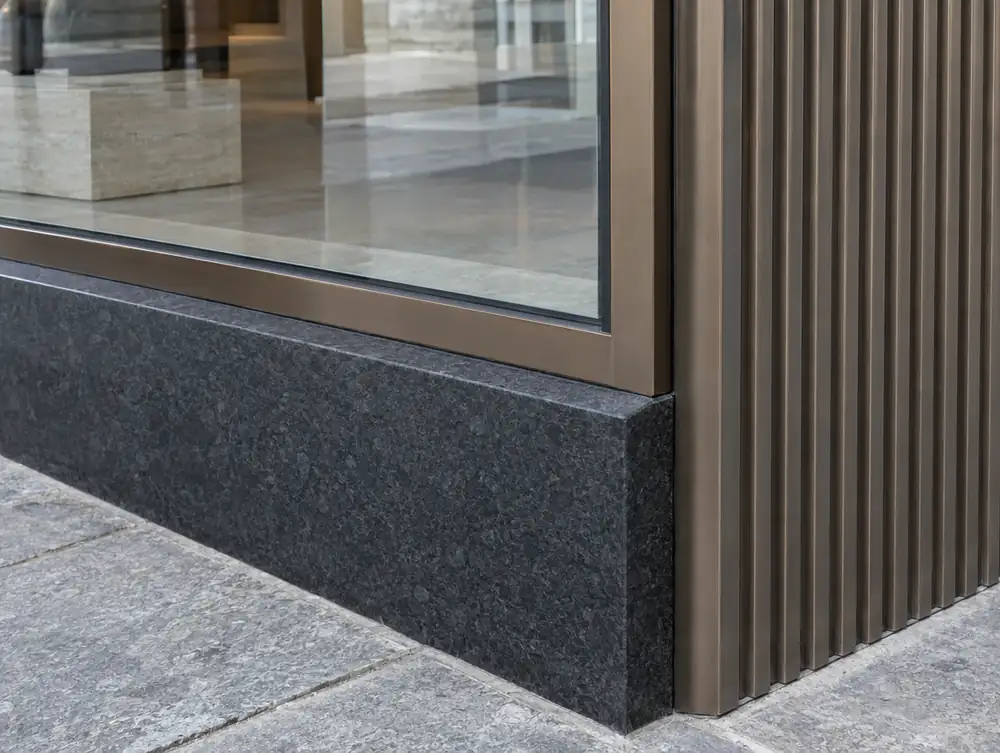
What should you settle before committing to stallrisers and cladding in Merseyside?
Stripping an old facing can reveal what the building had first. If original tile or timber turns up on your premises in Merseyside, we stop and talk to you, since repairing it may cost less than cladding over it.
Road grit does the most damage at this level. On premises across Merseyside that take winter salt or regular pavement washing, we fit a replaceable plinth so the lowest edge can be changed without disturbing the facing.
What consents apply to stallrisers and cladding in Merseyside?
A true like-for-like replacement usually needs no planning permission in England, because the external appearance isn't materially affected. New materials, a different glass line or altered proportions usually do count as material, so for stallrisers and cladding at premises in the Merseyside area, an application is then likely. The council confirms which side of that line a job falls on.
How much do stallrisers and cladding cost in Merseyside?
A sensible starting budget is £195 to £495 plus VAT per m². What shifts the figure is whatever can't be seen yet, such as the condition behind the old frontage or the services running through it.
| Area | Merseyside |
|---|---|
| Nation | England |
| Towns covered | 41 |
| Main town | Liverpool |
| Planning regime | England: TCPA 1990 and the 2007 Advertisement Regulations |
| Building approval | Building Regulations (Approved Documents) |
| Survey | Free for new work, from our Great Barr base |
Does Knowsley Metropolitan Borough Council publish shopfront guidance?
Yes, Shopfront and Signage Design Supplementary Planning Document (2023). It tells applicants what the council expects from new and altered shopfronts. A few of the things it asks for:
- The stallriser should generally be no more than 20% of the shopfront's overall height.
- The fascia should be no more than 20% of the shopfront's height and generally no deeper than 400mm.
- Solid external roller shutters are unacceptable, and internal grilles or shutters are preferred.
Questions about stallrisers and cladding in Merseyside
Do you fit natural stone stallrisers across Merseyside?
Yes. Stone is templated from the measured survey, then fixed with mechanical restraints and a ventilated cavity. Heavier stone may need a check of the wall behind before we confirm the thickness.
How do I pick a stallriser finish for a unit in Merseyside?
Start with the brick, stone or render above the shop, then bring in the brand colour. Samples held against the building in daylight will tell you more than a screen, so try them in the morning and the evening.
Will road salt damage a metal stallriser in Merseyside?
It will, if cut edges are left exposed. We use folded sheet with hidden edges, keep the base clear of the pavement and fit a replaceable plinth where salt is heavy.
Does a shop sign in the Merseyside area need advertisement consent?
Not always. In England, an unlit sign within Class 5 of the 2007 Advertisement Regulations generally needs no application, and neither does a lit sign within Class 4B. Anything outside those classes needs consent, and Class 4B isn't available in conservation areas, so check before ordering.
Do I need listed building consent for a shopfront in the Merseyside area?
Usually yes, if the building is listed. In England the local planning authority decides, and Historic England is notified of Grade I and II* works and specified Grade II works. Like-for-like repair may not need consent, so ask the council before work starts.