For structural glazing across Merseyside, we draw first and order later. You see a scale drawing with signed-off dimensions before anything is made, so the frontage on paper is the frontage you get.
Finishes behave differently at full size. Any sample we show you for structural glazing is better judged at the premises in daylight, since a colour that looks quiet on a desk can read much louder across a whole elevation.
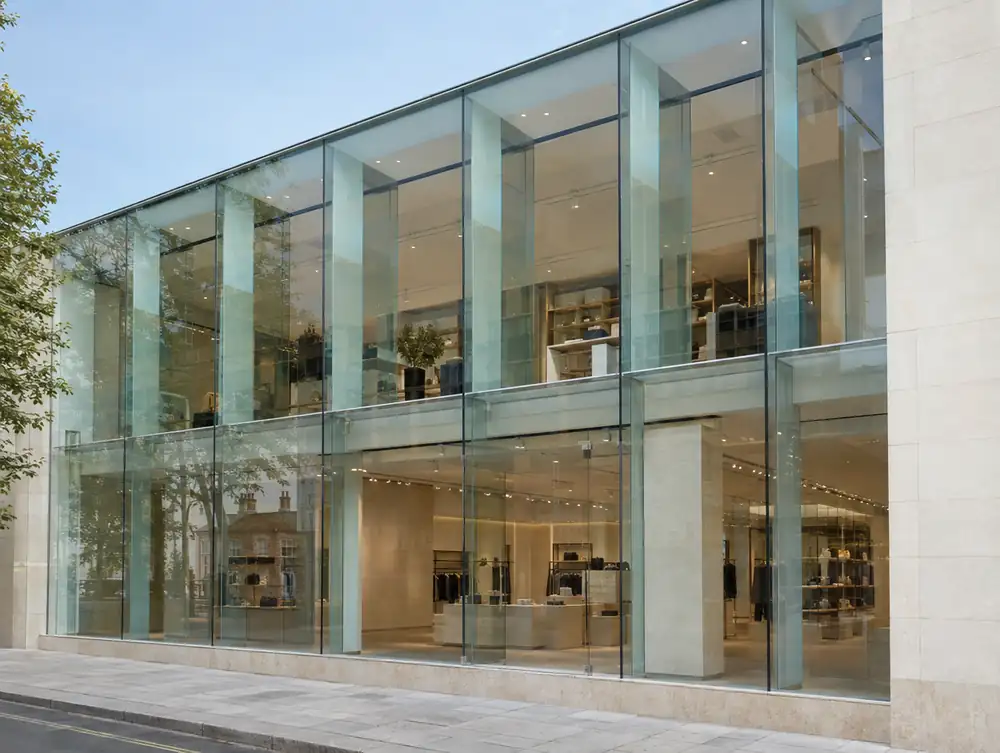
Where do you start with structural glazing in Merseyside?
Deflection matters as much as strength if your frontage in Merseyside sits beneath a steel or timber head. We check how that head behaves before glass goes under it, since a pane with no frame cannot absorb movement.
Lifting decides what is possible on most structural glazing jobs. For premises across Merseyside we walk the route from the delivery point to the opening at survey, looking for kerbs, cellar hatches and cables that would stop a glass lifter.
What consents apply to structural glazing in Merseyside?
England has no permitted development route for changing a shopfront. Part 7 Class A of the General Permitted Development Order 2015 excludes creating, altering or replacing one, and it allows no alterations at all on article 2(3) land. That leaves two outcomes for structural glazing at premises in the Merseyside area: a planning application, or work that doesn't materially affect the external appearance.
How much does structural glazing cost in Merseyside?
The guide for structural glazing is £950 to £1,850 plus VAT per m². Expect the lower end for simple work with clear access, and the upper end where detail, finish or awkward conditions add hours.
| Area | Merseyside |
|---|---|
| Nation | England |
| Towns covered | 41 |
| Main town | Liverpool |
| Planning regime | England: TCPA 1990 and the 2007 Advertisement Regulations |
| Building approval | Building Regulations (Approved Documents) |
| Survey | Free for new work, from our Great Barr base |
Does Knowsley Metropolitan Borough Council publish shopfront guidance?
Yes, Shopfront and Signage Design Supplementary Planning Document (2023). It tells applicants what the council expects from new and altered shopfronts. A few of the things it asks for:
- The stallriser should generally be no more than 20% of the shopfront's overall height.
- The fascia should be no more than 20% of the shopfront's height and generally no deeper than 400mm.
- Solid external roller shutters are unacceptable, and internal grilles or shutters are preferred.
Questions about structural glazing in Merseyside
What happens if a large pane breaks on premises in Merseyside?
A laminated pane normally stays in place until it can be replaced. We would make the opening safe, then schedule the new pane and the lift, which typically takes some weeks because large glass is made to order.
Will my existing floor in Merseyside take a concealed channel?
That depends on the depth of the floor build-up. Where it is too shallow, the channel can sit on the slab with the finish cut around it, or a raised detail can be drawn. We open up a small area at survey to find out.
Can I get a price for premises in Merseyside from photographs?
No, every price comes from a measure-up. Structural glazing depends on the exact opening, floor and head, so a figure from a photograph would mislead you.
Do roller shutters need planning permission in the Merseyside area?
Usually yes. Installing or replacing a security grill or shutter on a shopfront is expressly outside England's shop permitted development rights, so the only way to avoid an application is work that doesn't materially affect the appearance. Ask the council before ordering.
Does a shop sign in the Merseyside area need advertisement consent?
Not always. In England, an unlit sign within Class 5 of the 2007 Advertisement Regulations generally needs no application, and neither does a lit sign within Class 4B. Anything outside those classes needs consent, and Class 4B isn't available in conservation areas, so check before ordering.