For revolving doors across Greater London, we draw first and order later. You see a scale drawing with signed-off dimensions before anything is made, so the frontage on paper is the frontage you get.
Openings are rarely square or level, so the survey for revolving doors records diagonals, pavement fall and head height at several points. Those few millimetres decide whether the finished front sits true against the building.
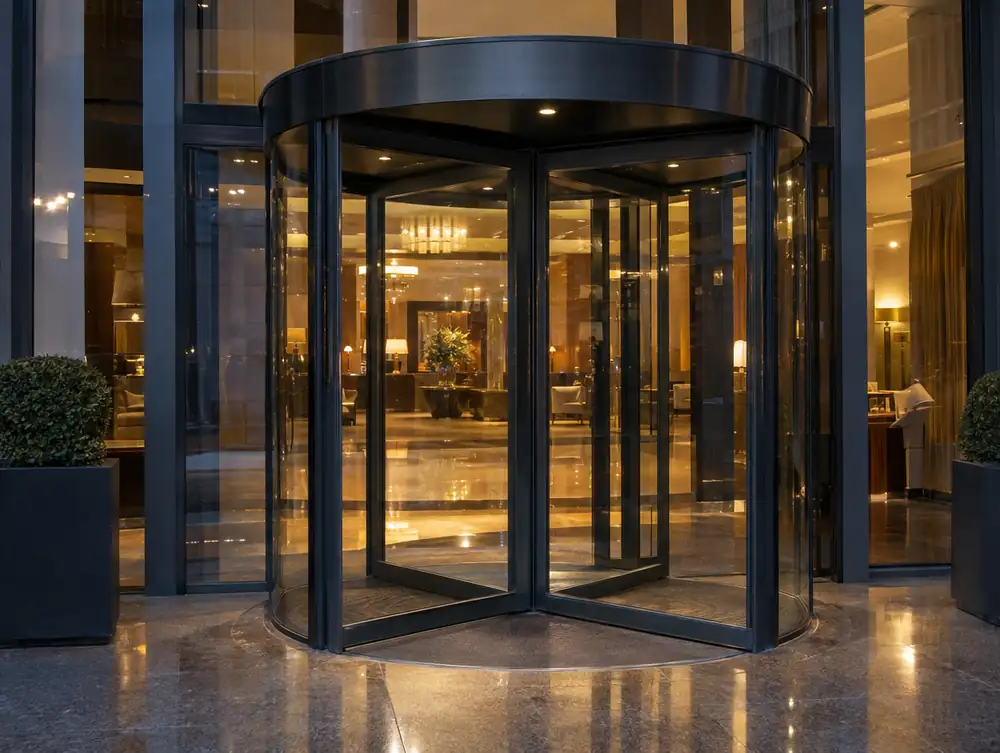
What makes revolving doors work well for premises in Greater London?
Getting a drum into the building takes some thought. For addresses in Greater London, we check how the curved panels and canopy reach the opening, since large pieces may need lifting gear or a delivery outside trading hours.
Measure the floor before falling for the drum. If your building in Greater London is an older one, the slab may fall toward the street, so we check levels across the full diameter and find out what lies beneath before choosing a drive.
What consents apply to revolving doors in Greater London?
England has no permitted development route for changing a shopfront. Part 7 Class A of the General Permitted Development Order 2015 excludes creating, altering or replacing one, and it allows no alterations at all on article 2(3) land. That leaves two outcomes for revolving doors at premises in the Greater London area: a planning application, or work that doesn't materially affect the external appearance.
How much do revolving doors cost in Greater London?
The guide for revolving doors is £19,995 to £59,995 plus VAT per door. Expect the lower end for simple work with clear access, and the upper end where detail, finish or awkward conditions add hours.
| Area | Greater London |
|---|---|
| Nation | England |
| Towns covered | 235 |
| Main town | Central London |
| Planning regime | England: TCPA 1990 and the 2007 Advertisement Regulations |
| Building approval | Building Regulations (Approved Documents) |
| Survey | Free for new work, from our Great Barr base |
Does Royal Borough of Kensington and Chelsea publish shopfront guidance?
Yes, Shopfront Design Guidelines Supplementary Planning Document (2011). It tells applicants what the council expects from new and altered shopfronts. A few of the things it asks for:
- Stallriser height should not exceed the base of the pilasters, around 450mm, or the fascia depth, whichever is less.
- Box fascias are not to be used, and painted timber is treated as the most appropriate fascia on nineteenth-century buildings.
- External shutters are not acceptable across most of the borough, with internal open-link grilles preferred.
Questions about revolving doors in Greater London
Can a lobby in Greater London stay open during installation?
Usually, with the side door or another entrance in use while the drum goes in. We'd agree the sequence with you before the floor work starts.
Is my entrance in Central London big enough for a revolving door?
It may be, if the frontage or lobby is generous. A 2.1m drum takes around 2.4m each way, and you'll need room for a side door as well.
Can you replace an old revolving door in Central London?
Often, yes. We'd measure the existing drum and floor, then advise on refurbishing or replacing it, and a like-sized drum keeps the building work down.
Does a shop sign in the Greater London area need advertisement consent?
Not always. In England, an unlit sign within Class 5 of the 2007 Advertisement Regulations generally needs no application, and neither does a lit sign within Class 4B. Anything outside those classes needs consent, and Class 4B isn't available in conservation areas, so check before ordering.
What rules apply to a fire exit door through a shopfront in the Greater London area?
It must open in the direction of escape and can't be locked against immediate use, and a dedicated fire exit can't be a sliding or revolving door. In England that comes from article 14(2) of the Regulatory Reform (Fire Safety) Order 2005, and the duty sits with the responsible person, normally the employer or whoever controls the premises for a business, otherwise the owner. An outward door can clash with section 153 of the Highways Act 1980 where it opens onto the footway, so raise it early.