Our quotation for aluminium shopfronts in Greater London is written, itemised and valid for 90 days. Nothing is ordered until you accept it, which gives you time to take it to a landlord, a partner or a board.
If you're a tenant, your landlord will probably want to see what is proposed. The scale drawings we produce for aluminium shopfronts are clear enough to send straight on, which saves a round of explaining.
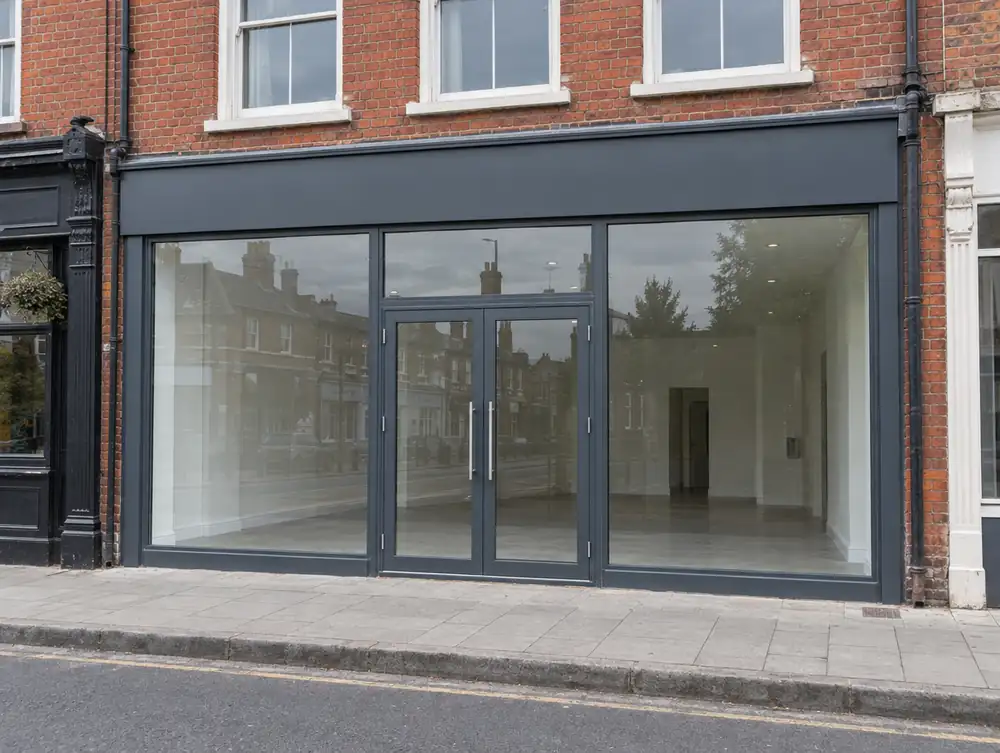
How do we handle aluminium shopfronts for premises in Greater London?
Large panes set the logistics for any aluminium front in Greater London. We look at where a glass vehicle can stop, how far the panes must be carried and whether a lifting aid will fit, because a 3m sheet that can't reach the opening on the day is a wasted trip.
Across Greater London, the same aluminium section can look sharp or wrong depending on what stands around it. We choose colour on site against the real brick, stone or render at your address, because a RAL chip under office lights tells you very little.
What consents apply to aluminium shopfronts in Greater London?
England has no permitted development route for changing a shopfront. Part 7 Class A of the General Permitted Development Order 2015 excludes creating, altering or replacing one, and it allows no alterations at all on article 2(3) land. That leaves two outcomes for aluminium shopfronts at premises in the Greater London area: a planning application, or work that doesn't materially affect the external appearance.
How much do aluminium shopfronts cost in Greater London?
Guide price: £2,495 to £11,995 plus VAT for a typical 3 to 7 m frontage. Materials, finish and the amount of drawing and coordination involved all move it, and your itemised quotation shows where the money goes on aluminium shopfronts.
| Area | Greater London |
|---|---|
| Nation | England |
| Towns covered | 235 |
| Main town | Central London |
| Planning regime | England: TCPA 1990 and the 2007 Advertisement Regulations |
| Building approval | Building Regulations (Approved Documents) |
| Survey | Free for new work, from our Great Barr base |
Does Brent Council publish shopfront guidance?
Yes, Shopfronts SPD3 (2018). It tells applicants what the council expects from new and altered shopfronts. A few of the things it asks for:
- A stallriser of at least 300mm should be kept or installed at the base of the shop display.
- Fascia text should cover no more than half the fascia's width and height, with lettering no taller than 30cm.
- Solid or pin-hole roller shutters are discouraged, and security options run from laminated glass to internal open shutters, then external open shutters only where needed for insurance.
Questions about aluminium shopfronts in Greater London
Can you match other units we run in Greater London?
Yes, if we can see what is already there. We record the section, colour and stallriser detail from your existing front, then draw the new unit to sit with it.
How long would an aluminium shopfront take in Greater London?
Typically 2 to 4 weeks to fabricate once drawings are signed off, then 1 to 5 days on site. The programme depends on the opening rather than the postcode, so it is set after the measured survey.
Do you fit aluminium shopfronts across Greater London?
Yes. We travel from Great Barr to survey and fit across Greater London, using vetted teams working under S&K Glazing with one named contact for the job.
Does a new shopfront in the Greater London area need Building Regulations approval?
Assume yes until building control says otherwise. England has no like-for-like exemption, though registered installers can self-certify replacement windows and doors in non-dwellings. That route doesn't cover structural glass, curtain walling or revolving doors.
Does the Equality Act apply to a shop entrance in the Greater London area?
Yes. The Equality Act 2010 applies in England, as across Great Britain, and it requires reasonable steps to remove, alter or avoid physical features that disadvantage disabled people. The duty is anticipatory, so it looks at disabled people generally, and a new Services Code replaced the 2011 Code on 5 August 2026.