From Central London to the furthest corner of Greater London, the sequence for projecting signs stays the same: survey, drawings, written price, then work on site. We travel from Great Barr in Birmingham and use vetted teams working under S&K Glazing.
Openings are rarely square or level, so the survey for projecting signs records diagonals, pavement fall and head height at several points. Those few millimetres decide whether the finished front sits true against the building.
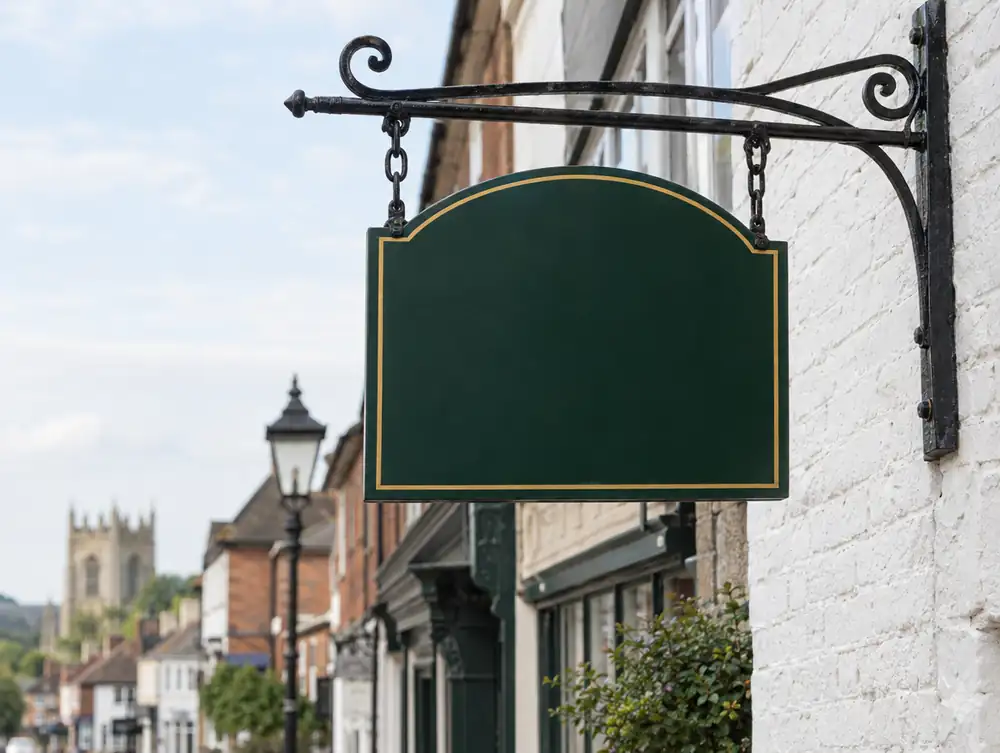
What should you settle before committing to projecting signs in Greater London?
A symbol can do what a name cannot. For premises near Central London with a long business name, we would look at a logo or simple shape that reads in a second from an angle.
Exposure can change the bracket design. Where a frontage in Greater London faces into the prevailing wind, a fixed blade may be a better choice than a free-swinging panel, as it has no shackles to wear.
What consents apply to projecting signs in Greater London?
A true like-for-like replacement usually needs no planning permission in England, because the external appearance isn't materially affected. New materials, a different glass line or altered proportions usually do count as material, so for projecting signs at premises in the Greater London area, an application is then likely. The council confirms which side of that line a job falls on.
In England, signs at premises in the Greater London area come under the 2007 Advertisement Regulations. An unlit fascia sign generally needs no application under Class 5 of Schedule 3 if it sits on a wall containing a shop window, tops out at 4.6m or the first-floor sill if that is lower, and keeps letters to 0.75m high. Displaying a sign without the consent it needs is a criminal offence, so check before it goes up.
How much do projecting signs cost in Greater London?
A sensible starting budget is £395 to £1,295 plus VAT per sign. What shifts the figure is whatever can't be seen yet, such as the condition behind the old frontage or the services running through it.
| Area | Greater London |
|---|---|
| Nation | England |
| Towns covered | 235 |
| Main town | Central London |
| Planning regime | England: TCPA 1990 and the 2007 Advertisement Regulations |
| Building approval | Building Regulations (Approved Documents) |
| Survey | Free for new work, from our Great Barr base |
Does Brent Council publish shopfront guidance?
Yes, Shopfronts SPD3 (2018). It tells applicants what the council expects from new and altered shopfronts. A few of the things it asks for:
- A stallriser of at least 300mm should be kept or installed at the base of the shop display.
- Fascia text should cover no more than half the fascia's width and height, with lettering no taller than 30cm.
- Solid or pin-hole roller shutters are discouraged, and security options run from laminated glass to internal open shutters, then external open shutters only where needed for insurance.
Questions about projecting signs in Greater London
Do you make projecting signs to match a fascia in Greater London?
Yes. We use the same letter style, colours and finishes, so the two read as one. Both signs appear on the same scale drawing, which also shows how they line up.
Is a hanging sign better than a fixed one for premises around Central London?
It depends on the building and the exposure. Hanging signs suit traditional frontages and give a bit of movement, while fixed signs need less upkeep. On a windy elevation we usually suggest fixed.
What artwork works on a small hanging sign around Central London?
Bold, simple artwork works, with a logo or a short name. Fine lettering and long strap lines get lost at an angle, so we test the design at full size.
Do I need listed building consent for a shopfront in the Greater London area?
Usually yes, if the building is listed. In England the local planning authority decides, and Historic England is notified of Grade I and II* works and specified Grade II works. Like-for-like repair may not need consent, so ask the council before work starts.
Do I need planning permission to change a shopfront in the Greater London area?
Usually yes, if the work materially affects the building's external appearance. England's shop permitted development rights exclude creating, altering or replacing a shopfront, so there is no shortcut. A true like-for-like replacement usually needs no application, and the council confirms the position.