What should your premises say from across the road? We open every conversation about frameless glass shopfronts in Greater London with that question, then treat sightlines and proportion as seriously as the budget.
Most frontages share something with someone, be that a door to the flats above, a meter cupboard or a pilaster on the boundary. We pick those up early on frameless glass shopfronts in Greater London, because they are far easier to design around than to discover on the day.
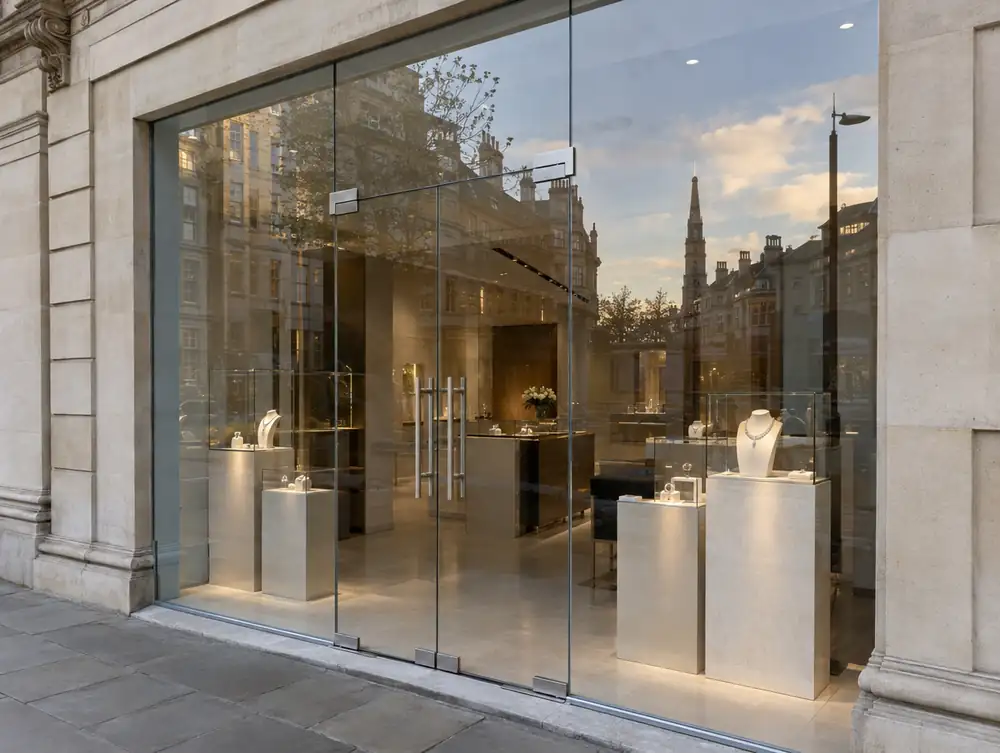
How should you approach frameless glass shopfronts in Greater London?
Evening light changes how glass behaves. A bright interior makes the pane disappear, while a dim one turns it into a mirror of the street, so for premises across Greater London we set lighting levels with the glass in mind.
Getting the panes to site is part of the design. For addresses in Central London and across Greater London we check kerb height, parking, overhead cables and the route from the vehicle, since a 200kg sheet travels upright and can't turn a tight corner.
What consents apply to frameless glass shopfronts in Greater London?
A true like-for-like replacement usually needs no planning permission in England, because the external appearance isn't materially affected. New materials, a different glass line or altered proportions usually do count as material, so for frameless glass shopfronts at premises in the Greater London area, an application is then likely. The council confirms which side of that line a job falls on.
How much do frameless glass shopfronts cost in Greater London?
As a working budget, use £4,995 to £15,995 plus VAT for a typical frontage. Your place inside that range for frameless glass shopfronts depends mostly on how much of the existing frontage can stay and how much has to be put right first.
| Area | Greater London |
|---|---|
| Nation | England |
| Towns covered | 235 |
| Main town | Central London |
| Planning regime | England: TCPA 1990 and the 2007 Advertisement Regulations |
| Building approval | Building Regulations (Approved Documents) |
| Survey | Free for new work, from our Great Barr base |
Does Westminster City Council publish shopfront guidance?
Yes, Shopfronts, Blinds and Signs - A Guide to their Design (1993). It tells applicants what the council expects from new and altered shopfronts. A few of the things it asks for:
- Roller shutters will not normally be given consent, and internally fitted brick-bond grilles are the preferred solution.
- Large internally lit box signs are generally inappropriate, while externally lit fascias and back-lit or halo-lit letters are accepted.
- Projecting signs need at least 2.6m clearance above the pavement and should sit at fascia level, centred on a pilaster.
Questions about frameless glass shopfronts in Greater London
Can a frameless front in Greater London still have a shutter?
Yes, and an internal shutter usually suits it better than an external one because the glass stays on show. We'd draw the box behind the fascia from the start.
Can you install frameless glass shopfronts across Greater London?
Yes. The survey, check measure and fitting are all arranged from Great Barr, and the panes come to site when the opening is ready.
How are heavy panes handled at premises in Central London?
With vacuum lifters and a glazing crew sized to the pane, and a mechanical lifter on the larger sheets. Delivery and lifting are planned around your street before the order is placed.
Do I need planning permission to change a shopfront in the Greater London area?
Usually yes, if the work materially affects the building's external appearance. England's shop permitted development rights exclude creating, altering or replacing a shopfront, so there is no shortcut. A true like-for-like replacement usually needs no application, and the council confirms the position.
Does a new shopfront in the Greater London area need Building Regulations approval?
Assume yes until building control says otherwise. England has no like-for-like exemption, though registered installers can self-certify replacement windows and doors in non-dwellings. That route doesn't cover structural glass, curtain walling or revolving doors.