If you've seen a glass frontage you admire, the craft is usually in what you can't see. We design the hidden channels, fine joints and low-iron glass that give your Wembley shop the same quiet look.
Expect us to measure the opening, photograph the existing front and check how materials will reach it on the day, at a time you have agreed.
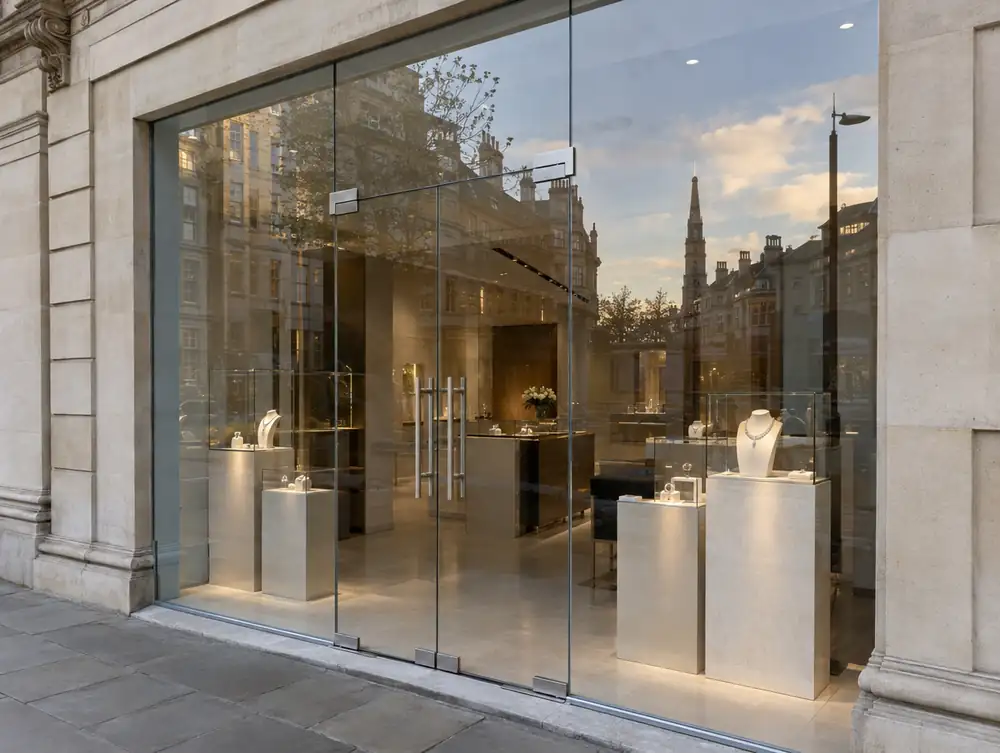
What should you think about before commissioning frameless glass shopfronts in Wembley?
A recessed entrance gives frameless glass somewhere to perform. At Wembley premises with a deep lobby, we'd carry glass back along the returns, light the soffit and run one floor finish from the pavement line into the shop.
If your Wembley landlord wants the front reinstated at lease end, frameless glass needs thought now. We'd record the existing front in the drawings and keep the channels simple, so returning the opening later stays a straightforward job.
If your Wembley unit sits in a Victorian parade, the old pilasters usually set the rhythm, so a new front should land on them and not run past them. Keep that line and even a modern frame looks as though it belongs.
What is a realistic budget for frameless glass shopfronts in Wembley?
As a working budget, use £4,995 to £15,995 plus VAT for a typical frontage. Your place inside that range for frameless glass shopfronts depends mostly on how much of the existing frontage can stay and how much has to be put right first.
Who approves frameless glass shopfronts in Wembley?
A true like-for-like replacement usually needs no planning permission in England, because the external appearance isn't materially affected. New materials, a different glass line or altered proportions usually do count as material, so for frameless glass shopfronts at premises in the Wembley area, an application is then likely. The council confirms which side of that line a job falls on.
Planning and advert applications for Wembley premises normally go to London Borough of Brent. We check the position for your address at survey.
| Town | Wembley |
|---|---|
| Area | Greater London |
| Postcode districts | HA0, HA9, NW10, UB6 |
| Planning authority | London Borough of Brent |
| Building approval | Building Regulations (Approved Documents) |
| Distance from Great Barr | About 97 miles |
| Survey | Free for new work |
Does Brent Council publish shopfront guidance?
Yes, Shopfronts SPD3 (2018). It tells applicants what the council expects from new and altered shopfronts. A few of the things it asks for:
- A stallriser of at least 300mm should be kept or installed at the base of the shop display.
- Fascia text should cover no more than half the fascia's width and height, with lettering no taller than 30cm.
- Solid or pin-hole roller shutters are discouraged, and security options run from laminated glass to internal open shutters, then external open shutters only where needed for insurance.
Questions about frameless glass shopfronts in Wembley
How do you stop people walking into the glass at my Wembley shop?
Markings on the glass are designed as part of the front. We can turn them into a pattern, logo or frosted band that suits your brand, placed where the eye naturally catches them.
Which glass should I choose for premises in Greater London?
Clear toughened is the starting point, with low-iron for a whiter look and toughened laminated where you want the pane to stay put after a break. The right one depends on your stock, your street and your insurer.
Who fits frameless glass in Wembley?
Glazing crews vetted by us and working under S&K Glazing handle the panes. They travel to Wembley from Great Barr, and you keep one named contact throughout.
Do I need planning permission to change a shopfront in the Wembley area?
Usually yes, if the work materially affects the building's external appearance. England's shop permitted development rights exclude creating, altering or replacing a shopfront, so there is no shortcut. A true like-for-like replacement usually needs no application, and the council confirms the position.
Does the Equality Act apply to a shop entrance in the Wembley area?
Yes. The Equality Act 2010 applies in England, as across Great Britain, and it requires reasonable steps to remove, alter or avoid physical features that disadvantage disabled people. The duty is anticipatory, so it looks at disabled people generally, and a new Services Code replaced the 2011 Code on 5 August 2026.