Every enquiry for curved glass shopfronts in Greater London begins with a measured survey at the premises, because a price taken from a photograph is only a guess. That visit gives you real dimensions before anyone draws a line or orders a thing.
What sits behind the existing fascia often decides the job. Old beams, abandoned cable runs and earlier frames are common finds, which is why our visit to Greater London premises looks past the surface before anything is drawn or priced for curved glass shopfronts.
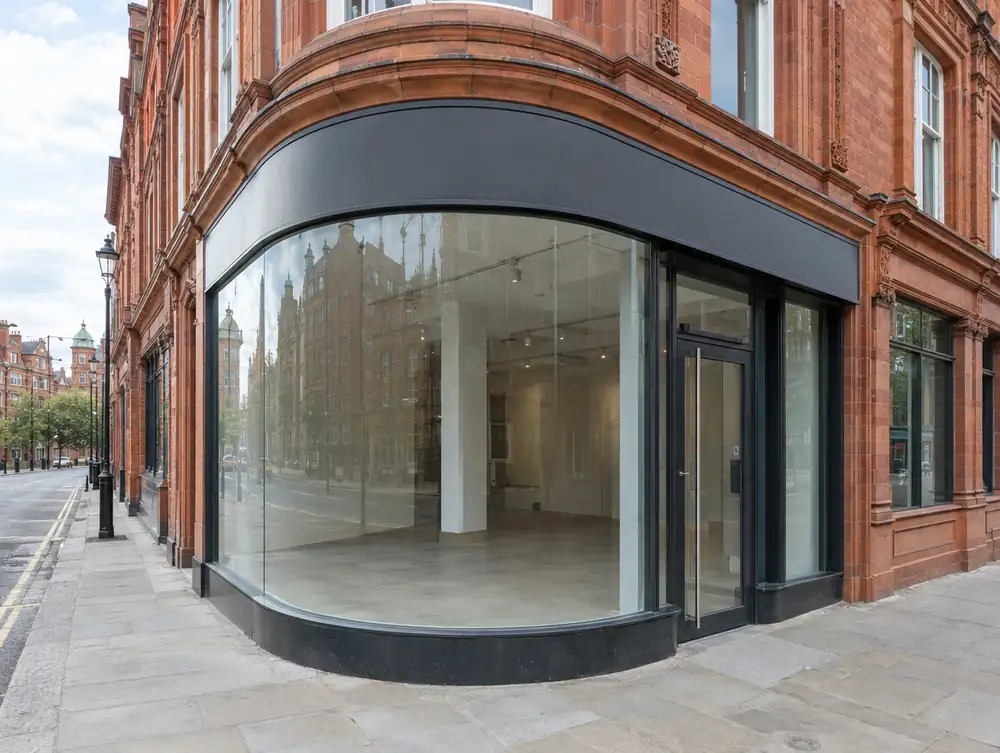
How should you approach curved glass shopfronts in Greater London?
Curves change how a corner reads after dark. For a unit in Central London or anywhere in Greater London, we'd run lighting with the arc, because a single bright spot on curved glass pulls the eye to the reflection instead of the display.
Breakage plans matter more with curved glass. For premises across Greater London, we'd keep the template and glass details on record and talk through how the opening would be protected during the weeks a new pane takes.
What consents apply to curved glass shopfronts in Greater London?
For curved glass shopfronts at premises in the Greater London area, the deciding question in England is whether the building work materially affects the external appearance. If it does, planning permission is needed, while a true like-for-like replacement usually needs none. The council confirms the position for each site.
How much do curved glass shopfronts cost in Greater London?
Allow £6,995 to £19,995 plus VAT for a typical frontage. Size and specification set most of that figure for curved glass shopfronts, and the rest depends on what the survey finds on site.
| Area | Greater London |
|---|---|
| Nation | England |
| Towns covered | 235 |
| Main town | Central London |
| Planning regime | England: TCPA 1990 and the 2007 Advertisement Regulations |
| Building approval | Building Regulations (Approved Documents) |
| Survey | Free for new work, from our Great Barr base |
Does Westminster City Council publish shopfront guidance?
Yes, Shopfronts, Blinds and Signs - A Guide to their Design (1993). It tells applicants what the council expects from new and altered shopfronts. A few of the things it asks for:
- Roller shutters will not normally be given consent, and internally fitted brick-bond grilles are the preferred solution.
- Large internally lit box signs are generally inappropriate, while externally lit fascias and back-lit or halo-lit letters are accepted.
- Projecting signs need at least 2.6m clearance above the pavement and should sit at fascia level, centred on a pilaster.
Questions about curved glass shopfronts in Greater London
Do you supply curved glass shopfronts across Greater London?
Yes. We travel from Great Barr to template the curve and fit the glass, with the panes made to that template.
How do you measure a curve at premises in Central London?
At three heights, using a plywood template or a laser survey. That shows whether the corner is a true arc, and tells us where any difference has to be taken up.
Can the old curved pane at my Greater London premises be reused?
Sometimes, if it is sound and can be taken out safely. We'd examine it at survey and tell you honestly whether repairing around it is the safer choice.
Do roller shutters need planning permission in the Greater London area?
Usually yes. Installing or replacing a security grill or shutter on a shopfront is expressly outside England's shop permitted development rights, so the only way to avoid an application is work that doesn't materially affect the appearance. Ask the council before ordering.
Does a shop sign in the Greater London area need advertisement consent?
Not always. In England, an unlit sign within Class 5 of the 2007 Advertisement Regulations generally needs no application, and neither does a lit sign within Class 4B. Anything outside those classes needs consent, and Class 4B isn't available in conservation areas, so check before ordering.