For multi-site rollouts across Greater London, we draw first and order later. You see a scale drawing with signed-off dimensions before anything is made, so the frontage on paper is the frontage you get.
Most frontages share something with someone, be that a door to the flats above, a meter cupboard or a pilaster on the boundary. We pick those up early on multi-site rollouts in Greater London, because they are far easier to design around than to discover on the day.
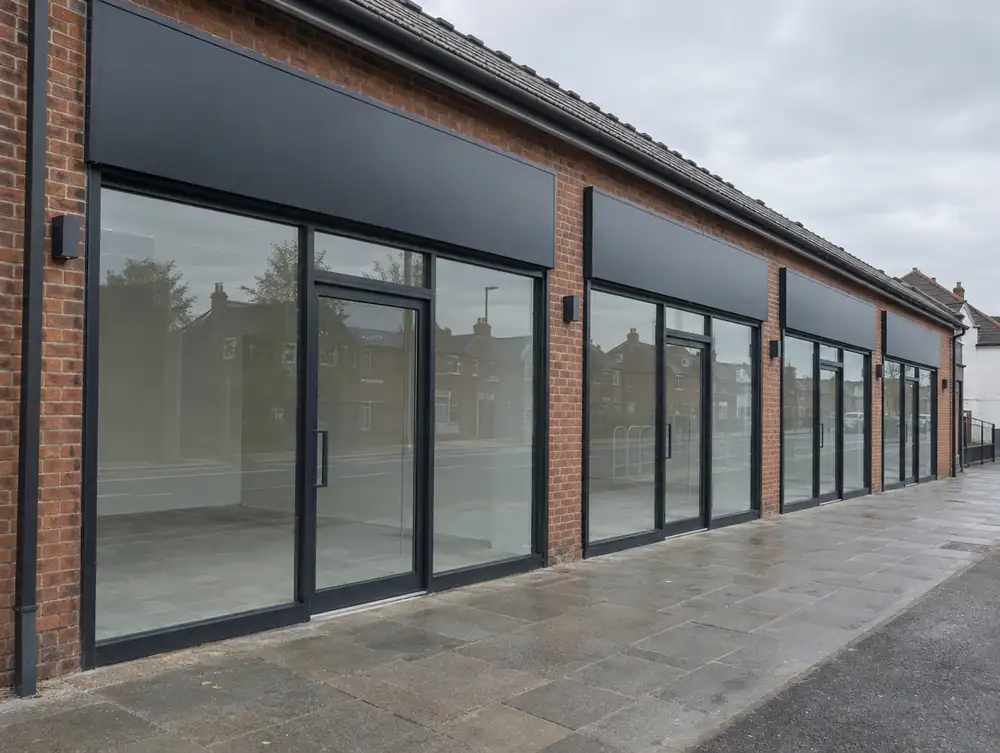
How do we handle multi-site rollouts for premises in Greater London?
Trading patterns vary by site. Within Greater London, we would agree fit dates with each manager, since a lunchtime food unit and an evening bar have very different quiet hours.
Units in the same chain can differ widely. A shopping centre unit and a street-front unit in Greater London need different details, so the kit of parts would give each its own route.
What consents apply to multi-site rollouts in Greater London?
England has no permitted development route for changing a shopfront. Part 7 Class A of the General Permitted Development Order 2015 excludes creating, altering or replacing one, and it allows no alterations at all on article 2(3) land. That leaves two outcomes for multi-site rollouts at premises in the Greater London area: a planning application, or work that doesn't materially affect the external appearance.
| Area | Greater London |
|---|---|
| Nation | England |
| Towns covered | 235 |
| Main town | Central London |
| Planning regime | England: TCPA 1990 and the 2007 Advertisement Regulations |
| Building approval | Building Regulations (Approved Documents) |
| Survey | Free for new work, from our Great Barr base |
Does Brent Council publish shopfront guidance?
Yes, Shopfronts SPD3 (2018). It tells applicants what the council expects from new and altered shopfronts. A few of the things it asks for:
- A stallriser of at least 300mm should be kept or installed at the base of the shop display.
- Fascia text should cover no more than half the fascia's width and height, with lettering no taller than 30cm.
- Solid or pin-hole roller shutters are discouraged, and security options run from laminated glass to internal open shutters, then external open shutters only where needed for insurance.
Questions about multi-site rollouts in Greater London
What if one site near Central London cannot follow the standard?
It would get a drawn variation that keeps the brand's proportions, colours and type. That is normal, and the kit of parts would be written with exceptions in mind.
Would one person manage all my sites around Central London?
Yes, you would have one named contact for the programme. Vetted teams working under S&K Glazing would carry out the work, with each site following the same drawings and checks.
Could new sites in Greater London join the programme later?
Yes. A good standard and a schedule of rates make a new address simple to add. Each one would still need its own measured survey and drawings.
What rules apply to a fire exit door through a shopfront in the Greater London area?
It must open in the direction of escape and can't be locked against immediate use, and a dedicated fire exit can't be a sliding or revolving door. In England that comes from article 14(2) of the Regulatory Reform (Fire Safety) Order 2005, and the duty sits with the responsible person, normally the employer or whoever controls the premises for a business, otherwise the owner. An outward door can clash with section 153 of the Highways Act 1980 where it opens onto the footway, so raise it early.
Does a new shopfront in the Greater London area need Building Regulations approval?
Assume yes until building control says otherwise. England has no like-for-like exemption, though registered installers can self-certify replacement windows and doors in non-dwellings. That route doesn't cover structural glass, curtain walling or revolving doors.