Every enquiry for stallrisers and cladding in Greater London begins with a measured survey at the premises, because a price taken from a photograph is only a guess. That visit gives you real dimensions before anyone draws a line or orders a thing.
Access gets as much attention as appearance at survey. Where a vehicle can stop, how long sections reach the opening and how the pavement stays safe for the public all shape the programme for stallrisers and cladding in Greater London.
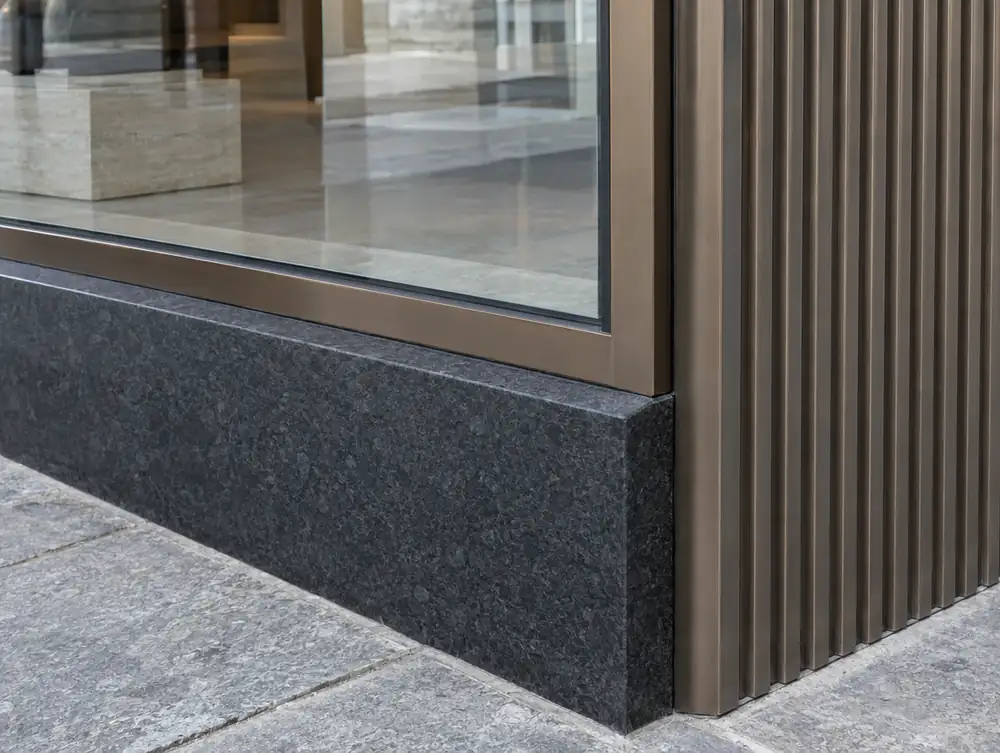
What should you settle before committing to stallrisers and cladding in Greater London?
A restaurant and a jeweller want very different stallrisers, even side by side. For premises in Greater London we set the height around what people do behind the glass, whether that is sitting, browsing or studying a tray.
Stone and tile need a clean, dry surface and time to set. If your unit around Central London opens straight onto the pavement, we cut off site and keep the working area small so the entrance stays usable.
What consents apply to stallrisers and cladding in Greater London?
For stallrisers and cladding at premises in the Greater London area, the deciding question in England is whether the building work materially affects the external appearance. If it does, planning permission is needed, while a true like-for-like replacement usually needs none. The council confirms the position for each site.
How much do stallrisers and cladding cost in Greater London?
Allow £195 to £495 plus VAT per m². Size and specification set most of that figure for stallrisers and cladding, and the rest depends on what the survey finds on site.
| Area | Greater London |
|---|---|
| Nation | England |
| Towns covered | 235 |
| Main town | Central London |
| Planning regime | England: TCPA 1990 and the 2007 Advertisement Regulations |
| Building approval | Building Regulations (Approved Documents) |
| Survey | Free for new work, from our Great Barr base |
Does Brent Council publish shopfront guidance?
Yes, Shopfronts SPD3 (2018). It tells applicants what the council expects from new and altered shopfronts. A few of the things it asks for:
- A stallriser of at least 300mm should be kept or installed at the base of the shop display.
- Fascia text should cover no more than half the fascia's width and height, with lettering no taller than 30cm.
- Solid or pin-hole roller shutters are discouraged, and security options run from laminated glass to internal open shutters, then external open shutters only where needed for insurance.
Questions about stallrisers and cladding in Greater London
Do you fit natural stone stallrisers across Greater London?
Yes. Stone is templated from the measured survey, then fixed with mechanical restraints and a ventilated cavity. Heavier stone may need a check of the wall behind before we confirm the thickness.
How do I pick a stallriser finish for a unit in Greater London?
Start with the brick, stone or render above the shop, then bring in the brand colour. Samples held against the building in daylight will tell you more than a screen, so try them in the morning and the evening.
Can you reclad only the stallriser on my premises in Greater London?
Yes. It is one of the simplest ways to lift a tired frontage, provided the frame above is sound. We check the sill detail first, because a new facing must not trap water beneath it.
Does a new shopfront in the Greater London area need Building Regulations approval?
Assume yes until building control says otherwise. England has no like-for-like exemption, though registered installers can self-certify replacement windows and doors in non-dwellings. That route doesn't cover structural glass, curtain walling or revolving doors.
Does the Equality Act apply to a shop entrance in the Greater London area?
Yes. The Equality Act 2010 applies in England, as across Great Britain, and it requires reasonable steps to remove, alter or avoid physical features that disadvantage disabled people. The duty is anticipatory, so it looks at disabled people generally, and a new Services Code replaced the 2011 Code on 5 August 2026.