What should your premises say from across the road? We open every conversation about timber shopfronts in Greater London with that question, then treat sightlines and proportion as seriously as the budget.
Daylight is only half the brief for timber shopfronts, because a frontage keeps working after dark. Think about how the glass, the sign and the view inside will read to someone walking past at six o'clock on a winter evening.
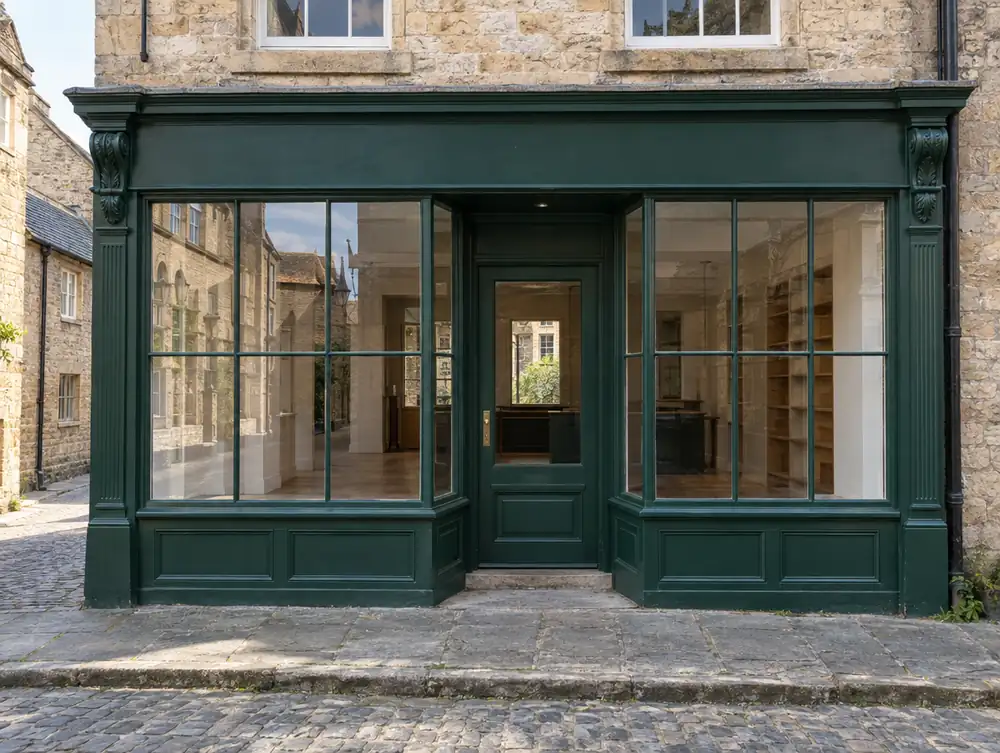
How should you approach timber shopfronts in Greater London?
Colour does a lot of the work on timber. For premises across Greater London we test samples on the actual frontage in morning and evening light, because a deep green or navy can read as black at dusk, and the sign then has to carry more contrast.
A timber front has to sit comfortably with what's around it. If your premises in Greater London share a terrace, we draw the mouldings at a scale that suits the neighbours, so the new work looks settled from the day it goes in.
What consents apply to timber shopfronts in Greater London?
A true like-for-like replacement usually needs no planning permission in England, because the external appearance isn't materially affected. New materials, a different glass line or altered proportions usually do count as material, so for timber shopfronts at premises in the Greater London area, an application is then likely. The council confirms which side of that line a job falls on.
How much do timber shopfronts cost in Greater London?
As a working budget, use £3,995 to £13,995 plus VAT for a typical frontage. Your place inside that range for timber shopfronts depends mostly on how much of the existing frontage can stay and how much has to be put right first.
| Area | Greater London |
|---|---|
| Nation | England |
| Towns covered | 235 |
| Main town | Central London |
| Planning regime | England: TCPA 1990 and the 2007 Advertisement Regulations |
| Building approval | Building Regulations (Approved Documents) |
| Survey | Free for new work, from our Great Barr base |
Does Westminster City Council publish shopfront guidance?
Yes, Shopfronts, Blinds and Signs - A Guide to their Design (1993). It tells applicants what the council expects from new and altered shopfronts. A few of the things it asks for:
- Roller shutters will not normally be given consent, and internally fitted brick-bond grilles are the preferred solution.
- Large internally lit box signs are generally inappropriate, while externally lit fascias and back-lit or halo-lit letters are accepted.
- Projecting signs need at least 2.6m clearance above the pavement and should sit at fascia level, centred on a pilaster.
Questions about timber shopfronts in Greater London
Do you make timber shopfronts for premises in Greater London?
Yes. Each front is drawn and made to a measured survey, and we travel from Great Barr to fit it, with one named contact throughout.
How far ahead should we plan a timber front in Greater London?
Allow typically 4 to 8 weeks for making after sign-off, then around a week on site. A winter fit needs extra margin for paint drying.
Who looks after a timber shopfront in Greater London once it is fitted?
Any good decorator can, working to the paint reference on your drawings. Keep a note of each repaint, as it makes future work far easier to plan.
What rules apply to a fire exit door through a shopfront in the Greater London area?
It must open in the direction of escape and can't be locked against immediate use, and a dedicated fire exit can't be a sliding or revolving door. In England that comes from article 14(2) of the Regulatory Reform (Fire Safety) Order 2005, and the duty sits with the responsible person, normally the employer or whoever controls the premises for a business, otherwise the owner. An outward door can clash with section 153 of the Highways Act 1980 where it opens onto the footway, so raise it early.
Does a shop sign in the Greater London area need advertisement consent?
Not always. In England, an unlit sign within Class 5 of the 2007 Advertisement Regulations generally needs no application, and neither does a lit sign within Class 4B. Anything outside those classes needs consent, and Class 4B isn't available in conservation areas, so check before ordering.