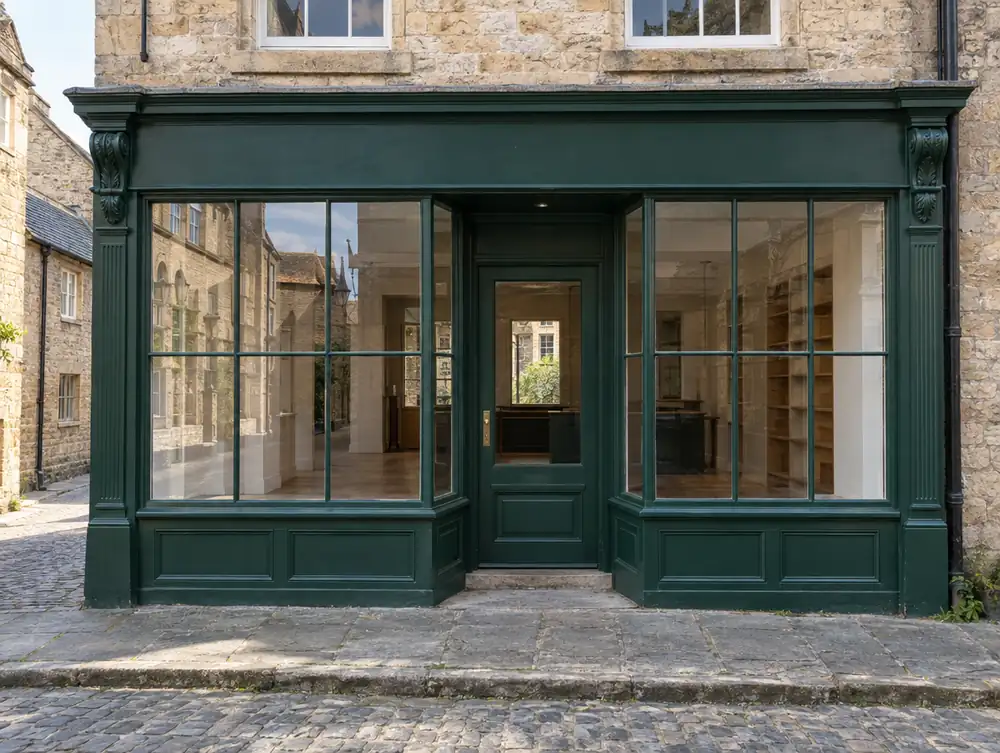
Timber gives a shopfront in Putney something metal can't: real depth, cast shadows and mouldings you can run your hand along. We draw each front to the measured opening and make it to those signed-off dimensions.
Surveys for Putney are booked with you directly. Tell us your quieter days and we'll work around them.
What goes into getting timber shopfronts right in Putney?
Timber fits a night programme better than you'd think, since most of the joinery is made elsewhere. For a unit in Putney that can't close by day, we'd fit the frame in stages at night and leave painting until the end, once the dust has gone.
Narrow units suit timber well, because mouldings add interest where there's little width to work with. On a slim Putney frontage we'd keep one strong pane, a panelled door and a fascia that doesn't crowd them.
Where a fascia has crept down over the years, lifting it back to its original line can add real height to the glass. Check what sits behind it first at Putney premises, since a shutter box or old beam may set the limit.
Which applications might timber shopfronts in Putney involve?
For timber shopfronts at premises in the Putney area, the deciding question in England is whether the building work materially affects the external appearance. If it does, planning permission is needed, while a true like-for-like replacement usually needs none. The council confirms the position for each site.
We confirm the position at survey, because a boundary or a special designation can change who handles the file, but applications from Putney premises normally go to London Borough of Wandsworth.
How much could timber shopfronts in Putney cost you?
Until the survey is done, plan on £3,995 to £13,995 plus VAT for a typical frontage. Unusual sizes, fine detail and phased working push the figure up, while a simple brief and clear access keep it toward the lower end.
| Town | Putney |
|---|---|
| Area | Greater London |
| Postcode districts | SW13, SW15, SW18, SW6 |
| Planning authority | London Borough of Wandsworth |
| Building approval | Building Regulations (Approved Documents) |
| Distance from Great Barr | About 104 miles |
| Survey | Free for new work |
Does Wandsworth Borough Council publish shopfront guidance?
Yes, Shopfronts SPG (1988). It tells applicants what the council expects from new and altered shopfronts. A few of the things it asks for:
- Stallrisers should be retained where possible and be at least 500mm high, or reach the top of the pilaster base.
- Solid external metal shutters are discouraged, with boxes set behind the fascia or recessed flush and guides colour-coated to match.
- Internally lit box fascias and projecting box signs are generally unsuitable in conservation areas and on traditional shopfronts.
Questions about timber shopfronts in Putney
How much disruption will a timber front cause in my Putney shop?
Expect more time on site than an aluminium front, typically 3 to 7 days with the painting. Closed-day or out-of-hours fitting can be arranged, and the opening stays boarded and secure between stages.
Can you copy a timber shopfront I've seen in Greater London?
We can work from your photo and borrow what makes it succeed, including proportions, moulding sizes and colour. The front is then drawn to your own Putney opening.
What should I budget for looking after a timber front in Putney?
A repaint every 5 to 7 years, plus a yearly wash and touch-up of the cills. Door gear needs checking too, since seasonal movement can throw a door out of line.
Does a shop sign in the Putney area need advertisement consent?
Not always. In England, an unlit sign within Class 5 of the 2007 Advertisement Regulations generally needs no application, and neither does a lit sign within Class 4B. Anything outside those classes needs consent, and Class 4B isn't available in conservation areas, so check before ordering.
Do I need planning permission to change a shopfront in the Putney area?
Usually yes, if the work materially affects the building's external appearance. England's shop permitted development rights exclude creating, altering or replacing a shopfront, so there is no shortcut. A true like-for-like replacement usually needs no application, and the council confirms the position.