Want a front in Westminster that feels made rather than assembled? Timber does that well, provided the mouldings are in scale and the joinery is detailed to shed water.
Bring whatever you have to the survey in Westminster: brand guidelines, lease plans, old drawings or a photo of a frontage you admire.
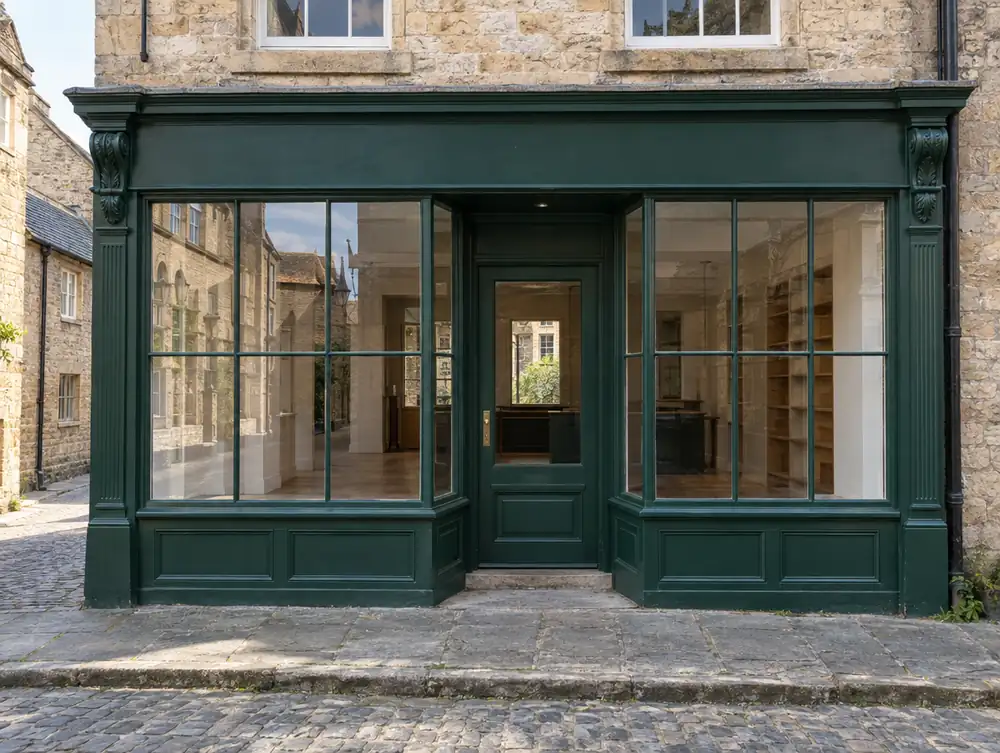
How do you design around the building when planning timber shopfronts in Westminster?
If your Westminster premises have a deep recessed entrance, timber can make it feel like a welcome. We'd panel the returns, add a lit soffit and lay a hard-wearing threshold, keeping the end grain of every post clear of the wet.
Narrow units suit timber well, because mouldings add interest where there's little width to work with. On a slim Westminster frontage we'd keep one strong pane, a panelled door and a fascia that doesn't crowd them.
Where a fascia has crept down over the years, lifting it back to its original line can add real height to the glass. Check what sits behind it first at Westminster premises, since a shutter box or old beam may set the limit.
What might timber shopfronts cost in Westminster?
Until the survey is done, plan on £3,995 to £13,995 plus VAT for a typical frontage. Unusual sizes, fine detail and phased working push the figure up, while a simple brief and clear access keep it toward the lower end.
What permissions should you check for timber shopfronts in Westminster?
Security grilles and shutters are named in England's rules: installing or replacing one on a shopfront sits outside the shop permitted development rights. The frontage itself is treated the same way, so for timber shopfronts at premises in the Westminster area, building work that materially affects the appearance needs planning permission. Confirm the position with the council before anything is ordered.
At survey we check how things stand for your building, although applications for planning permission or advertisement consent here normally go to Westminster City Council.
| Town | Westminster |
|---|---|
| Area | Greater London |
| Postcode districts | SW1 |
| Planning authority | Westminster City Council |
| Building approval | Building Regulations (Approved Documents) |
| Distance from Great Barr | About 105 miles |
| Survey | Free for new work |
Does Westminster City Council publish shopfront guidance?
Yes, Shopfronts, Blinds and Signs - A Guide to their Design (1993). It tells applicants what the council expects from new and altered shopfronts. A few of the things it asks for:
- Roller shutters will not normally be given consent, and internally fitted brick-bond grilles are the preferred solution.
- Large internally lit box signs are generally inappropriate, while externally lit fascias and back-lit or halo-lit letters are accepted.
- Projecting signs need at least 2.6m clearance above the pavement and should sit at fascia level, centred on a pilaster.
Questions about timber shopfronts in Westminster
Can a timber front take a modern sign in Westminster?
Yes. Hand-painted letters suit a timber fascia well, and raised letters or a concealed trough light work too. We draw the sign and the joinery together, so the fixings don't cut through a moulding.
Is timber a sensible choice for my Westminster frontage?
Usually, if you're happy with a repaint every 5 to 7 years. A survey shows how exposed the front is and whether the structure behind it is sound, and we'll tell you if aluminium would serve you better.
What should I budget for looking after a timber front in Westminster?
A repaint every 5 to 7 years, plus a yearly wash and touch-up of the cills. Door gear needs checking too, since seasonal movement can throw a door out of line.
Does a shop sign in the Westminster area need advertisement consent?
Not always. In England, an unlit sign within Class 5 of the 2007 Advertisement Regulations generally needs no application, and neither does a lit sign within Class 4B. Anything outside those classes needs consent, and Class 4B isn't available in conservation areas, so check before ordering.
What rules apply to a fire exit door through a shopfront in the Westminster area?
It must open in the direction of escape and can't be locked against immediate use, and a dedicated fire exit can't be a sliding or revolving door. In England that comes from article 14(2) of the Regulatory Reform (Fire Safety) Order 2005, and the duty sits with the responsible person, normally the employer or whoever controls the premises for a business, otherwise the owner. An outward door can clash with section 153 of the Highways Act 1980 where it opens onto the footway, so raise it early.