Looking for a front with more character on your St James's premises? A painted timber frontage, built up in layers and proportioned to the building, has a warmth that reads from across the street.
Expect us to measure the opening, photograph the existing front and check how materials will reach it on the day, at a time you have agreed.
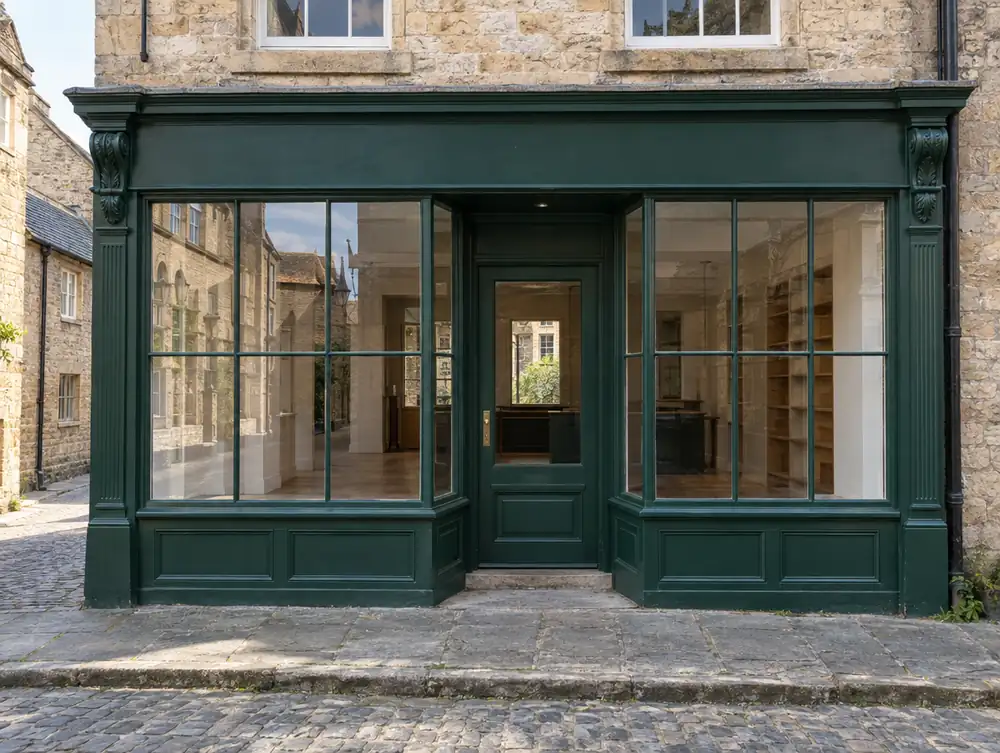
How do you design around the building when planning timber shopfronts in St James's?
A south or west-facing St James's frontage is hard on paint. We'd steer you toward a lighter colour or a more stable timber, and if the brand needs a dark finish, we'd plan a shorter repaint interval from the outset.
A corner plot gives a timber front two faces and one chance to get the turn right. For St James's premises on a corner, we'd use a pilaster or a canted bay at the angle, so the cornice wraps round without a clumsy mitre.
A corner unit has two fronts to think about, and the return elevation often does as much selling as the main one. If that is your layout in St James's, carry the fascia and glass line round the corner and treat both faces as one composition.
What might timber shopfronts cost in St James's?
As a working budget, use £3,995 to £13,995 plus VAT for a typical frontage. Your place inside that range for timber shopfronts depends mostly on how much of the existing frontage can stay and how much has to be put right first.
What permissions should you check for timber shopfronts in St James's?
England has no permitted development route for changing a shopfront. Part 7 Class A of the General Permitted Development Order 2015 excludes creating, altering or replacing one, and it allows no alterations at all on article 2(3) land. That leaves two outcomes for timber shopfronts at premises in the St James's area: a planning application, or work that doesn't materially affect the external appearance.
Expect planning and advert applications here to go to Westminster City Council in the normal way. We check what that means for your building when we survey it in St James's.
| Town | St James's |
|---|---|
| Area | Greater London |
| Postcode districts | SW1Y, W1F, W1J, W1S |
| Planning authority | Westminster City Council |
| Building approval | Building Regulations (Approved Documents) |
| Distance from Great Barr | About 104 miles |
| Survey | Free for new work |
Does Westminster City Council publish shopfront guidance?
Yes, Shopfronts, Blinds and Signs - A Guide to their Design (1993). It tells applicants what the council expects from new and altered shopfronts. A few of the things it asks for:
- Roller shutters will not normally be given consent, and internally fitted brick-bond grilles are the preferred solution.
- Large internally lit box signs are generally inappropriate, while externally lit fascias and back-lit or halo-lit letters are accepted.
- Projecting signs need at least 2.6m clearance above the pavement and should sit at fascia level, centred on a pilaster.
Questions about timber shopfronts in St James's
Will timber suffer on my St James's frontage if it gets a lot of rain?
Not if the details are right. Sloped cills, sealed end grain and plinth blocks keep water moving, and the paint system then only has to deal with the weather, not trapped damp.
Can a timber front take a modern sign in St James's?
Yes. Hand-painted letters suit a timber fascia well, and raised letters or a concealed trough light work too. We draw the sign and the joinery together, so the fixings don't cut through a moulding.
What should I budget for looking after a timber front in St James's?
A repaint every 5 to 7 years, plus a yearly wash and touch-up of the cills. Door gear needs checking too, since seasonal movement can throw a door out of line.
Do I need listed building consent for a shopfront in the St James's area?
Usually yes, if the building is listed. In England the local planning authority decides, and Historic England is notified of Grade I and II* works and specified Grade II works. Like-for-like repair may not need consent, so ask the council before work starts.
Does a new shopfront in the St James's area need Building Regulations approval?
Assume yes until building control says otherwise. England has no like-for-like exemption, though registered installers can self-certify replacement windows and doors in non-dwellings. That route doesn't cover structural glass, curtain walling or revolving doors.