Want a front in West End that feels made rather than assembled? Timber does that well, provided the mouldings are in scale and the joinery is detailed to shed water.
It helps if you can be there when we visit West End, since five minutes walking the frontage together answers more than a long email.
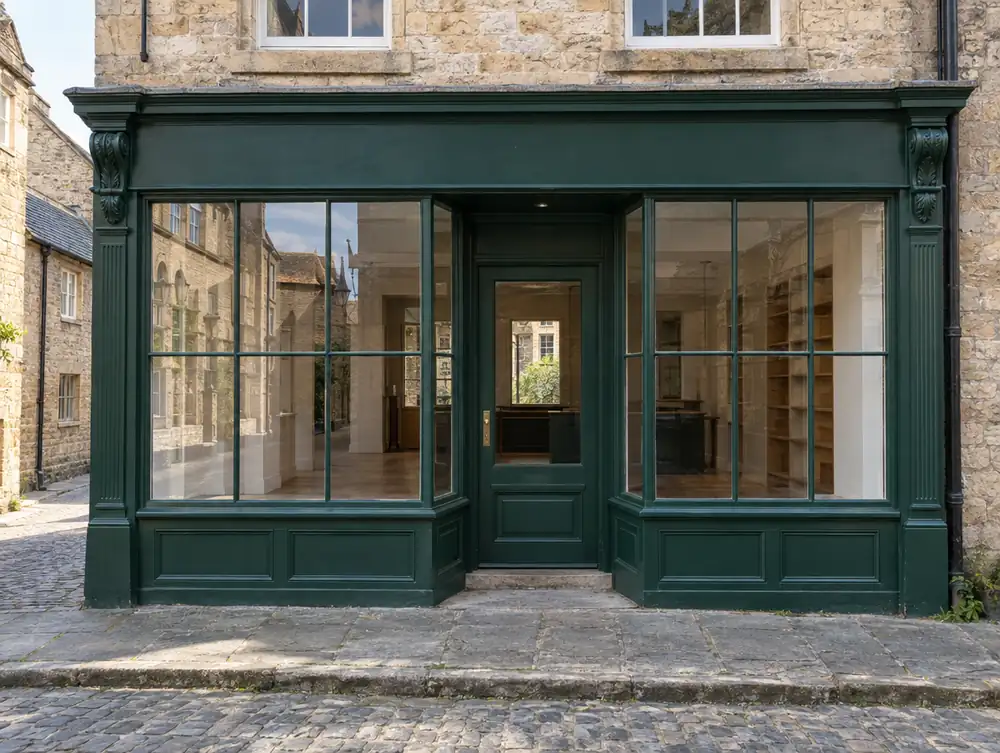
How do you design around the building when planning timber shopfronts in West End?
A brand rollout can include timber, as long as the details repeat. For a branch in West End we'd use the same mouldings, colours and sign panel as your other sites, adjusting only the widths and heights to fit the opening.
A south or west-facing West End frontage is hard on paint. We'd steer you toward a lighter colour or a more stable timber, and if the brand needs a dark finish, we'd plan a shorter repaint interval from the outset.
If there are storeys above the shop, the frontage should feel like the base of the building and not a sign stuck on it. Lining up mullions with the windows overhead is a small move that settles the whole elevation at West End premises.
What permissions should you check for timber shopfronts in West End?
Security grilles and shutters are named in England's rules: installing or replacing one on a shopfront sits outside the shop permitted development rights. The frontage itself is treated the same way, so for timber shopfronts at premises in the West End area, building work that materially affects the appearance needs planning permission. Confirm the position with the council before anything is ordered.
Expect planning and advert applications here to go to Westminster City Council in the normal way. We check what that means for your building when we survey it in West End.
What might timber shopfronts cost in West End?
We would budget £3,995 to £13,995 plus VAT for a typical frontage. Scope sets most of the figure, so a clear brief at the start does more for the budget than any later change of detail.
| Town | West End |
|---|---|
| Area | Greater London |
| Postcode districts | W1C, W1H, W1K, W1U |
| Planning authority | Westminster City Council |
| Building approval | Building Regulations (Approved Documents) |
| Distance from Great Barr | About 103 miles |
| Survey | Free for new work |
Does Westminster City Council publish shopfront guidance?
Yes, Shopfronts, Blinds and Signs - A Guide to their Design (1993). It tells applicants what the council expects from new and altered shopfronts. A few of the things it asks for:
- Roller shutters will not normally be given consent, and internally fitted brick-bond grilles are the preferred solution.
- Large internally lit box signs are generally inappropriate, while externally lit fascias and back-lit or halo-lit letters are accepted.
- Projecting signs need at least 2.6m clearance above the pavement and should sit at fascia level, centred on a pilaster.
Questions about timber shopfronts in West End
What should I budget for looking after a timber front in West End?
A repaint every 5 to 7 years, plus a yearly wash and touch-up of the cills. Door gear needs checking too, since seasonal movement can throw a door out of line.
Will timber suffer on my West End frontage if it gets a lot of rain?
Not if the details are right. Sloped cills, sealed end grain and plinth blocks keep water moving, and the paint system then only has to deal with the weather, not trapped damp.
Can a timber front take a modern sign in West End?
Yes. Hand-painted letters suit a timber fascia well, and raised letters or a concealed trough light work too. We draw the sign and the joinery together, so the fixings don't cut through a moulding.
Does the Equality Act apply to a shop entrance in the West End area?
Yes. The Equality Act 2010 applies in England, as across Great Britain, and it requires reasonable steps to remove, alter or avoid physical features that disadvantage disabled people. The duty is anticipatory, so it looks at disabled people generally, and a new Services Code replaced the 2011 Code on 5 August 2026.
Do I need listed building consent for a shopfront in the West End area?
Usually yes, if the building is listed. In England the local planning authority decides, and Historic England is notified of Grade I and II* works and specified Grade II works. Like-for-like repair may not need consent, so ask the council before work starts.