Solid shutters leave a blank wall behind them, and perforated ones do not. Across West End we fit curtains with enough open area for the display to read through them.
Measuring the opening is the easy part of a survey in West End. We also look at the beam above, the pavement fall and any meters or drains nearby.
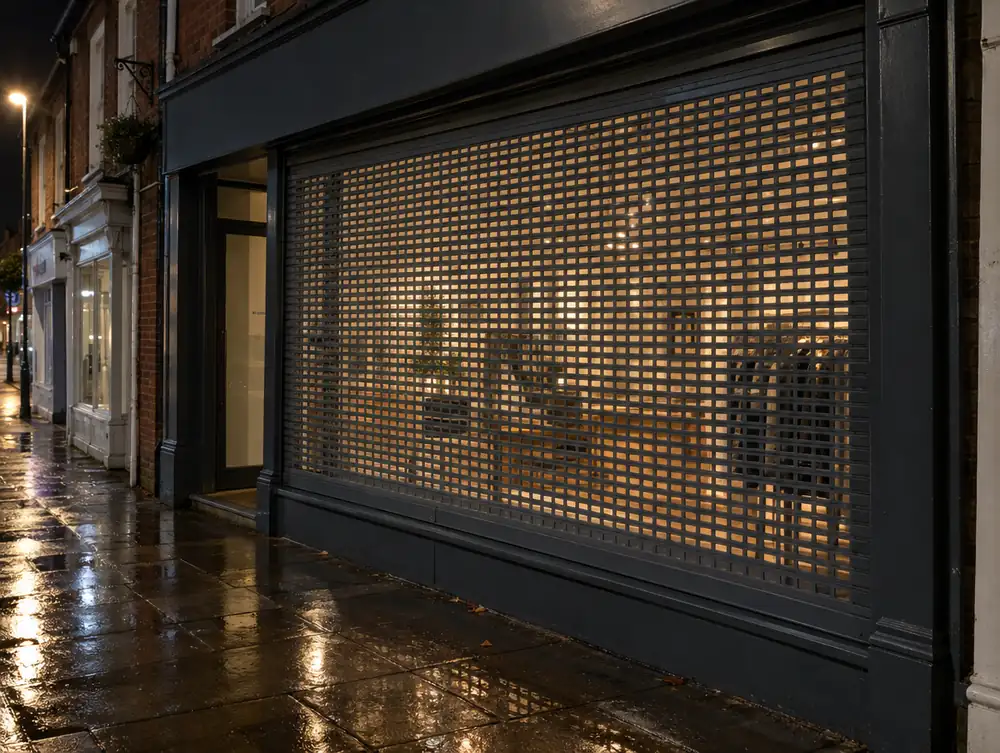
What should you think about before commissioning perforated roller shutters in West End?
Where stock is high in value, a perforated shutter alone may not be enough. We would look at laminated glass in front, a rated curtain, and what your insurer expects, then specify the three together.
If your West End shopfront has a suspended ceiling behind it, an internal box can often hide above the tiles. Where the ceiling is solid or very low, we would look at a slim box in a painted bulkhead.
Where the building has good brick or stone around the opening, set the frame back in the reveal so the masonry can be seen. On West End premises with a flat elevation, that deep reveal throws a shadow line that adds real depth in low sun.
What is a realistic budget for perforated roller shutters in West End?
Until the survey is done, plan on £1,695 to £4,495 plus VAT per shutter. Unusual sizes, fine detail and phased working push the figure up, while a simple brief and clear access keep it toward the lower end.
Who approves perforated roller shutters in West End?
For perforated roller shutters at premises in the West End area, the deciding question in England is whether the building work materially affects the external appearance. If it does, planning permission is needed, while a true like-for-like replacement usually needs none. The council confirms the position for each site.
West End applications for planning permission or advertisement consent are normally handled by Westminster City Council. Our survey includes a check of the position for your address.
| Town | West End |
|---|---|
| Area | Greater London |
| Postcode districts | W1C, W1H, W1K, W1U |
| Planning authority | Westminster City Council |
| Building approval | Building Regulations (Approved Documents) |
| Distance from Great Barr | About 103 miles |
| Survey | Free for new work |
Does Westminster City Council publish shopfront guidance?
Yes, Shopfronts, Blinds and Signs - A Guide to their Design (1993). It tells applicants what the council expects from new and altered shopfronts. A few of the things it asks for:
- Roller shutters will not normally be given consent, and internally fitted brick-bond grilles are the preferred solution.
- Large internally lit box signs are generally inappropriate, while externally lit fascias and back-lit or halo-lit letters are accepted.
- Projecting signs need at least 2.6m clearance above the pavement and should sit at fascia level, centred on a pilaster.
Questions about perforated roller shutters in West End
Do you remove old shutters in West End?
Yes. Taking out the old curtain, box and guides, then making good the frontage, is shown as its own line in the itemised quotation.
Can one person open the shutter at my West End shop?
Yes. Powered shutters run at the turn of a key or a button press, and a manual override is available if the power fails. We show your staff both at handover.
How noisy is a shutter in West End premises?
A modern tubular motor is fairly quiet, and a well-set curtain only makes a low rumble. Heavier steel shutters and worn guides make more noise, which matters if there are flats above.
Does a shop sign in the West End area need advertisement consent?
Not always. In England, an unlit sign within Class 5 of the 2007 Advertisement Regulations generally needs no application, and neither does a lit sign within Class 4B. Anything outside those classes needs consent, and Class 4B isn't available in conservation areas, so check before ordering.
Does a new shopfront in the West End area need Building Regulations approval?
Assume yes until building control says otherwise. England has no like-for-like exemption, though registered installers can self-certify replacement windows and doors in non-dwellings. That route doesn't cover structural glass, curtain walling or revolving doors.