Panels that fold away should still look right when closed, since that is how a front in West End spends most of the year. We keep the widths even, the rails aligned and the frames slim, so the set reads as a shopfront.
Measuring the opening is the easy part of a survey in West End. We also look at the beam above, the pavement fall and any meters or drains nearby.
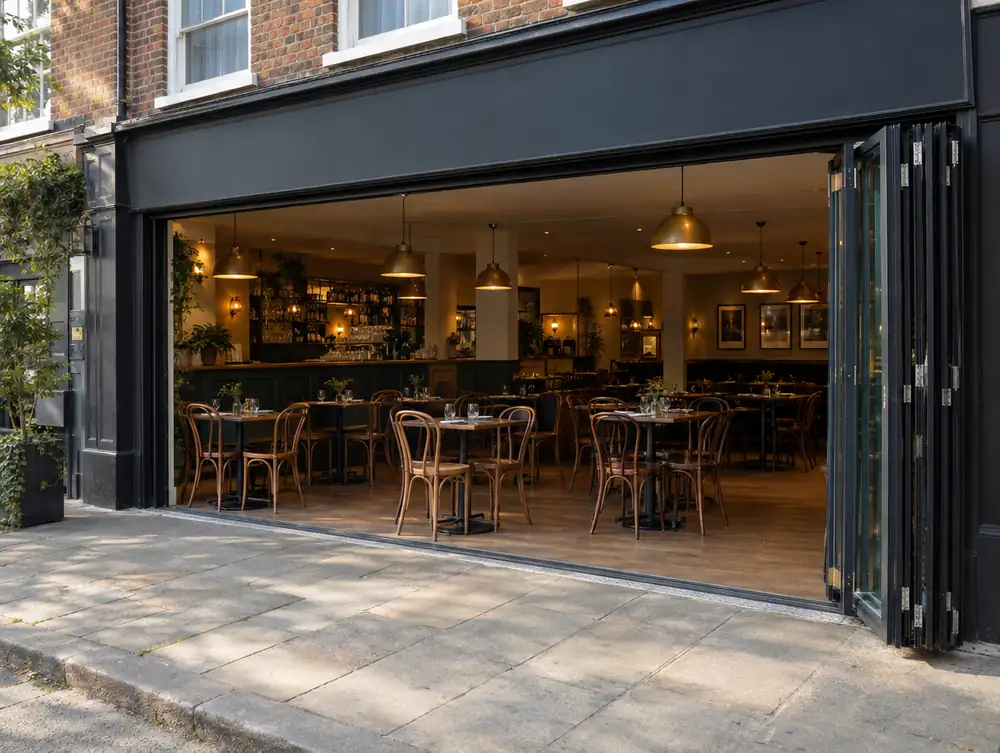
What goes into getting bi-folding shopfronts right in West End?
Landlords often worry about what a bi-fold does to the structure and the weather line. For a unit in West End we'd prepare a drawing of the head, threshold and reinstatement route, so the conversation is about detail rather than doubt.
If your West End frontage faces the sun, a bi-fold doubles as ventilation. We'd pair it with an awning so the room stays usable at midday, and look at solar control glass for the days the set stays closed.
Where units share one long run of fascia, breaking the height makes you stand out for the wrong reason. If that describes your West End parade, keep the line and win attention with lettering, lighting and what's in the window.
Which applications might bi-folding shopfronts in West End involve?
A true like-for-like replacement usually needs no planning permission in England, because the external appearance isn't materially affected. New materials, a different glass line or altered proportions usually do count as material, so for bi-folding shopfronts at premises in the West End area, an application is then likely. The council confirms which side of that line a job falls on.
At survey we check how things stand for your building, although applications for planning permission or advertisement consent here normally go to Westminster City Council.
How much could bi-folding shopfronts in West End cost you?
The guide for bi-folding shopfronts is £5,195 to £13,995 plus VAT for a typical opening. Expect the lower end for simple work with clear access, and the upper end where detail, finish or awkward conditions add hours.
| Town | West End |
|---|---|
| Area | Greater London |
| Postcode districts | W1C, W1H, W1K, W1U |
| Planning authority | Westminster City Council |
| Building approval | Building Regulations (Approved Documents) |
| Distance from Great Barr | About 103 miles |
| Survey | Free for new work |
Does Westminster City Council publish shopfront guidance?
Yes, Shopfronts, Blinds and Signs - A Guide to their Design (1993). It tells applicants what the council expects from new and altered shopfronts. A few of the things it asks for:
- Roller shutters will not normally be given consent, and internally fitted brick-bond grilles are the preferred solution.
- Large internally lit box signs are generally inappropriate, while externally lit fascias and back-lit or halo-lit letters are accepted.
- Projecting signs need at least 2.6m clearance above the pavement and should sit at fascia level, centred on a pilaster.
Questions about bi-folding shopfronts in West End
Can I have a timber bi-fold on my West End frontage?
Yes. Painted hardwood sets suit older premises across Greater London, though the panels are heavier and need a stiffer head than aluminium.
How secure is a folding front in West End overnight?
Very, if it is specified for the job. Each leaf locks top and bottom with concealed bolts, and laminated glass adds a second line of defence.
Can my West End bi-fold be fitted around service?
Yes. Closed-day or out-of-hours fitting can be arranged to avoid your busiest sittings, and the job typically takes 2 to 4 days on site.
Do roller shutters need planning permission in the West End area?
Usually yes. Installing or replacing a security grill or shutter on a shopfront is expressly outside England's shop permitted development rights, so the only way to avoid an application is work that doesn't materially affect the appearance. Ask the council before ordering.
Does a new shopfront in the West End area need Building Regulations approval?
Assume yes until building control says otherwise. England has no like-for-like exemption, though registered installers can self-certify replacement windows and doors in non-dwellings. That route doesn't cover structural glass, curtain walling or revolving doors.