On a warm evening, an open front does more for a cafe or bar in Soho than any sign. We design the folding set around your seating, so the panels park where they don't cost you a table.
A survey in Soho usually starts outside, looking at the whole elevation before any tape comes out, because the frontage has to answer the building above it.
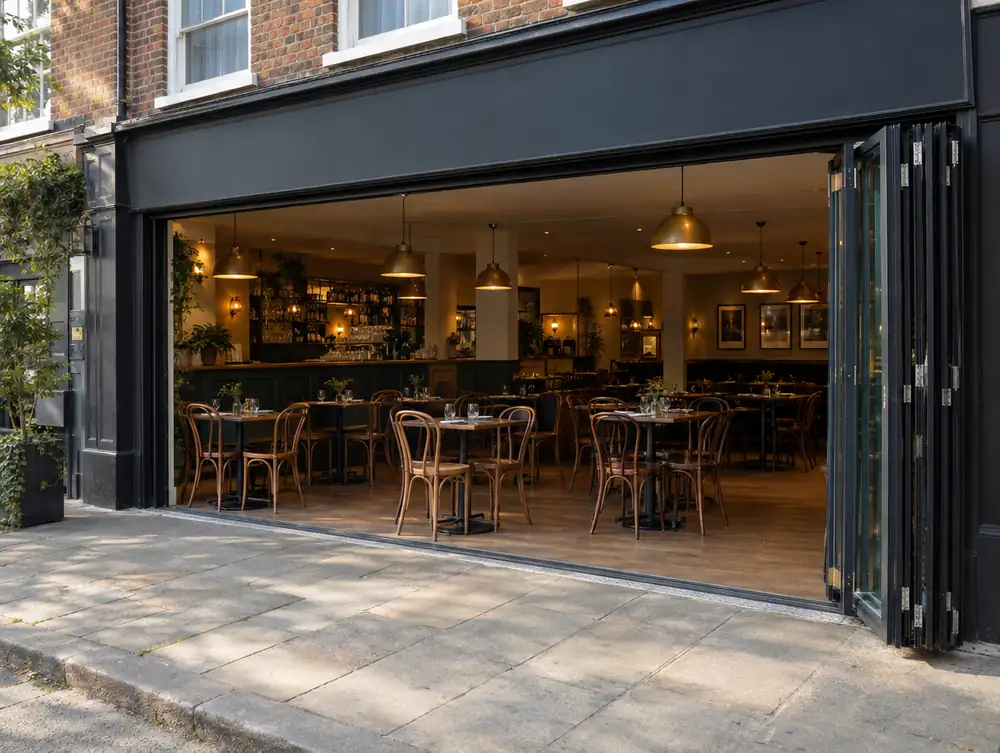
What makes bi-folding shopfronts work well on Soho premises?
On a narrow Soho unit, the stack can swallow the opening. We'd limit the set to three panels, or look at a single sliding leaf, so the opening you gain outweighs the width lost to parked frames.
A deep recess can host a bi-fold set back from the street, which keeps the panels clear of passers-by and creates a sheltered pocket by the door. At Soho premises with that depth, it's often the neatest layout.
If the pavement falls across your frontage, let the stallriser take up the slope and keep the glass line dead level. The eye reads the long horizontal, so Soho premises on a slope look settled once that line is true.
Could bi-folding shopfronts in Soho need planning permission?
England has no permitted development route for changing a shopfront. Part 7 Class A of the General Permitted Development Order 2015 excludes creating, altering or replacing one, and it allows no alterations at all on article 2(3) land. That leaves two outcomes for bi-folding shopfronts at premises in the Soho area: a planning application, or work that doesn't materially affect the external appearance.
Planning and advert applications for Soho premises normally go to Westminster City Council. We check the position for your address at survey.
How much should you set aside for bi-folding shopfronts in Soho?
Allow £5,195 to £13,995 plus VAT for a typical opening. Size and specification set most of that figure for bi-folding shopfronts, and the rest depends on what the survey finds on site.
| Town | Soho |
|---|---|
| Area | Greater London |
| Postcode districts | W1, W1B, W1D, W1F |
| Planning authority | Westminster City Council |
| Building approval | Building Regulations (Approved Documents) |
| Distance from Great Barr | About 104 miles |
| Survey | Free for new work |
Does Westminster City Council publish shopfront guidance?
Yes, Shopfronts, Blinds and Signs - A Guide to their Design (1993). It tells applicants what the council expects from new and altered shopfronts. A few of the things it asks for:
- Roller shutters will not normally be given consent, and internally fitted brick-bond grilles are the preferred solution.
- Large internally lit box signs are generally inappropriate, while externally lit fascias and back-lit or halo-lit letters are accepted.
- Projecting signs need at least 2.6m clearance above the pavement and should sit at fascia level, centred on a pilaster.
Questions about bi-folding shopfronts in Soho
Can my Soho bi-fold be fitted around service?
Yes. Closed-day or out-of-hours fitting can be arranged to avoid your busiest sittings, and the job typically takes 2 to 4 days on site.
How many panels would my Soho opening need?
It depends on the width and how you want the set to open. Most openings divide into leaves under 1m wide, and an odd number gives you a daily door, so we draw the options after the measure-up.
Can I have a timber bi-fold on my Soho frontage?
Yes. Painted hardwood sets suit older premises across Greater London, though the panels are heavier and need a stiffer head than aluminium.
What rules apply to a fire exit door through a shopfront in the Soho area?
It must open in the direction of escape and can't be locked against immediate use, and a dedicated fire exit can't be a sliding or revolving door. In England that comes from article 14(2) of the Regulatory Reform (Fire Safety) Order 2005, and the duty sits with the responsible person, normally the employer or whoever controls the premises for a business, otherwise the owner. An outward door can clash with section 153 of the Highways Act 1980 where it opens onto the footway, so raise it early.
Do I need listed building consent for a shopfront in the Soho area?
Usually yes, if the building is listed. In England the local planning authority decides, and Historic England is notified of Grade I and II* works and specified Grade II works. Like-for-like repair may not need consent, so ask the council before work starts.