A bi-folding front lets a restaurant, bar or showroom in Bloomsbury open fully to the street when the weather allows. We draw the panels, stack and threshold to your opening, so it closes up tight when the weather doesn't.
Bring whatever you have to the survey in Bloomsbury: brand guidelines, lease plans, old drawings or a photo of a frontage you admire.
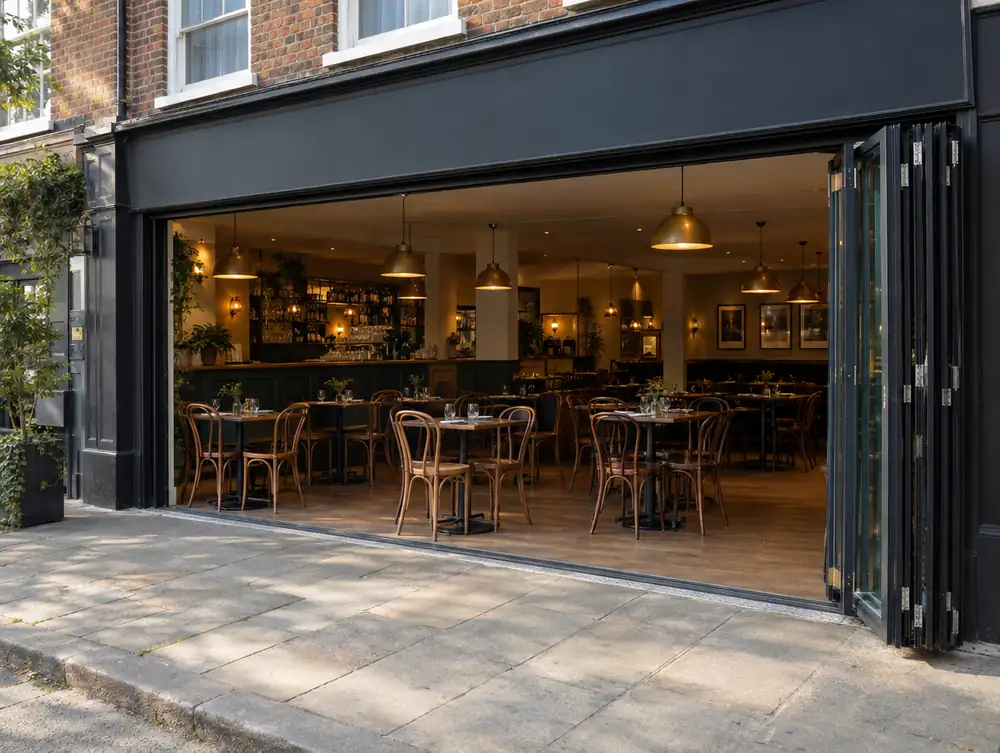
How would we approach bi-folding shopfronts for your Bloomsbury premises?
A deep recess can host a bi-fold set back from the street, which keeps the panels clear of passers-by and creates a sheltered pocket by the door. At Bloomsbury premises with that depth, it's often the neatest layout.
For a restaurant group opening in Bloomsbury, a bi-fold can carry the brand's look from site to site. We'd standardise the panel section, colour and hardware, then vary the panel count and stack side to suit each opening.
On a north-facing frontage the glass stays free of glare, but the interior can look dim from the street, so lighting needs to sit closer to the window. If your Bloomsbury premises face south, the problem flips to reflections by day and fading stock.
What should you budget for bi-folding shopfronts in Bloomsbury?
Our guide band is £5,195 to £13,995 plus VAT for a typical opening. Scope is the biggest lever, so a tighter brief for bi-folding shopfronts brings the figure down faster than any change of detail.
What consents could affect bi-folding shopfronts in Bloomsbury?
For bi-folding shopfronts at premises in the Bloomsbury area, the deciding question in England is whether the building work materially affects the external appearance. If it does, planning permission is needed, while a true like-for-like replacement usually needs none. The council confirms the position for each site.
Bloomsbury applications for planning permission or advertisement consent are normally handled by London Borough of Camden. Our survey includes a check of the position for your address.
| Town | Bloomsbury |
|---|---|
| Area | Greater London |
| Postcode districts | WC1 |
| Planning authority | London Borough of Camden |
| Building approval | Building Regulations (Approved Documents) |
| Distance from Great Barr | About 104 miles |
| Survey | Free for new work |
Does London Borough of Camden publish shopfront guidance?
Yes, Camden Planning Guidance: Design (Chapter 6: Shopfronts) (2021). It tells applicants what the council expects from new and altered shopfronts. A few of the things it asks for:
- Existing stall risers should be kept, and new ones should be at least 300mm high or reach the top of the pilaster base or door panel.
- Solid shutters are only acceptable in exceptional circumstances, and internal security measures are strongly encouraged.
- Uncoated shutters, galvanised steel, milled finishes and anodised aluminium are not acceptable finishes.
Questions about bi-folding shopfronts in Bloomsbury
Will I lose a table to the stack in my Bloomsbury restaurant?
Possibly one, but careful layout usually avoids it. We draw the folded panels on your floor plan, then look at moving the stack to a quieter corner or splitting the set in two.
Can the threshold be level at my Bloomsbury premises?
It can be close to level, depending on the floor and drainage. We'd check the levels at survey, because a track sitting flush with the pavement still needs somewhere for water to go.
How many panels would my Bloomsbury opening need?
It depends on the width and how you want the set to open. Most openings divide into leaves under 1m wide, and an odd number gives you a daily door, so we draw the options after the measure-up.
Does a new shopfront in the Bloomsbury area need Building Regulations approval?
Assume yes until building control says otherwise. England has no like-for-like exemption, though registered installers can self-certify replacement windows and doors in non-dwellings. That route doesn't cover structural glass, curtain walling or revolving doors.
Does the Equality Act apply to a shop entrance in the Bloomsbury area?
Yes. The Equality Act 2010 applies in England, as across Great Britain, and it requires reasonable steps to remove, alter or avoid physical features that disadvantage disabled people. The duty is anticipatory, so it looks at disabled people generally, and a new Services Code replaced the 2011 Code on 5 August 2026.