For a boutique, salon, office or restaurant in Bloomsbury, the ideal door almost disappears. Toughened glass gets close, provided the floor and head are detailed properly.
Expect us to measure the opening, photograph the existing front and check how materials will reach it on the day, at a time you have agreed.
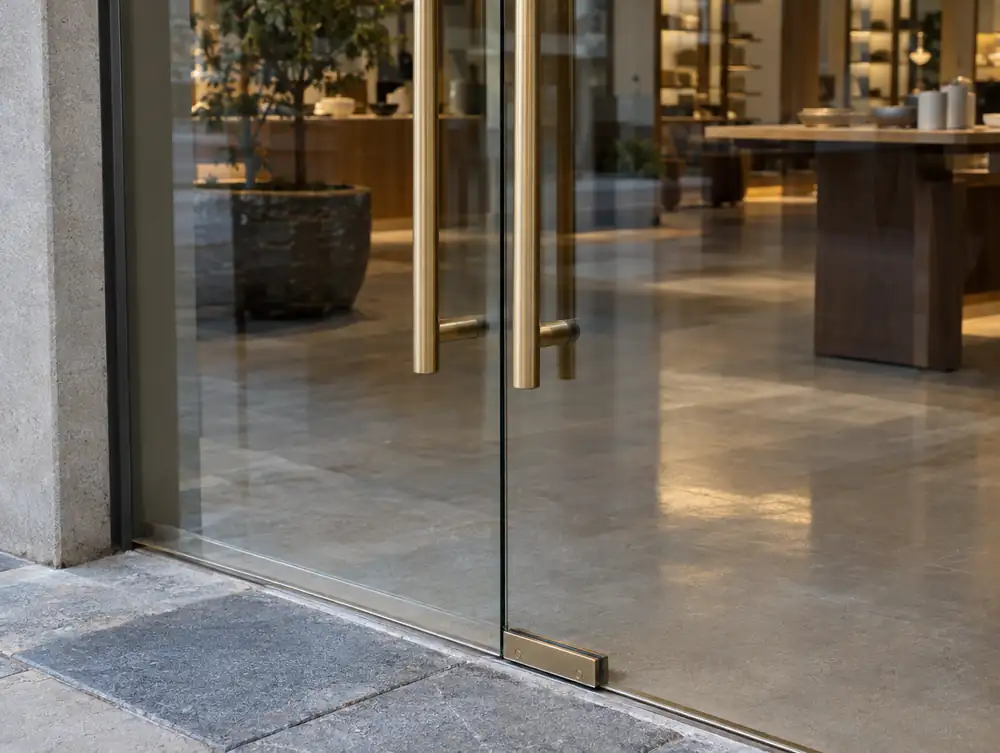
What goes into getting frameless glass doors right in Bloomsbury?
If a landlord in Bloomsbury controls the frontage, a glass door is often an easy approval because so little changes visually. We'd supply a drawing showing the door, the fittings and any markings on the glass.
A narrow Bloomsbury unit benefits from a door that takes up no visual width. We'd use a single glass leaf hung beside one clear pane, so the entrance and the display read as one view into the shop.
If your Bloomsbury unit sits in a Victorian parade, the old pilasters usually set the rhythm, so a new front should land on them and not run past them. Keep that line and even a modern frame looks as though it belongs.
Which applications might frameless glass doors in Bloomsbury involve?
For frameless glass doors at premises in the Bloomsbury area, the deciding question in England is whether the building work materially affects the external appearance. If it does, planning permission is needed, while a true like-for-like replacement usually needs none. The council confirms the position for each site.
Planning and advert applications for Bloomsbury premises normally go to London Borough of Camden. We check the position for your address at survey.
How much could frameless glass doors in Bloomsbury cost you?
We would budget £1,495 to £4,495 plus VAT per door set. Scope sets most of the figure, so a clear brief at the start does more for the budget than any later change of detail.
| Town | Bloomsbury |
|---|---|
| Area | Greater London |
| Postcode districts | WC1 |
| Planning authority | London Borough of Camden |
| Building approval | Building Regulations (Approved Documents) |
| Distance from Great Barr | About 104 miles |
| Survey | Free for new work |
Does London Borough of Camden publish shopfront guidance?
Yes, Camden Planning Guidance: Design (Chapter 6: Shopfronts) (2021). It tells applicants what the council expects from new and altered shopfronts. A few of the things it asks for:
- Existing stall risers should be kept, and new ones should be at least 300mm high or reach the top of the pilaster base or door panel.
- Solid shutters are only acceptable in exceptional circumstances, and internal security measures are strongly encouraged.
- Uncoated shutters, galvanised steel, milled finishes and anodised aluminium are not acceptable finishes.
Questions about frameless glass doors in Bloomsbury
Can you reuse my existing floor spring in Bloomsbury?
Sometimes, if it is sound and suits the new leaf. We'd test it at survey, because an old spring under a heavier door tends to fail early.
Can my Bloomsbury premises take a frameless glass door?
Most can, once the floor and opening have been checked. The survey shows whether a floor spring will fit, and if not, a concealed closer in a transom does the same job.
What handle should I choose for a door in Greater London?
Full-height pulls suit tall leaves, while shorter offset handles suit small doors. We'd bring examples to your Bloomsbury premises so you can feel the difference.
Do I need planning permission to change a shopfront in the Bloomsbury area?
Usually yes, if the work materially affects the building's external appearance. England's shop permitted development rights exclude creating, altering or replacing a shopfront, so there is no shortcut. A true like-for-like replacement usually needs no application, and the council confirms the position.
What rules apply to a fire exit door through a shopfront in the Bloomsbury area?
It must open in the direction of escape and can't be locked against immediate use, and a dedicated fire exit can't be a sliding or revolving door. In England that comes from article 14(2) of the Regulatory Reform (Fire Safety) Order 2005, and the duty sits with the responsible person, normally the employer or whoever controls the premises for a business, otherwise the owner. An outward door can clash with section 153 of the Highways Act 1980 where it opens onto the footway, so raise it early.