Our quotation for bi-folding shopfronts in Greater London is written, itemised and valid for 90 days. Nothing is ordered until you accept it, which gives you time to take it to a landlord, a partner or a board.
Your frontage is read alongside its neighbours, so we note the fascia line, stallriser height and pilasters on either side before drawing bi-folding shopfronts for Greater London premises. Matching those lines or breaking them on purpose can both work, whereas doing it by accident never does.
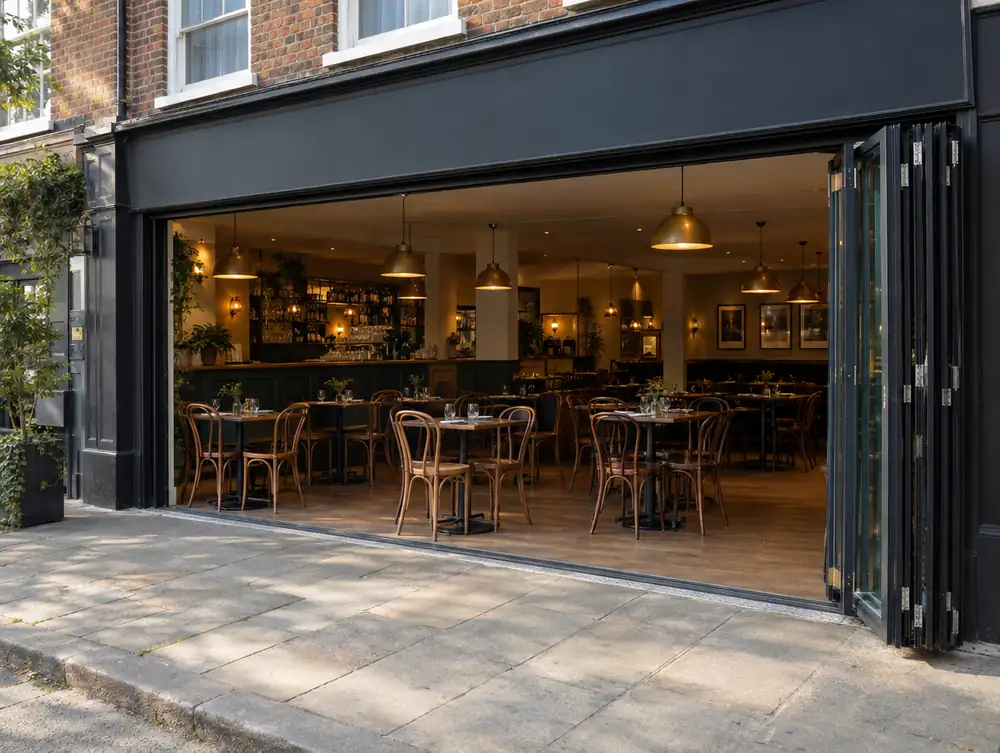
Where do you start with bi-folding shopfronts in Greater London?
Floors vary more than people expect. If your premises in Greater London are older, a level track can mean cutting into a slab, a stone threshold or a cellar head, so we find out what's under the floor before deciding between top-hung and bottom-rolling.
In Central London and across Greater London, we draw the stack around your seating plan. Moving a table or two a short way often frees the parking spot for the panels, and that is far easier to agree on a drawing than after the set is fitted.
What consents apply to bi-folding shopfronts in Greater London?
England has no permitted development route for changing a shopfront. Part 7 Class A of the General Permitted Development Order 2015 excludes creating, altering or replacing one, and it allows no alterations at all on article 2(3) land. That leaves two outcomes for bi-folding shopfronts at premises in the Greater London area: a planning application, or work that doesn't materially affect the external appearance.
How much do bi-folding shopfronts cost in Greater London?
Guide price: £5,195 to £13,995 plus VAT for a typical opening. Materials, finish and the amount of drawing and coordination involved all move it, and your itemised quotation shows where the money goes on bi-folding shopfronts.
| Area | Greater London |
|---|---|
| Nation | England |
| Towns covered | 235 |
| Main town | Central London |
| Planning regime | England: TCPA 1990 and the 2007 Advertisement Regulations |
| Building approval | Building Regulations (Approved Documents) |
| Survey | Free for new work, from our Great Barr base |
Does Westminster City Council publish shopfront guidance?
Yes, Shopfronts, Blinds and Signs - A Guide to their Design (1993). It tells applicants what the council expects from new and altered shopfronts. A few of the things it asks for:
- Roller shutters will not normally be given consent, and internally fitted brick-bond grilles are the preferred solution.
- Large internally lit box signs are generally inappropriate, while externally lit fascias and back-lit or halo-lit letters are accepted.
- Projecting signs need at least 2.6m clearance above the pavement and should sit at fascia level, centred on a pilaster.
Questions about bi-folding shopfronts in Greater London
Will a bi-fold work on a sloping street in Greater London?
Usually, with the right threshold. We take levels across the opening, then step the track, add a low upstand or set the frame back so water stays outside.
Can premises in Central London have a bi-fold and still use a normal door?
Yes. An odd number of panels gives you one leaf that swings like an ordinary door, so the set can stay closed on cold days.
Can a bi-fold be fitted while my Greater London restaurant stays open?
A closed day or two is usually needed. Fitting typically takes 2 to 4 days, and it can be scheduled around your quieter days with temporary boarding overnight.
Does a shop sign in the Greater London area need advertisement consent?
Not always. In England, an unlit sign within Class 5 of the 2007 Advertisement Regulations generally needs no application, and neither does a lit sign within Class 4B. Anything outside those classes needs consent, and Class 4B isn't available in conservation areas, so check before ordering.
What rules apply to a fire exit door through a shopfront in the Greater London area?
It must open in the direction of escape and can't be locked against immediate use, and a dedicated fire exit can't be a sliding or revolving door. In England that comes from article 14(2) of the Regulatory Reform (Fire Safety) Order 2005, and the duty sits with the responsible person, normally the employer or whoever controls the premises for a business, otherwise the owner. An outward door can clash with section 153 of the Highways Act 1980 where it opens onto the footway, so raise it early.