Folding glass is a simple idea that rewards careful detailing. For Canary Wharf premises, we check the head, floor and drainage before the panels are ordered.
We measure your Canary Wharf opening in person, at a time agreed with you first, so the visit fits around your trading.
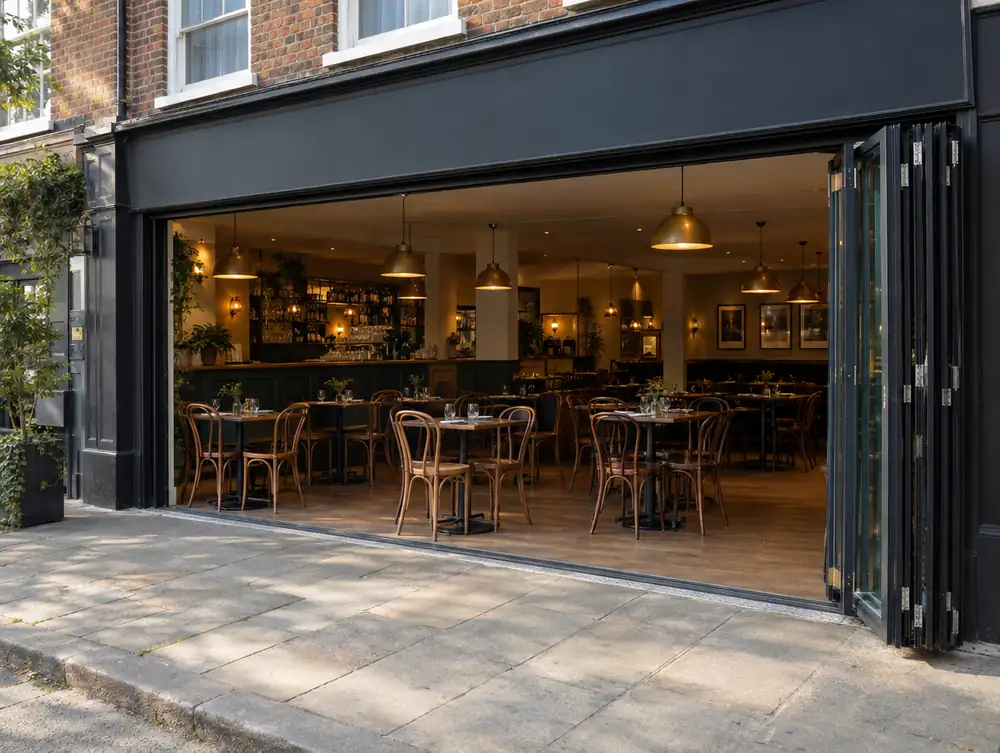
What goes into getting bi-folding shopfronts right in Canary Wharf?
A deep recess can host a bi-fold set back from the street, which keeps the panels clear of passers-by and creates a sheltered pocket by the door. At Canary Wharf premises with that depth, it's often the neatest layout.
A corner plot offers something rare: a front that can open on two sides. For Canary Wharf corner premises, we'd look at two sets meeting with no fixed post, provided the structure above can span it.
If the pavement falls across your frontage, let the stallriser take up the slope and keep the glass line dead level. The eye reads the long horizontal, so Canary Wharf premises on a slope look settled once that line is true.
How much could bi-folding shopfronts in Canary Wharf cost you?
As a working budget, use £5,195 to £13,995 plus VAT for a typical opening. Your place inside that range for bi-folding shopfronts depends mostly on how much of the existing frontage can stay and how much has to be put right first.
Which applications might bi-folding shopfronts in Canary Wharf involve?
A true like-for-like replacement usually needs no planning permission in England, because the external appearance isn't materially affected. New materials, a different glass line or altered proportions usually do count as material, so for bi-folding shopfronts at premises in the Canary Wharf area, an application is then likely. The council confirms which side of that line a job falls on.
Planning and advert applications for Canary Wharf premises normally go to London Borough of Tower Hamlets. We check the position for your address at survey.
| Town | Canary Wharf |
|---|---|
| Area | Greater London |
| Postcode districts | E14, E1W, E3, SE16 |
| Planning authority | London Borough of Tower Hamlets |
| Building approval | Building Regulations (Approved Documents) |
| Distance from Great Barr | About 108 miles |
| Survey | Free for new work |
Does London Borough of Tower Hamlets publish shopfront guidance?
Yes, Shopfronts and Roller Shutter Grilles. It tells applicants what the council expects from new and altered shopfronts. A few of the things it asks for:
- Stallrisers are always required on traditional shopfronts.
- Fascias should normally be no more than 500mm deep and no higher than ground floor level.
- External roller shutter boxes will not be permitted, and shutters should wherever possible be an integral feature of the shopfront.
Questions about bi-folding shopfronts in Canary Wharf
Can the threshold be level at my Canary Wharf premises?
It can be close to level, depending on the floor and drainage. We'd check the levels at survey, because a track sitting flush with the pavement still needs somewhere for water to go.
How many panels would my Canary Wharf opening need?
It depends on the width and how you want the set to open. Most openings divide into leaves under 1m wide, and an odd number gives you a daily door, so we draw the options after the measure-up.
Who do I speak to about a bi-fold in Canary Wharf?
Your named contact stays the same from the first visit to the final adjustment. Fitting is carried out by vetted teams working under S&K Glazing, travelling from Great Barr.
Does a shop sign in the Canary Wharf area need advertisement consent?
Not always. In England, an unlit sign within Class 5 of the 2007 Advertisement Regulations generally needs no application, and neither does a lit sign within Class 4B. Anything outside those classes needs consent, and Class 4B isn't available in conservation areas, so check before ordering.
Does a new shopfront in the Canary Wharf area need Building Regulations approval?
Assume yes until building control says otherwise. England has no like-for-like exemption, though registered installers can self-certify replacement windows and doors in non-dwellings. That route doesn't cover structural glass, curtain walling or revolving doors.