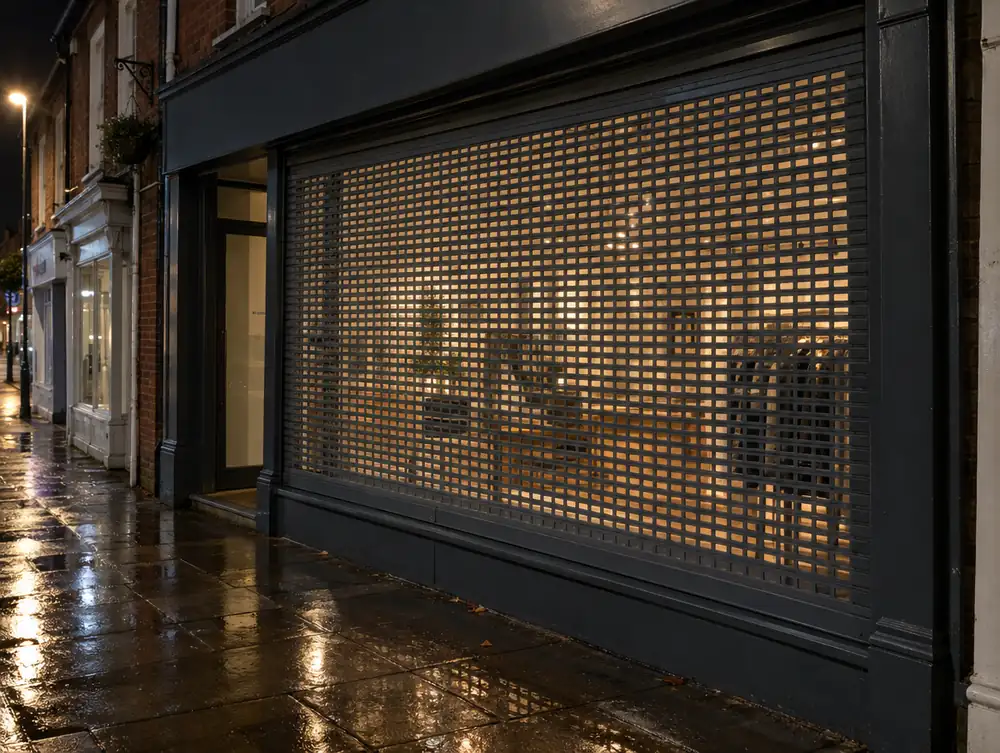
Perforated roller shutters give Canary Wharf premises out-of-hours protection while light and the display still show through. We look first at whether the shutter should sit inside the glass, since that often gives a better frontage.
A survey in Canary Wharf usually starts outside, looking at the whole elevation before any tape comes out, because the frontage has to answer the building above it.
How would we approach perforated roller shutters for your Canary Wharf premises?
On premises with a recessed entrance, the shutter line needs careful thought. We usually bring it forward to the building line, or close the recess separately, so the doorway does not become a hiding place.
For premises that open early or trade late, shutter noise can matter to neighbours. A motor with a soft start and well-set guides runs noticeably more quietly.
If your premises were once two shops, decide early whether the front should read as one or as two. One continuous fascia with a repeated bay width usually settles the elevation better than two mismatched halves, which is worth testing on any Canary Wharf unit of that kind.
What should you budget for perforated roller shutters in Canary Wharf?
Allow £1,695 to £4,495 plus VAT per shutter. Size and specification set most of that figure for perforated roller shutters, and the rest depends on what the survey finds on site.
What consents could affect perforated roller shutters in Canary Wharf?
For perforated roller shutters at premises in the Canary Wharf area, the deciding question in England is whether the building work materially affects the external appearance. If it does, planning permission is needed, while a true like-for-like replacement usually needs none. The council confirms the position for each site.
For Canary Wharf, the usual route for planning and advert applications is through London Borough of Tower Hamlets, and we confirm that when we visit.
| Town | Canary Wharf |
|---|---|
| Area | Greater London |
| Postcode districts | E14, E1W, E3, SE16 |
| Planning authority | London Borough of Tower Hamlets |
| Building approval | Building Regulations (Approved Documents) |
| Distance from Great Barr | About 108 miles |
| Survey | Free for new work |
Does London Borough of Tower Hamlets publish shopfront guidance?
Yes, Shopfronts and Roller Shutter Grilles. It tells applicants what the council expects from new and altered shopfronts. A few of the things it asks for:
- Stallrisers are always required on traditional shopfronts.
- Fascias should normally be no more than 500mm deep and no higher than ground floor level.
- External roller shutter boxes will not be permitted, and shutters should wherever possible be an integral feature of the shopfront.
Questions about perforated roller shutters in Canary Wharf
Can one person open the shutter at my Canary Wharf shop?
Yes. Powered shutters run at the turn of a key or a button press, and a manual override is available if the power fails. We show your staff both at handover.
Can a perforated shutter match my other sites in Greater London?
Yes. Send us the colour reference and curtain type from an existing site, and we match them on the new one. The box and guides may differ, because each frontage has its own structure.
How noisy is a shutter in Canary Wharf premises?
A modern tubular motor is fairly quiet, and a well-set curtain only makes a low rumble. Heavier steel shutters and worn guides make more noise, which matters if there are flats above.
Does the Equality Act apply to a shop entrance in the Canary Wharf area?
Yes. The Equality Act 2010 applies in England, as across Great Britain, and it requires reasonable steps to remove, alter or avoid physical features that disadvantage disabled people. The duty is anticipatory, so it looks at disabled people generally, and a new Services Code replaced the 2011 Code on 5 August 2026.
Do I need listed building consent for a shopfront in the Canary Wharf area?
Usually yes, if the building is listed. In England the local planning authority decides, and Historic England is notified of Grade I and II* works and specified Grade II works. Like-for-like repair may not need consent, so ask the council before work starts.