From Central London to the furthest corner of Greater London, the sequence for perforated roller shutters stays the same: survey, drawings, written price, then work on site. We travel from Great Barr in Birmingham and use vetted teams working under S&K Glazing.
Access gets as much attention as appearance at survey. Where a vehicle can stop, how long sections reach the opening and how the pavement stays safe for the public all shape the programme for perforated roller shutters in Greater London.
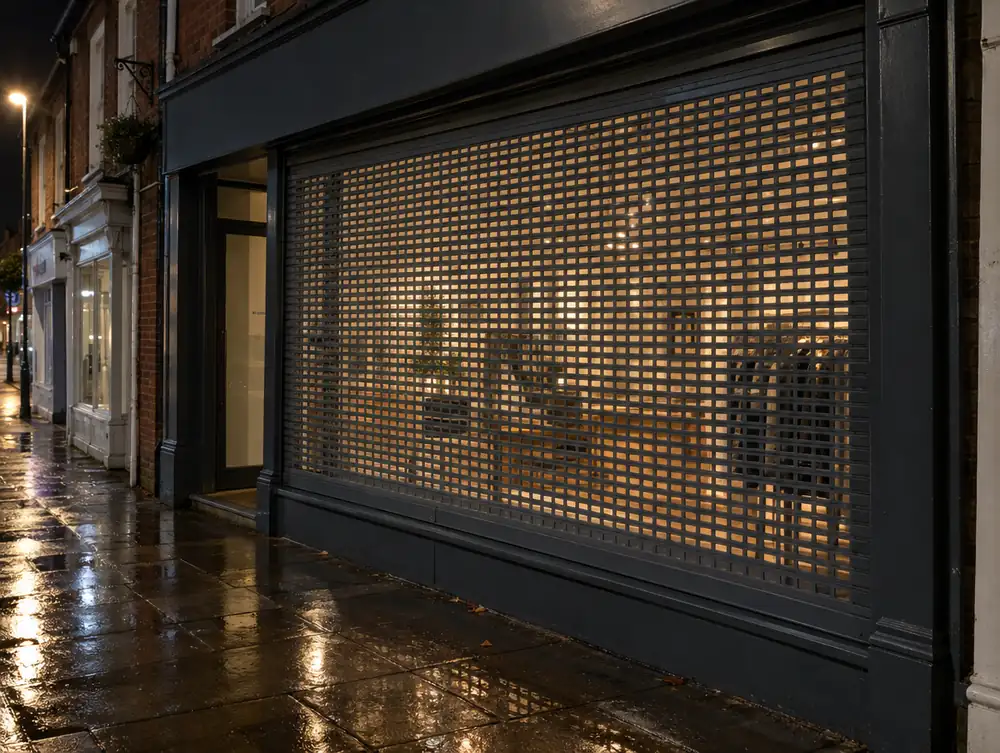
How should you approach perforated roller shutters in Greater London?
Several shops can share one specification. If you run premises across Greater London, a single curtain type, colour and control arrangement makes keys, servicing and staff training simpler.
Your lighting does half the work of a perforated curtain. For a unit in Greater London we look at what stays on overnight, so the display still reads from the pavement after you lock up.
What consents apply to perforated roller shutters in Greater London?
A true like-for-like replacement usually needs no planning permission in England, because the external appearance isn't materially affected. New materials, a different glass line or altered proportions usually do count as material, so for perforated roller shutters at premises in the Greater London area, an application is then likely. The council confirms which side of that line a job falls on.
How much do perforated roller shutters cost in Greater London?
A sensible starting budget is £1,695 to £4,495 plus VAT per shutter. What shifts the figure is whatever can't be seen yet, such as the condition behind the old frontage or the services running through it.
| Area | Greater London |
|---|---|
| Nation | England |
| Towns covered | 235 |
| Main town | Central London |
| Planning regime | England: TCPA 1990 and the 2007 Advertisement Regulations |
| Building approval | Building Regulations (Approved Documents) |
| Survey | Free for new work, from our Great Barr base |
Does Westminster City Council publish shopfront guidance?
Yes, Shopfronts, Blinds and Signs - A Guide to their Design (1993). It tells applicants what the council expects from new and altered shopfronts. A few of the things it asks for:
- Roller shutters will not normally be given consent, and internally fitted brick-bond grilles are the preferred solution.
- Large internally lit box signs are generally inappropriate, while externally lit fascias and back-lit or halo-lit letters are accepted.
- Projecting signs need at least 2.6m clearance above the pavement and should sit at fascia level, centred on a pilaster.
Questions about perforated roller shutters in Greater London
Will a shutter stop the need for laminated glass in Greater London?
Not if it sits inside the glass, because the pane stays exposed. Many shops combine a good laminate with an internal shutter, which protects both the frontage and the stock.
Can an existing shopfront in Greater London take an internal shutter?
Often, yes, if there is room for the box and guides behind the frame. We check the ceiling, window bed and any display fittings at survey.
Which colour suits a perforated shutter near Central London?
Dark colours usually work well, because they let the eye through to the display. Match the shopfront frame where you can, so the guides and curtain read as part of it.
Do roller shutters need planning permission in the Greater London area?
Usually yes. Installing or replacing a security grill or shutter on a shopfront is expressly outside England's shop permitted development rights, so the only way to avoid an application is work that doesn't materially affect the appearance. Ask the council before ordering.
What rules apply to a fire exit door through a shopfront in the Greater London area?
It must open in the direction of escape and can't be locked against immediate use, and a dedicated fire exit can't be a sliding or revolving door. In England that comes from article 14(2) of the Regulatory Reform (Fire Safety) Order 2005, and the duty sits with the responsible person, normally the employer or whoever controls the premises for a business, otherwise the owner. An outward door can clash with section 153 of the Highways Act 1980 where it opens onto the footway, so raise it early.