Every enquiry for canopies and awnings in Greater London begins with a measured survey at the premises, because a price taken from a photograph is only a guess. That visit gives you real dimensions before anyone draws a line or orders a thing.
Finishes behave differently at full size. Any sample we show you for canopies and awnings is better judged at the premises in daylight, since a colour that looks quiet on a desk can read much louder across a whole elevation.
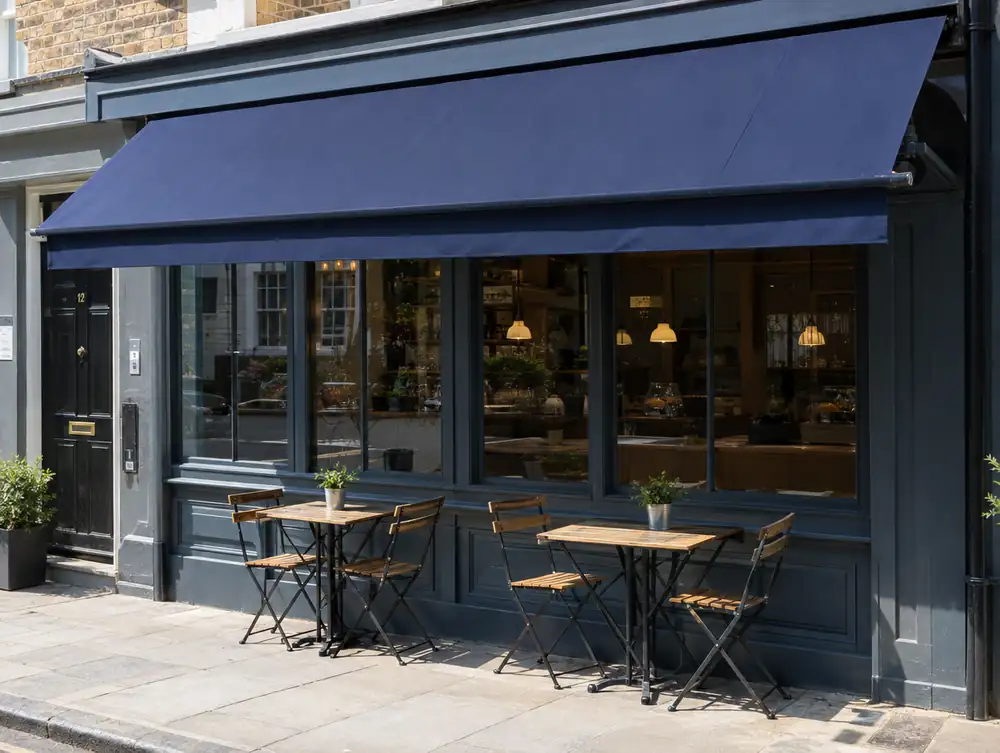
What should you look for from canopies and awnings in Greater London?
Your sign needs to survive the awning. On premises in Greater London we set the box and the valance so the name still reads with the cover out, or we letter the valance to carry it.
Wind can be far stronger on an open frontage than in a sheltered street nearby. On premises around Central London we judge the exposure on site, and on a windy elevation we may suggest a shorter projection, a sensor or a fixed cover.
What consents apply to canopies and awnings in Greater London?
For canopies and awnings at premises in the Greater London area, the deciding question in England is whether the building work materially affects the external appearance. If it does, planning permission is needed, while a true like-for-like replacement usually needs none. The council confirms the position for each site.
Class 4B, England's class for lit signs, isn't available in conservation areas, Areas of Outstanding Natural Beauty, National Parks or the Broads, so a lit sign there normally needs advertisement consent. In an area of special control it is unavailable too, and Class 5 drops to a 3.6m top height, 0.3m letters and one-tenth of the building face up to 3.6m. Ask the council which designations cover premises in the Greater London area.
How much do canopies and awnings cost in Greater London?
Allow £1,495 to £9,995 plus VAT per canopy or awning. Size and specification set most of that figure for canopies and awnings, and the rest depends on what the survey finds on site.
| Area | Greater London |
|---|---|
| Nation | England |
| Towns covered | 235 |
| Main town | Central London |
| Planning regime | England: TCPA 1990 and the 2007 Advertisement Regulations |
| Building approval | Building Regulations (Approved Documents) |
| Survey | Free for new work, from our Great Barr base |
Does Royal Borough of Kensington and Chelsea publish shopfront guidance?
Yes, Shopfront Design Guidelines Supplementary Planning Document (2011). It tells applicants what the council expects from new and altered shopfronts. A few of the things it asks for:
- Stallriser height should not exceed the base of the pilasters, around 450mm, or the fascia depth, whichever is less.
- Box fascias are not to be used, and painted timber is treated as the most appropriate fascia on nineteenth-century buildings.
- External shutters are not acceptable across most of the borough, with internal open-link grilles preferred.
Questions about canopies and awnings in Greater London
Will an awning make my premises in Greater London cooler?
Yes, external shade stops sun before it reaches the glass. It can make a clear difference on south and west-facing frontages, and it also slows fading of stock in the window.
Can a new cover go on the awning frame on my premises in Greater London?
Often, yes. If the arms, roller and gear are sound, we measure the frame and make a new cover to fit. Frames that have started to bend or seize are usually better replaced.
Motorised or manual for a unit near Central London?
Motorised makes sense if the awning goes in and out every day, because people use it properly. A hand crank suits small covers and occasional use, and it avoids a power supply.
Do roller shutters need planning permission in the Greater London area?
Usually yes. Installing or replacing a security grill or shutter on a shopfront is expressly outside England's shop permitted development rights, so the only way to avoid an application is work that doesn't materially affect the appearance. Ask the council before ordering.
Does a new shopfront in the Greater London area need Building Regulations approval?
Assume yes until building control says otherwise. England has no like-for-like exemption, though registered installers can self-certify replacement windows and doors in non-dwellings. That route doesn't cover structural glass, curtain walling or revolving doors.