Across Greater London, a frameless door is often the simplest way to modernise an entrance. For Canary Wharf premises, we look first at the floor, because the spring box needs depth to sit in.
Measuring the opening is the easy part of a survey in Canary Wharf. We also look at the beam above, the pavement fall and any meters or drains nearby.
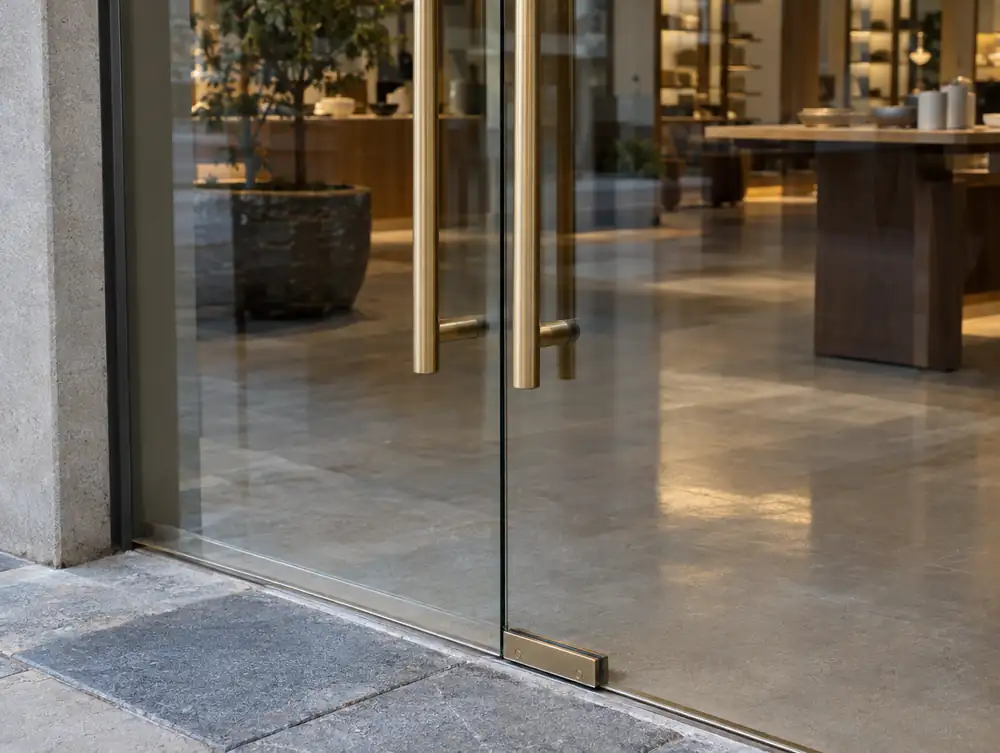
What should you think about before commissioning frameless glass doors in Canary Wharf?
In a parade in Canary Wharf, a frameless door can sit within a framed front without looking out of place. We'd match its head height to the neighbouring transoms and keep the fittings in the frame colour.
A narrow Canary Wharf unit benefits from a door that takes up no visual width. We'd use a single glass leaf hung beside one clear pane, so the entrance and the display read as one view into the shop.
Where a fascia has crept down over the years, lifting it back to its original line can add real height to the glass. Check what sits behind it first at Canary Wharf premises, since a shutter box or old beam may set the limit.
What is a realistic budget for frameless glass doors in Canary Wharf?
The guide for frameless glass doors is £1,495 to £4,495 plus VAT per door set. Expect the lower end for simple work with clear access, and the upper end where detail, finish or awkward conditions add hours.
Who approves frameless glass doors in Canary Wharf?
A true like-for-like replacement usually needs no planning permission in England, because the external appearance isn't materially affected. New materials, a different glass line or altered proportions usually do count as material, so for frameless glass doors at premises in the Canary Wharf area, an application is then likely. The council confirms which side of that line a job falls on.
Canary Wharf applications for planning permission or advertisement consent are normally handled by London Borough of Tower Hamlets. Our survey includes a check of the position for your address.
| Town | Canary Wharf |
|---|---|
| Area | Greater London |
| Postcode districts | E14, E1W, E3, SE16 |
| Planning authority | London Borough of Tower Hamlets |
| Building approval | Building Regulations (Approved Documents) |
| Distance from Great Barr | About 108 miles |
| Survey | Free for new work |
Does London Borough of Tower Hamlets publish shopfront guidance?
Yes, Shopfronts and Roller Shutter Grilles. It tells applicants what the council expects from new and altered shopfronts. A few of the things it asks for:
- Stallrisers are always required on traditional shopfronts.
- Fascias should normally be no more than 500mm deep and no higher than ground floor level.
- External roller shutter boxes will not be permitted, and shutters should wherever possible be an integral feature of the shopfront.
Questions about frameless glass doors in Canary Wharf
Who fits glass doors in Canary Wharf?
Vetted glazing teams working under S&K Glazing fit them, and you have a single named contact. They travel to Canary Wharf from Great Barr.
Can my Canary Wharf premises take a frameless glass door?
Most can, once the floor and opening have been checked. The survey shows whether a floor spring will fit, and if not, a concealed closer in a transom does the same job.
Will a glass door be safe with children around in my Canary Wharf shop?
Toughened glass is strong and breaks into small pieces, so it is a good choice for a family-facing shop. The main risks are finger traps at the hinge side, which careful spring settings and guards can reduce.
Do I need planning permission to change a shopfront in the Canary Wharf area?
Usually yes, if the work materially affects the building's external appearance. England's shop permitted development rights exclude creating, altering or replacing a shopfront, so there is no shortcut. A true like-for-like replacement usually needs no application, and the council confirms the position.
Does a new shopfront in the Canary Wharf area need Building Regulations approval?
Assume yes until building control says otherwise. England has no like-for-like exemption, though registered installers can self-certify replacement windows and doors in non-dwellings. That route doesn't cover structural glass, curtain walling or revolving doors.