If your Canary Wharf building deserves better than the front it has, a recreated period shopfront could be the answer. We work from surviving fabric, old photographs and the proportions of the elevation above.
Measuring the opening is the easy part of a survey in Canary Wharf. We also look at the beam above, the pavement fall and any meters or drains nearby.
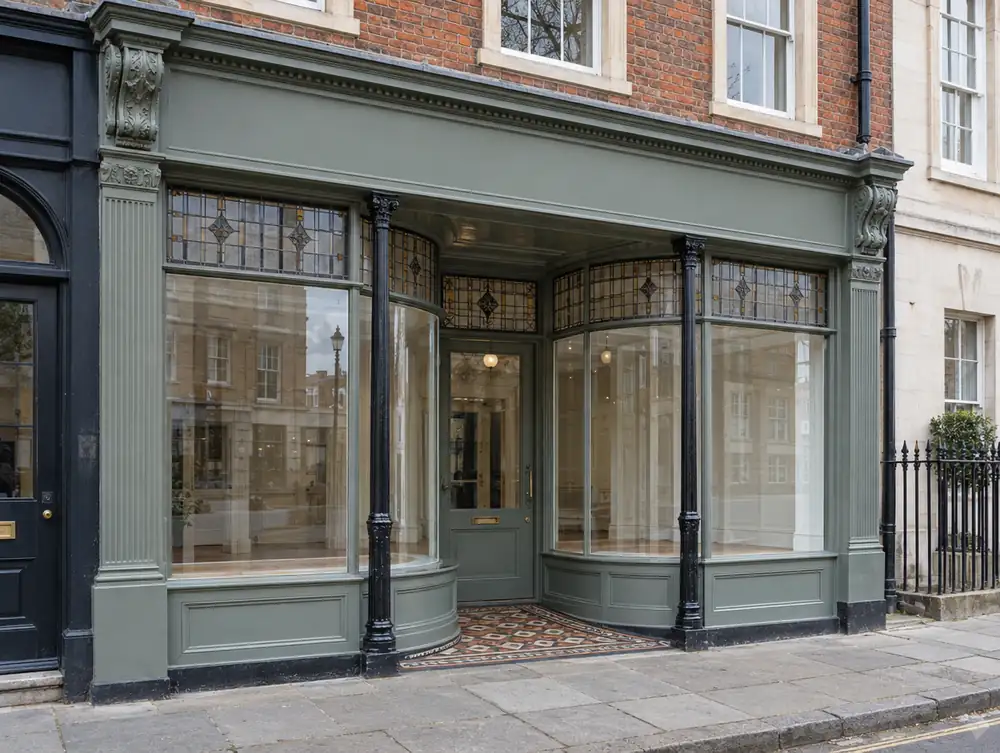
What makes heritage shopfronts work well on Canary Wharf premises?
A brand with a standard front can still take on a period unit. For a branch in Canary Wharf we'd translate its colours and lettering into traditional joinery and sign writing, so the building keeps its character and the name stays recognisable.
A landlord may own the building while you hold the lease, and each can see old fabric differently. For Canary Wharf premises we'd prepare a plain record of what's there and what we propose, so both sides can agree before work starts.
Where the building has good brick or stone around the opening, set the frame back in the reveal so the masonry can be seen. On Canary Wharf premises with a flat elevation, that deep reveal throws a shadow line that adds real depth in low sun.
How much should you set aside for heritage shopfronts in Canary Wharf?
Our guide band is £8,495 to £24,995 plus VAT for a typical frontage. Scope is the biggest lever, so a tighter brief for heritage shopfronts brings the figure down faster than any change of detail.
Could heritage shopfronts in Canary Wharf need planning permission?
Security grilles and shutters are named in England's rules: installing or replacing one on a shopfront sits outside the shop permitted development rights. The frontage itself is treated the same way, so for heritage shopfronts at premises in the Canary Wharf area, building work that materially affects the appearance needs planning permission. Confirm the position with the council before anything is ordered.
Canary Wharf applications for planning permission or advertisement consent are normally handled by London Borough of Tower Hamlets. Our survey includes a check of the position for your address.
| Town | Canary Wharf |
|---|---|
| Area | Greater London |
| Postcode districts | E14, E1W, E3, SE16 |
| Planning authority | London Borough of Tower Hamlets |
| Building approval | Building Regulations (Approved Documents) |
| Distance from Great Barr | About 108 miles |
| Survey | Free for new work |
Does London Borough of Tower Hamlets publish shopfront guidance?
Yes, Shopfronts and Roller Shutter Grilles. It tells applicants what the council expects from new and altered shopfronts. A few of the things it asks for:
- Stallrisers are always required on traditional shopfronts.
- Fascias should normally be no more than 500mm deep and no higher than ground floor level.
- External roller shutter boxes will not be permitted, and shutters should wherever possible be an integral feature of the shopfront.
Questions about heritage shopfronts in Canary Wharf
How much of my Canary Wharf shopfront can be kept?
Usually more than it first appears. Decay tends to stay low on posts and doors, while the upper joinery is often sound and can stay.
Can you find the colour my Canary Wharf shopfront used to be?
Often. Scraping back through the paint layers shows earlier colours, and a specialist can analyse them if the detail matters.
How long will restoration take at my Canary Wharf premises?
New joinery typically takes 8 to 14 weeks to make, then 1 to 3 weeks on site. The survey gives you a realistic programme, because repair-only jobs can take far less.
Does a new shopfront in the Canary Wharf area need Building Regulations approval?
Assume yes until building control says otherwise. England has no like-for-like exemption, though registered installers can self-certify replacement windows and doors in non-dwellings. That route doesn't cover structural glass, curtain walling or revolving doors.
What rules apply to a fire exit door through a shopfront in the Canary Wharf area?
It must open in the direction of escape and can't be locked against immediate use, and a dedicated fire exit can't be a sliding or revolving door. In England that comes from article 14(2) of the Regulatory Reform (Fire Safety) Order 2005, and the duty sits with the responsible person, normally the employer or whoever controls the premises for a business, otherwise the owner. An outward door can clash with section 153 of the Highways Act 1980 where it opens onto the footway, so raise it early.