Thinking about opening up your Stepney frontage? Start with where the stack will sit, because that one decision shapes the panel count, the track and the seating plan behind it.
Please have keys to any meter cupboards and shutter housings to hand when we survey in Stepney, because what sits behind them can change the drawing.
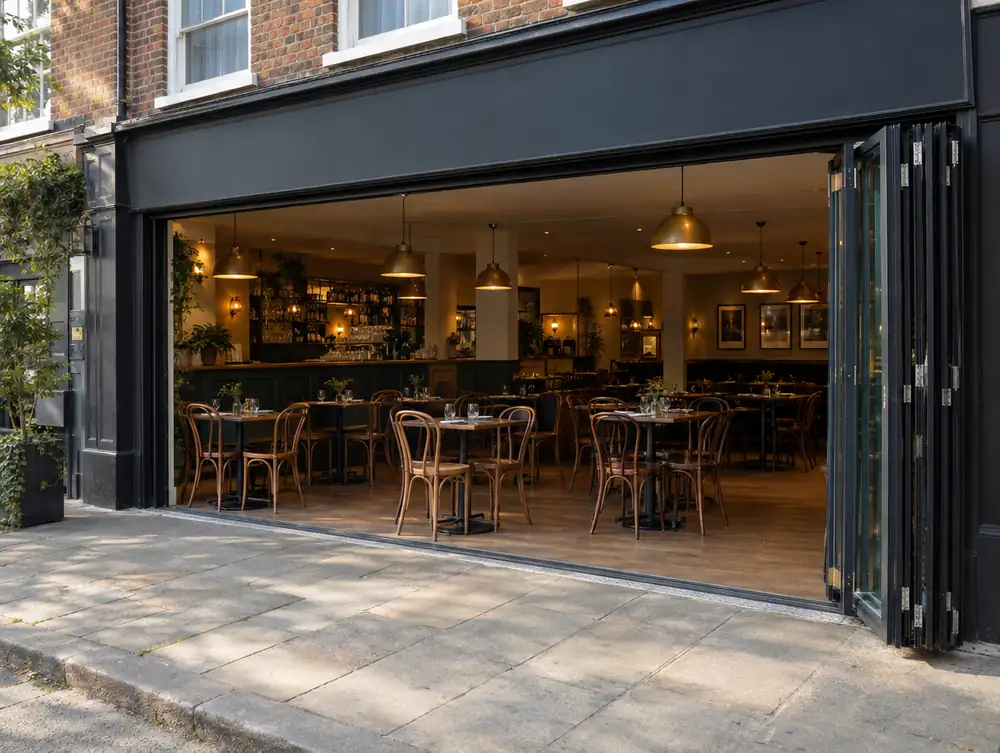
What makes bi-folding shopfronts work well on Stepney premises?
Landlords often worry about what a bi-fold does to the structure and the weather line. For a unit in Stepney we'd prepare a drawing of the head, threshold and reinstatement route, so the conversation is about detail rather than doubt.
If your Stepney frontage faces the sun, a bi-fold doubles as ventilation. We'd pair it with an awning so the room stays usable at midday, and look at solar control glass for the days the set stays closed.
If the pavement falls across your frontage, let the stallriser take up the slope and keep the glass line dead level. The eye reads the long horizontal, so Stepney premises on a slope look settled once that line is true.
Could bi-folding shopfronts in Stepney need planning permission?
Security grilles and shutters are named in England's rules: installing or replacing one on a shopfront sits outside the shop permitted development rights. The frontage itself is treated the same way, so for bi-folding shopfronts at premises in the Stepney area, building work that materially affects the appearance needs planning permission. Confirm the position with the council before anything is ordered.
For Stepney, the usual route for planning and advert applications is through London Borough of Tower Hamlets, and we confirm that when we visit.
How much should you set aside for bi-folding shopfronts in Stepney?
A sensible starting budget is £5,195 to £13,995 plus VAT for a typical opening. What shifts the figure is whatever can't be seen yet, such as the condition behind the old frontage or the services running through it.
| Town | Stepney |
|---|---|
| Area | Greater London |
| Postcode districts | E1, E1W, E2, E3 |
| Planning authority | London Borough of Tower Hamlets |
| Building approval | Building Regulations (Approved Documents) |
| Distance from Great Barr | About 107 miles |
| Survey | Free for new work |
Does London Borough of Tower Hamlets publish shopfront guidance?
Yes, Shopfronts and Roller Shutter Grilles. It tells applicants what the council expects from new and altered shopfronts. A few of the things it asks for:
- Stallrisers are always required on traditional shopfronts.
- Fascias should normally be no more than 500mm deep and no higher than ground floor level.
- External roller shutter boxes will not be permitted, and shutters should wherever possible be an integral feature of the shopfront.
Questions about bi-folding shopfronts in Stepney
How many panels would my Stepney opening need?
It depends on the width and how you want the set to open. Most openings divide into leaves under 1m wide, and an odd number gives you a daily door, so we draw the options after the measure-up.
Will I lose a table to the stack in my Stepney restaurant?
Possibly one, but careful layout usually avoids it. We draw the folded panels on your floor plan, then look at moving the stack to a quieter corner or splitting the set in two.
Can the threshold be level at my Stepney premises?
It can be close to level, depending on the floor and drainage. We'd check the levels at survey, because a track sitting flush with the pavement still needs somewhere for water to go.
Does the Equality Act apply to a shop entrance in the Stepney area?
Yes. The Equality Act 2010 applies in England, as across Great Britain, and it requires reasonable steps to remove, alter or avoid physical features that disadvantage disabled people. The duty is anticipatory, so it looks at disabled people generally, and a new Services Code replaced the 2011 Code on 5 August 2026.
Do I need listed building consent for a shopfront in the Stepney area?
Usually yes, if the building is listed. In England the local planning authority decides, and Historic England is notified of Grade I and II* works and specified Grade II works. Like-for-like repair may not need consent, so ask the council before work starts.