Our quotation for bronze and metal shopfronts in Greater London is written, itemised and valid for 90 days. Nothing is ordered until you accept it, which gives you time to take it to a landlord, a partner or a board.
Daylight is only half the brief for bronze and metal shopfronts, because a frontage keeps working after dark. Think about how the glass, the sign and the view inside will read to someone walking past at six o'clock on a winter evening.
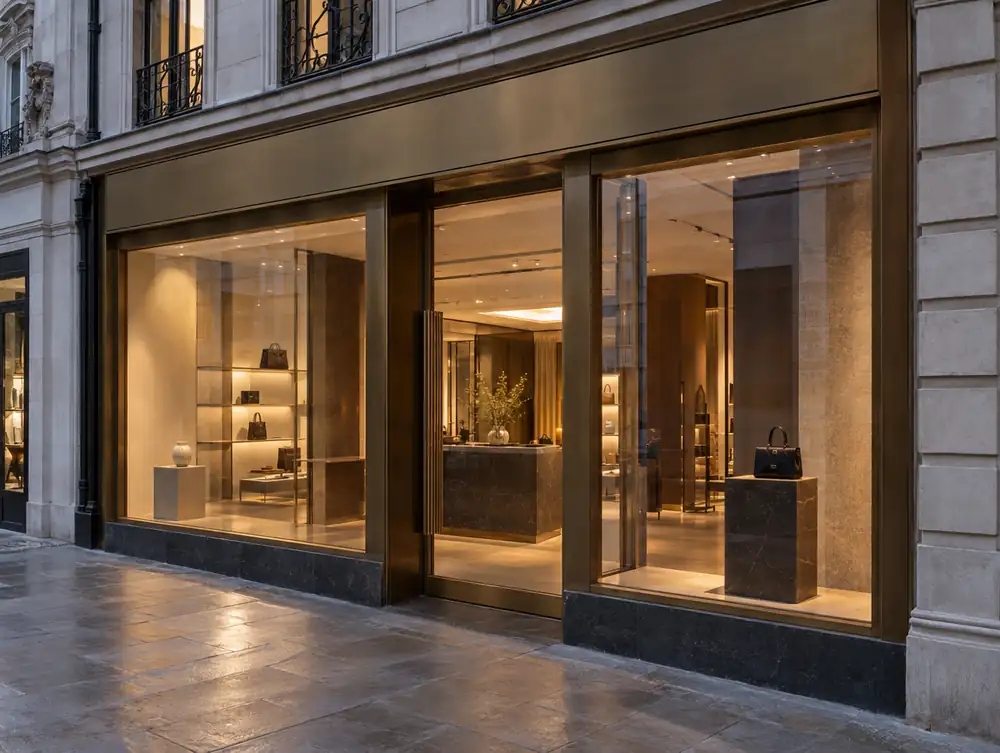
What makes bronze and metal shopfronts work well for premises in Greater London?
Long metal sections are awkward to move. For addresses across Greater London, we decide on joint positions early, because a 4m fascia may need splitting for the route to site, and a hidden joint is far better than a dented panel.
Traffic leaves its mark on metal. For a front on a main road anywhere in Greater London, we'd favour brushed finishes, which hide film and fingerprints far better than a mirror polish.
What consents apply to bronze and metal shopfronts in Greater London?
England has no permitted development route for changing a shopfront. Part 7 Class A of the General Permitted Development Order 2015 excludes creating, altering or replacing one, and it allows no alterations at all on article 2(3) land. That leaves two outcomes for bronze and metal shopfronts at premises in the Greater London area: a planning application, or work that doesn't materially affect the external appearance.
How much do bronze and metal shopfronts cost in Greater London?
Guide price: £7,995 to £24,995 plus VAT for a typical frontage. Materials, finish and the amount of drawing and coordination involved all move it, and your itemised quotation shows where the money goes on bronze and metal shopfronts.
| Area | Greater London |
|---|---|
| Nation | England |
| Towns covered | 235 |
| Main town | Central London |
| Planning regime | England: TCPA 1990 and the 2007 Advertisement Regulations |
| Building approval | Building Regulations (Approved Documents) |
| Survey | Free for new work, from our Great Barr base |
Does Royal Borough of Kensington and Chelsea publish shopfront guidance?
Yes, Shopfront Design Guidelines Supplementary Planning Document (2011). It tells applicants what the council expects from new and altered shopfronts. A few of the things it asks for:
- Stallriser height should not exceed the base of the pilasters, around 450mm, or the fascia depth, whichever is less.
- Box fascias are not to be used, and painted timber is treated as the most appropriate fascia on nineteenth-century buildings.
- External shutters are not acceptable across most of the borough, with internal open-link grilles preferred.
Questions about bronze and metal shopfronts in Greater London
Do you fit bronze and metal shopfronts in Greater London?
Yes. We travel from Great Barr to survey and fit them, and every finish is agreed with you on a sample before anything is made.
Who cleans a bronze shopfront in Greater London?
Your window cleaner can look after the glass, while the metal needs someone briefed on the finish. A short care note and a yearly check keep the two from getting mixed up.
Can you fit a metal front around trading in Greater London?
Yes, closed-day or out-of-hours fitting can be arranged. Metal skins go on last, so the dusty work is finished before any visible finish arrives.
Does the Equality Act apply to a shop entrance in the Greater London area?
Yes. The Equality Act 2010 applies in England, as across Great Britain, and it requires reasonable steps to remove, alter or avoid physical features that disadvantage disabled people. The duty is anticipatory, so it looks at disabled people generally, and a new Services Code replaced the 2011 Code on 5 August 2026.
Does a new shopfront in the Greater London area need Building Regulations approval?
Assume yes until building control says otherwise. England has no like-for-like exemption, though registered installers can self-certify replacement windows and doors in non-dwellings. That route doesn't cover structural glass, curtain walling or revolving doors.