Colour and craft do the work on a timber front in Soho. We test paint on your actual frontage, draw any moulding that matters at full size, and keep every dimension on paper for you to sign off.
Your survey is where the price gets real, because widths, heights, levels and access are all taken on site in Soho.
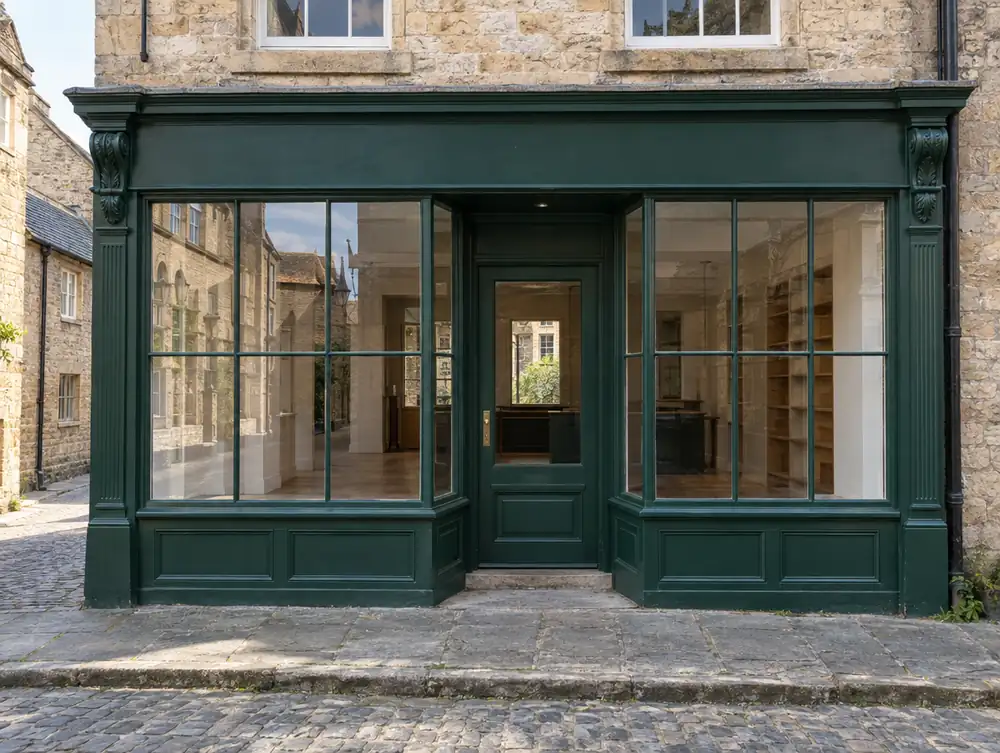
What goes into getting timber shopfronts right in Soho?
A south or west-facing Soho frontage is hard on paint. We'd steer you toward a lighter colour or a more stable timber, and if the brand needs a dark finish, we'd plan a shorter repaint interval from the outset.
In a parade of mixed fronts in Soho, painted timber can lift a unit without shouting. We'd take the height of the neighbouring cills and fascias, then let the depth of the mouldings and a considered colour do the talking.
A corner unit has two fronts to think about, and the return elevation often does as much selling as the main one. If that is your layout in Soho, carry the fascia and glass line round the corner and treat both faces as one composition.
Which applications might timber shopfronts in Soho involve?
A true like-for-like replacement usually needs no planning permission in England, because the external appearance isn't materially affected. New materials, a different glass line or altered proportions usually do count as material, so for timber shopfronts at premises in the Soho area, an application is then likely. The council confirms which side of that line a job falls on.
We confirm the position at survey, because a boundary or a special designation can change who handles the file, but applications from Soho premises normally go to Westminster City Council.
How much could timber shopfronts in Soho cost you?
Guide price: £3,995 to £13,995 plus VAT for a typical frontage. Materials, finish and the amount of drawing and coordination involved all move it, and your itemised quotation shows where the money goes on timber shopfronts.
| Town | Soho |
|---|---|
| Area | Greater London |
| Postcode districts | W1, W1B, W1D, W1F |
| Planning authority | Westminster City Council |
| Building approval | Building Regulations (Approved Documents) |
| Distance from Great Barr | About 104 miles |
| Survey | Free for new work |
Does Westminster City Council publish shopfront guidance?
Yes, Shopfronts, Blinds and Signs - A Guide to their Design (1993). It tells applicants what the council expects from new and altered shopfronts. A few of the things it asks for:
- Roller shutters will not normally be given consent, and internally fitted brick-bond grilles are the preferred solution.
- Large internally lit box signs are generally inappropriate, while externally lit fascias and back-lit or halo-lit letters are accepted.
- Projecting signs need at least 2.6m clearance above the pavement and should sit at fascia level, centred on a pilaster.
Questions about timber shopfronts in Soho
What should I budget for looking after a timber front in Soho?
A repaint every 5 to 7 years, plus a yearly wash and touch-up of the cills. Door gear needs checking too, since seasonal movement can throw a door out of line.
Can a timber front take a modern sign in Soho?
Yes. Hand-painted letters suit a timber fascia well, and raised letters or a concealed trough light work too. We draw the sign and the joinery together, so the fixings don't cut through a moulding.
Do you make the joinery for Soho shops to order?
Yes. Every length is made to the signed-off drawings for your opening, then brought to Soho from Great Barr by vetted teams working under S&K Glazing.
Do I need listed building consent for a shopfront in the Soho area?
Usually yes, if the building is listed. In England the local planning authority decides, and Historic England is notified of Grade I and II* works and specified Grade II works. Like-for-like repair may not need consent, so ask the council before work starts.
Do roller shutters need planning permission in the Soho area?
Usually yes. Installing or replacing a security grill or shutter on a shopfront is expressly outside England's shop permitted development rights, so the only way to avoid an application is work that doesn't materially affect the appearance. Ask the council before ordering.