Survey, supply and set-up of automatic sliding doors for Soho premises all run under one contract, arranged from Great Barr. The usual pattern is 3 to 6 weeks to order after sign-off, then typically 1 to 3 days on site.
Your survey is where the price gets real, because widths, heights, levels and access are all taken on site in Soho.
Where should you begin with automatic sliding doors in Soho?
If your Soho entrance catches low sun, infrared sensors can misread the light on the floor. We'd favour radar with a presence sensor set for those conditions, and consider solar control glass in the leaves.
Automatic doors suit a night fit in Soho, because most of the work is at the head and the opening stays usable in stages. We'd fit the track and leaves out of hours, then commission the door before you open.
If your Soho unit is narrow, a central door can split a small window into two weak ones. Moving the door to one side gives you a single confident pane, provided the layout inside still works.
What sign-off might you need for automatic sliding doors in Soho?
Security grilles and shutters are named in England's rules: installing or replacing one on a shopfront sits outside the shop permitted development rights. The frontage itself is treated the same way, so for automatic sliding doors at premises in the Soho area, building work that materially affects the appearance needs planning permission. Confirm the position with the council before anything is ordered.
We confirm the position at survey, because a boundary or a special designation can change who handles the file, but applications from Soho premises normally go to Westminster City Council.
What price should you expect for automatic sliding doors in Soho?
Guide price: £3,895 to £11,995 plus VAT per entrance. Materials, finish and the amount of drawing and coordination involved all move it, and your itemised quotation shows where the money goes on automatic sliding doors.
| Town | Soho |
|---|---|
| Area | Greater London |
| Postcode districts | W1, W1B, W1D, W1F |
| Planning authority | Westminster City Council |
| Building approval | Building Regulations (Approved Documents) |
| Distance from Great Barr | About 104 miles |
| Survey | Free for new work |
Does Westminster City Council publish shopfront guidance?
Yes, Shopfronts, Blinds and Signs - A Guide to their Design (1993). It tells applicants what the council expects from new and altered shopfronts. A few of the things it asks for:
- Roller shutters will not normally be given consent, and internally fitted brick-bond grilles are the preferred solution.
- Large internally lit box signs are generally inappropriate, while externally lit fascias and back-lit or halo-lit letters are accepted.
- Projecting signs need at least 2.6m clearance above the pavement and should sit at fascia level, centred on a pilaster.
Questions about automatic sliding doors in Soho
What will people on the street see at my Soho entrance?
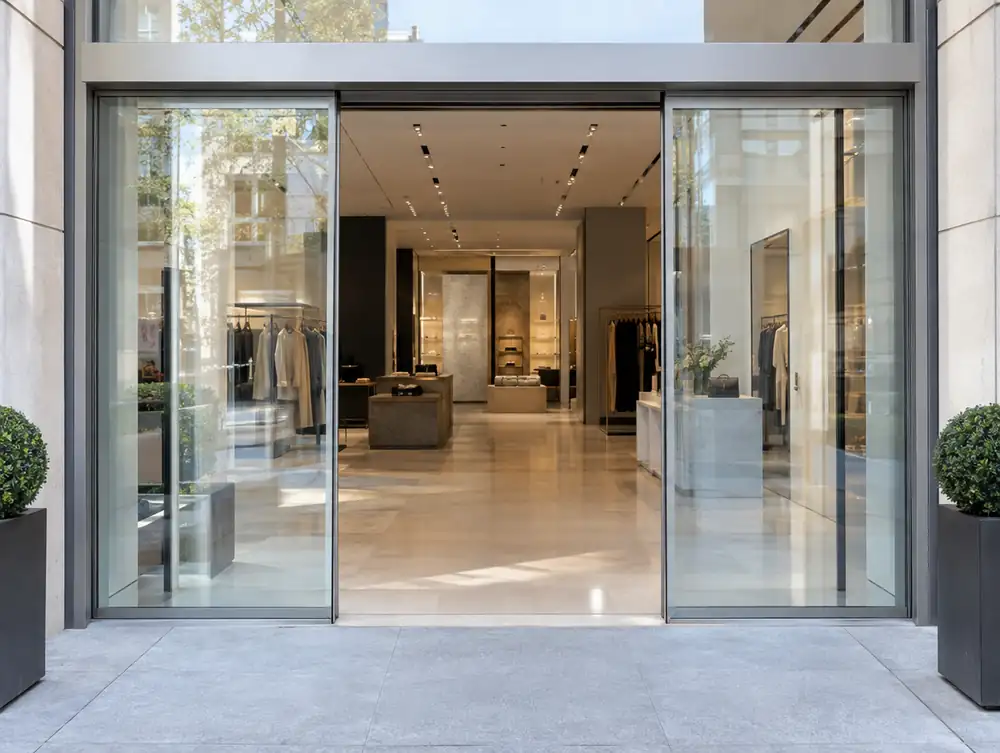
Ideally, very little. The drive sits behind the fascia, the leaves line up with the screens beside them, and the frame colour matches the rest of your front.
Who installs automatic doors in Soho?
Vetted door teams working under S&K Glazing handle the fit and set-up, travelling from Great Barr. Your agreement is with S&K Glazing Limited, and one person stays your point of call.
Will an automatic door fit my Soho shop?
It depends on the width of the front and the depth at the head. A survey shows whether the parked leaves fit and where the operator can hide, and if a slider won't work we'd look at a powered swing door.
Does a new shopfront in the Soho area need Building Regulations approval?
Assume yes until building control says otherwise. England has no like-for-like exemption, though registered installers can self-certify replacement windows and doors in non-dwellings. That route doesn't cover structural glass, curtain walling or revolving doors.
Does the Equality Act apply to a shop entrance in the Soho area?
Yes. The Equality Act 2010 applies in England, as across Great Britain, and it requires reasonable steps to remove, alter or avoid physical features that disadvantage disabled people. The duty is anticipatory, so it looks at disabled people generally, and a new Services Code replaced the 2011 Code on 5 August 2026.