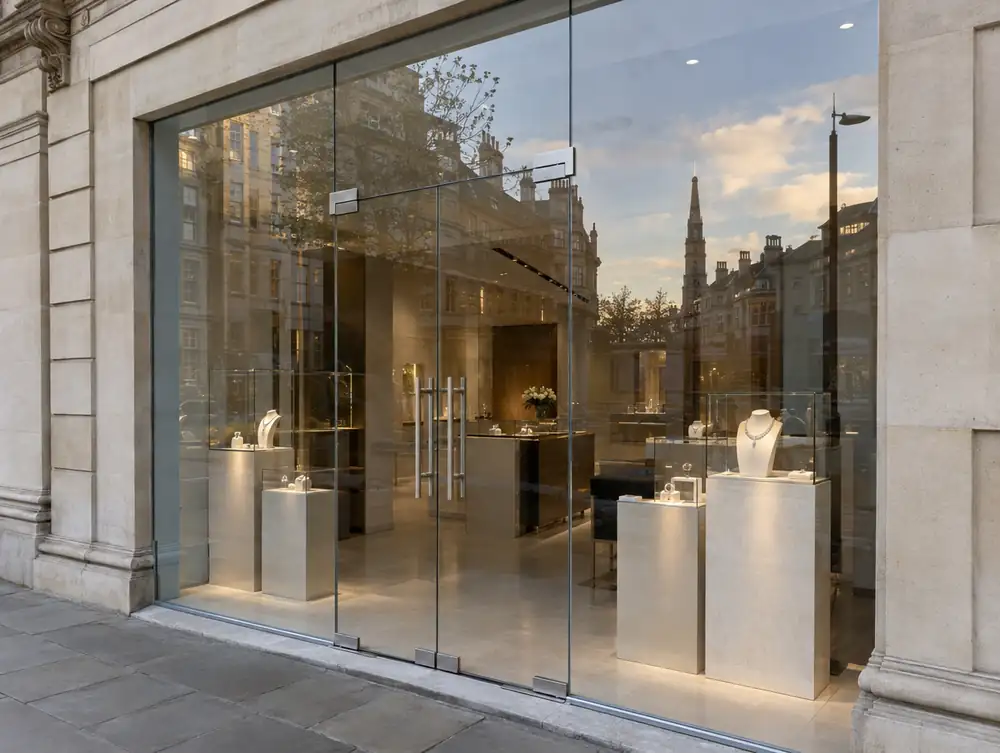
For brands that want the shop floor visible from the pavement, a frameless front in Soho is the natural answer. We set the panes to the rhythm of the building, so the glass keeps its order and scale.
A survey in Soho usually starts outside, looking at the whole elevation before any tape comes out, because the frontage has to answer the building above it.
Where should you begin with frameless glass shopfronts in Soho?
Between two framed neighbours in a parade in Soho, a frameless front can look brilliant or bare. We'd hold the neighbouring fascia line and keep a slim plinth at their stallriser height, so the glass feels deliberate and the row still reads as a row.
In a narrow Soho unit every millimetre of frame counts, so frameless glass helps. We'd run one clear pane beside a single glass door with both sharing the same head line, and let the full depth of the shop draw people in.
If you trade after dark in Soho, the view in matters more than the sign. A warm, evenly lit interior with light on the back wall will usually do more than a brighter fascia, because it gives the eye somewhere to go.
What sign-off might you need for frameless glass shopfronts in Soho?
Security grilles and shutters are named in England's rules: installing or replacing one on a shopfront sits outside the shop permitted development rights. The frontage itself is treated the same way, so for frameless glass shopfronts at premises in the Soho area, building work that materially affects the appearance needs planning permission. Confirm the position with the council before anything is ordered.
Expect planning and advert applications here to go to Westminster City Council in the normal way. We check what that means for your building when we survey it in Soho.
What price should you expect for frameless glass shopfronts in Soho?
We would budget £4,995 to £15,995 plus VAT for a typical frontage. Scope sets most of the figure, so a clear brief at the start does more for the budget than any later change of detail.
| Town | Soho |
|---|---|
| Area | Greater London |
| Postcode districts | W1, W1B, W1D, W1F |
| Planning authority | Westminster City Council |
| Building approval | Building Regulations (Approved Documents) |
| Distance from Great Barr | About 104 miles |
| Survey | Free for new work |
Does Westminster City Council publish shopfront guidance?
Yes, Shopfronts, Blinds and Signs - A Guide to their Design (1993). It tells applicants what the council expects from new and altered shopfronts. A few of the things it asks for:
- Roller shutters will not normally be given consent, and internally fitted brick-bond grilles are the preferred solution.
- Large internally lit box signs are generally inappropriate, while externally lit fascias and back-lit or halo-lit letters are accepted.
- Projecting signs need at least 2.6m clearance above the pavement and should sit at fascia level, centred on a pilaster.
Questions about frameless glass shopfronts in Soho
How much of my Soho shop will people see from the pavement?
All of it, which is both the point and the risk. Shelving backs, till positions and ceiling services become part of the front once the frames have gone, so we'd plan that view with you.
How much cleaning will a glass front in Soho need?
More than a framed front, because glass shows every mark. A regular window cleaner using soft tools can handle it, and a yearly look at the silicone keeps the joints tidy.
Will a frameless front suit my Soho premises?
It depends on the structure overhead and the floor at the threshold. A survey tells us whether the head is stiff enough and whether a channel can be cut, and if not, we'd suggest slim framing at the edges instead.
Does the Equality Act apply to a shop entrance in the Soho area?
Yes. The Equality Act 2010 applies in England, as across Great Britain, and it requires reasonable steps to remove, alter or avoid physical features that disadvantage disabled people. The duty is anticipatory, so it looks at disabled people generally, and a new Services Code replaced the 2011 Code on 5 August 2026.
What rules apply to a fire exit door through a shopfront in the Soho area?
It must open in the direction of escape and can't be locked against immediate use, and a dedicated fire exit can't be a sliding or revolving door. In England that comes from article 14(2) of the Regulatory Reform (Fire Safety) Order 2005, and the duty sits with the responsible person, normally the employer or whoever controls the premises for a business, otherwise the owner. An outward door can clash with section 153 of the Highways Act 1980 where it opens onto the footway, so raise it early.