We travel from Great Barr to design and fit frameless glass shopfronts for Mayfair premises. One named contact runs the job from first measure to final clean.
Expect us to measure the opening, photograph the existing front and check how materials will reach it on the day, at a time you have agreed.
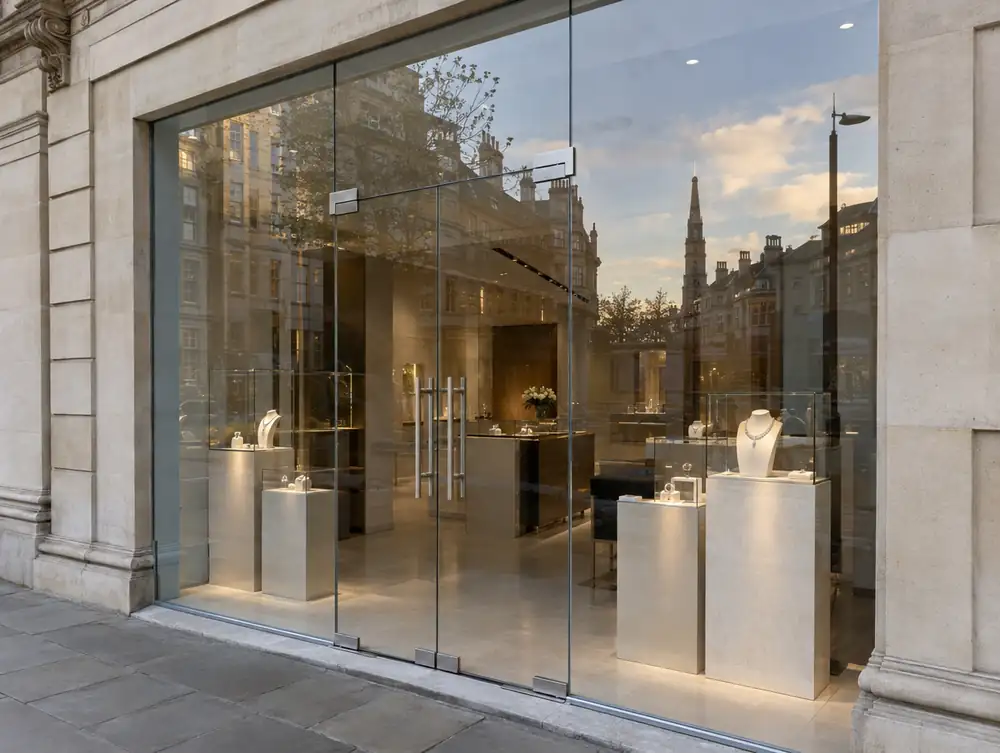
How would we approach frameless glass shopfronts for your Mayfair premises?
On a south or west-facing Mayfair frontage, a wall of clear glass will warm the shop and fade stock. We'd look at solar control coatings, blinds hidden in a ceiling slot or a retractable awning, and weigh up any loss of clarity with you.
A corner unit is where frameless glass earns its price, because a glass-to-glass corner dissolves the edge of the building. For a corner plot in Mayfair we'd check the structure above the missing pier first, then mitre the glass so the joint stays as fine as the panes allow.
If there are storeys above the shop, the frontage should feel like the base of the building and not a sign stuck on it. Lining up mullions with the windows overhead is a small move that settles the whole elevation at Mayfair premises.
What consents could affect frameless glass shopfronts in Mayfair?
For frameless glass shopfronts at premises in the Mayfair area, the deciding question in England is whether the building work materially affects the external appearance. If it does, planning permission is needed, while a true like-for-like replacement usually needs none. The council confirms the position for each site.
Planning and advert applications for Mayfair premises normally go to Westminster City Council. We check the position for your address at survey.
What should you budget for frameless glass shopfronts in Mayfair?
Allow £4,995 to £15,995 plus VAT for a typical frontage. Size and specification set most of that figure for frameless glass shopfronts, and the rest depends on what the survey finds on site.
| Town | Mayfair |
|---|---|
| Area | Greater London |
| Postcode districts | W1 |
| Planning authority | Westminster City Council |
| Building approval | Building Regulations (Approved Documents) |
| Distance from Great Barr | About 104 miles |
| Survey | Free for new work |
Does Westminster City Council publish shopfront guidance?
Yes, Shopfronts, Blinds and Signs - A Guide to their Design (1993). It tells applicants what the council expects from new and altered shopfronts. A few of the things it asks for:
- Roller shutters will not normally be given consent, and internally fitted brick-bond grilles are the preferred solution.
- Large internally lit box signs are generally inappropriate, while externally lit fascias and back-lit or halo-lit letters are accepted.
- Projecting signs need at least 2.6m clearance above the pavement and should sit at fascia level, centred on a pilaster.
Questions about frameless glass shopfronts in Mayfair
How much cleaning will a glass front in Mayfair need?
More than a framed front, because glass shows every mark. A regular window cleaner using soft tools can handle it, and a yearly look at the silicone keeps the joints tidy.
Can frameless glass go above a cellar in Mayfair?
Often, yes, with some redesign. A cellar or thin slab can rule out a recessed channel, so we'd clamp the glass to a strengthened threshold or add a low plinth to hold it.
How do you stop people walking into the glass at my Mayfair shop?
Markings on the glass are designed as part of the front. We can turn them into a pattern, logo or frosted band that suits your brand, placed where the eye naturally catches them.
Does a new shopfront in the Mayfair area need Building Regulations approval?
Assume yes until building control says otherwise. England has no like-for-like exemption, though registered installers can self-certify replacement windows and doors in non-dwellings. That route doesn't cover structural glass, curtain walling or revolving doors.
Does the Equality Act apply to a shop entrance in the Mayfair area?
Yes. The Equality Act 2010 applies in England, as across Great Britain, and it requires reasonable steps to remove, alter or avoid physical features that disadvantage disabled people. The duty is anticipatory, so it looks at disabled people generally, and a new Services Code replaced the 2011 Code on 5 August 2026.