One contract covers the paint, glass, sign and door work on refurbishments across West End and Greater London. That saves you chasing separate trades for a job that has to look like one piece.
Surveys for West End are booked with you directly. Tell us your quieter days and we'll work around them.
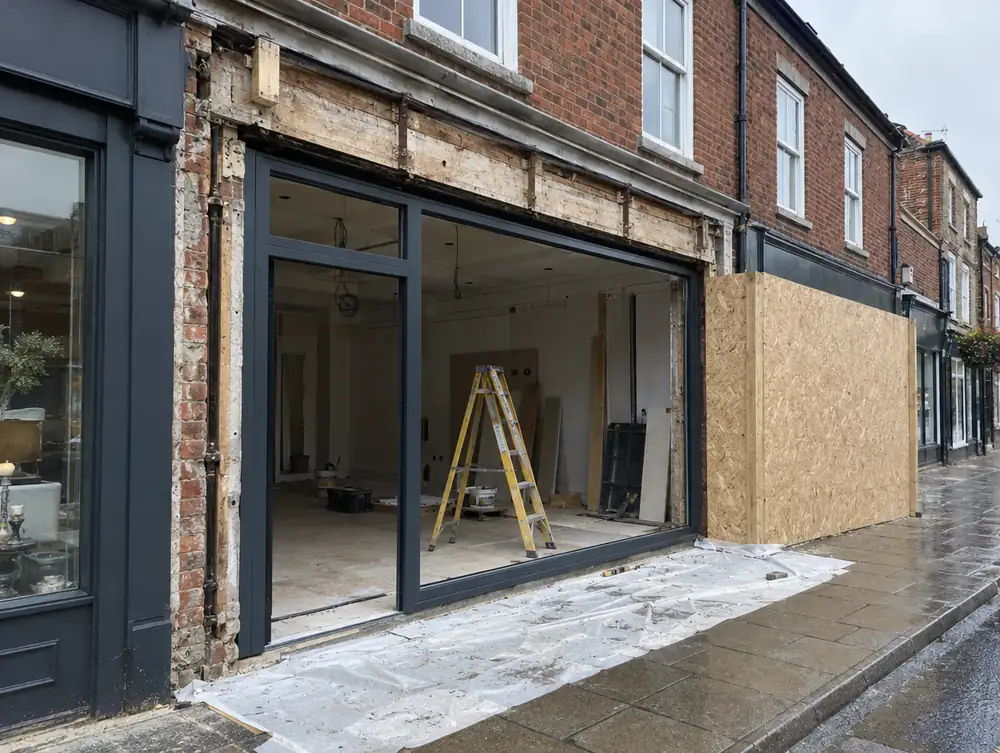
How do you design around the building when planning shopfront refurbishment in West End?
If later panels cover the original fascia, we lift a corner at survey. Surviving cornices, pilasters or tile can change the whole plan, and they cost nothing to keep.
If the glass is old, we look for the etched safety mark in the corner of each pane. Panes without one, in the door or at low level, should be replaced while the frontage is being worked on.
Where a fascia has crept down over the years, lifting it back to its original line can add real height to the glass. Check what sits behind it first at West End premises, since a shutter box or old beam may set the limit.
What might shopfront refurbishment cost in West End?
Guide price: £1,995 to £8,995 plus VAT depending on what is kept. Materials, finish and the amount of drawing and coordination involved all move it, and your itemised quotation shows where the money goes on shopfront refurbishment.
What permissions should you check for shopfront refurbishment in West End?
Security grilles and shutters are named in England's rules: installing or replacing one on a shopfront sits outside the shop permitted development rights. The frontage itself is treated the same way, so for shopfront refurbishment at premises in the West End area, building work that materially affects the appearance needs planning permission. Confirm the position with the council before anything is ordered.
We confirm the position at survey, because a boundary or a special designation can change who handles the file, but applications from West End premises normally go to Westminster City Council.
| Town | West End |
|---|---|
| Area | Greater London |
| Postcode districts | W1C, W1H, W1K, W1U |
| Planning authority | Westminster City Council |
| Building approval | Building Regulations (Approved Documents) |
| Distance from Great Barr | About 103 miles |
| Survey | Free for new work |
Does Westminster City Council publish shopfront guidance?
Yes, Shopfronts, Blinds and Signs - A Guide to their Design (1993). It tells applicants what the council expects from new and altered shopfronts. A few of the things it asks for:
- Roller shutters will not normally be given consent, and internally fitted brick-bond grilles are the preferred solution.
- Large internally lit box signs are generally inappropriate, while externally lit fascias and back-lit or halo-lit letters are accepted.
- Projecting signs need at least 2.6m clearance above the pavement and should sit at fascia level, centred on a pilaster.
Questions about shopfront refurbishment in West End
Can my West End shopfront be refurbished without closing?
Usually, yes. Work is split into stages around your trading hours, and closed-day or out-of-hours work can be arranged for anything that affects the door.
Can you repair a timber shopfront in West End?
Yes. Decayed sections are cut out and spliced with new hardwood, then primed and painted. That keeps the joinery you have, and it usually costs far less than making a new frontage.
Can you refurbish just the sign and door on my West End frontage?
Yes. A new sign and door gear can make a big difference on their own. We would look at how they sit with the frame and suggest a colour to tie them together.
Does the Equality Act apply to a shop entrance in the West End area?
Yes. The Equality Act 2010 applies in England, as across Great Britain, and it requires reasonable steps to remove, alter or avoid physical features that disadvantage disabled people. The duty is anticipatory, so it looks at disabled people generally, and a new Services Code replaced the 2011 Code on 5 August 2026.
Does a new shopfront in the West End area need Building Regulations approval?
Assume yes until building control says otherwise. England has no like-for-like exemption, though registered installers can self-certify replacement windows and doors in non-dwellings. That route doesn't cover structural glass, curtain walling or revolving doors.