Many tired frontages are closer to good than they look. On Fitzrovia premises a new sign, fresh colour and better glass can do most of the work of a full replacement.
Expect us to measure the opening, photograph the existing front and check how materials will reach it on the day, at a time you have agreed.
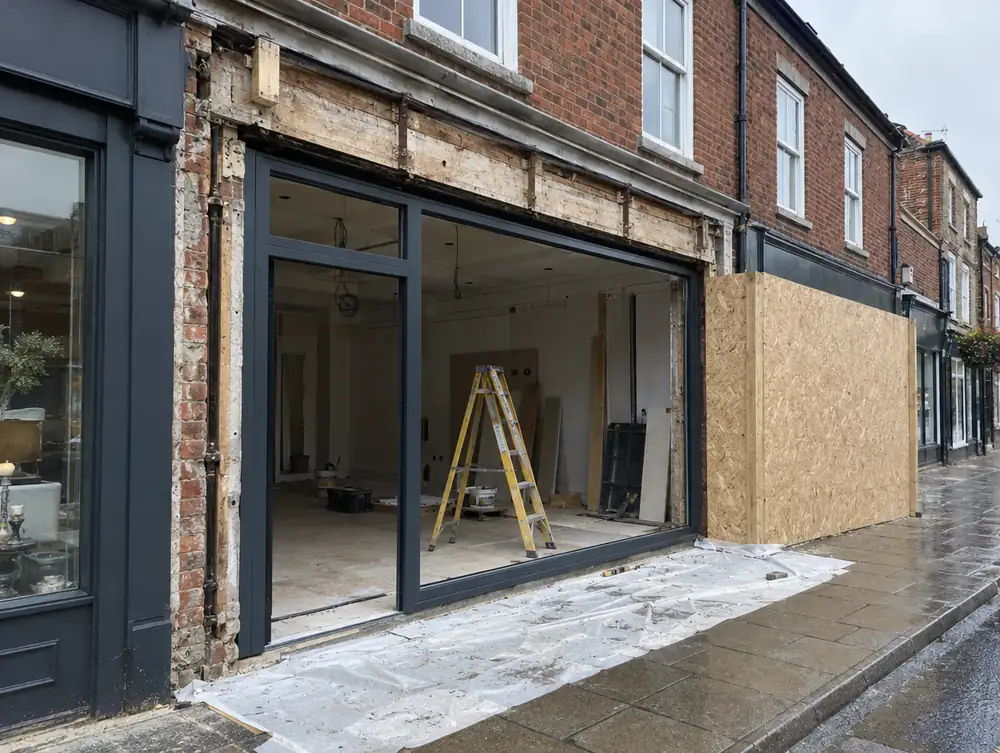
What makes shopfront refurbishment work well on Fitzrovia premises?
If the glass is old, we look for the etched safety mark in the corner of each pane. Panes without one, in the door or at low level, should be replaced while the frontage is being worked on.
If your Fitzrovia premises need to stay open, we split the work into short stages. One bay at a time keeps the door in use, with out-of-hours work for anything noisy.
Where the footway outside your Fitzrovia premises is narrow, a recessed entrance earns its keep. It gives people a dry place to pause out of the walkway, and it adds a longer run of display glass either side of the door.
Could shopfront refurbishment in Fitzrovia need planning permission?
England has no permitted development route for changing a shopfront. Part 7 Class A of the General Permitted Development Order 2015 excludes creating, altering or replacing one, and it allows no alterations at all on article 2(3) land. That leaves two outcomes for shopfront refurbishment at premises in the Fitzrovia area: a planning application, or work that doesn't materially affect the external appearance.
Planning and advert applications for Fitzrovia premises normally go to London Borough of Camden. We check the position for your address at survey.
How much should you set aside for shopfront refurbishment in Fitzrovia?
Allow £1,995 to £8,995 plus VAT depending on what is kept. Size and specification set most of that figure for shopfront refurbishment, and the rest depends on what the survey finds on site.
| Town | Fitzrovia |
|---|---|
| Area | Greater London |
| Postcode districts | W1 |
| Planning authority | London Borough of Camden |
| Building approval | Building Regulations (Approved Documents) |
| Distance from Great Barr | About 104 miles |
| Survey | Free for new work |
Does London Borough of Camden publish shopfront guidance?
Yes, Camden Planning Guidance: Design (Chapter 6: Shopfronts) (2021). It tells applicants what the council expects from new and altered shopfronts. A few of the things it asks for:
- Existing stall risers should be kept, and new ones should be at least 300mm high or reach the top of the pilaster base or door panel.
- Solid shutters are only acceptable in exceptional circumstances, and internal security measures are strongly encouraged.
- Uncoated shutters, galvanised steel, milled finishes and anodised aluminium are not acceptable finishes.
Questions about shopfront refurbishment in Fitzrovia
Can my Fitzrovia shopfront be refurbished without closing?
Usually, yes. Work is split into stages around your trading hours, and closed-day or out-of-hours work can be arranged for anything that affects the door.
Will the work match my other premises in Greater London?
Yes, if you can share colour references and sign files from an existing site. We match finishes as closely as the frame allows, and we show you a sample first.
Is it worth refurbishing an old aluminium shopfront in Fitzrovia?
Often, yes, if the frame is straight and the corners are tight. Recoating, new gaskets and better glass can add years of life. If the frame is corroded or the door has worn out its fixings, replacement may make more sense.
Does a new shopfront in the Fitzrovia area need Building Regulations approval?
Assume yes until building control says otherwise. England has no like-for-like exemption, though registered installers can self-certify replacement windows and doors in non-dwellings. That route doesn't cover structural glass, curtain walling or revolving doors.
Does the Equality Act apply to a shop entrance in the Fitzrovia area?
Yes. The Equality Act 2010 applies in England, as across Great Britain, and it requires reasonable steps to remove, alter or avoid physical features that disadvantage disabled people. The duty is anticipatory, so it looks at disabled people generally, and a new Services Code replaced the 2011 Code on 5 August 2026.