Across Greater London, timber is the material we suggest when a building has proportions worth respecting. For Pimlico premises, we set the stallriser, pilasters and fascia from the elevation above, then detail the joinery to match.
A survey in Pimlico usually starts outside, looking at the whole elevation before any tape comes out, because the frontage has to answer the building above it.
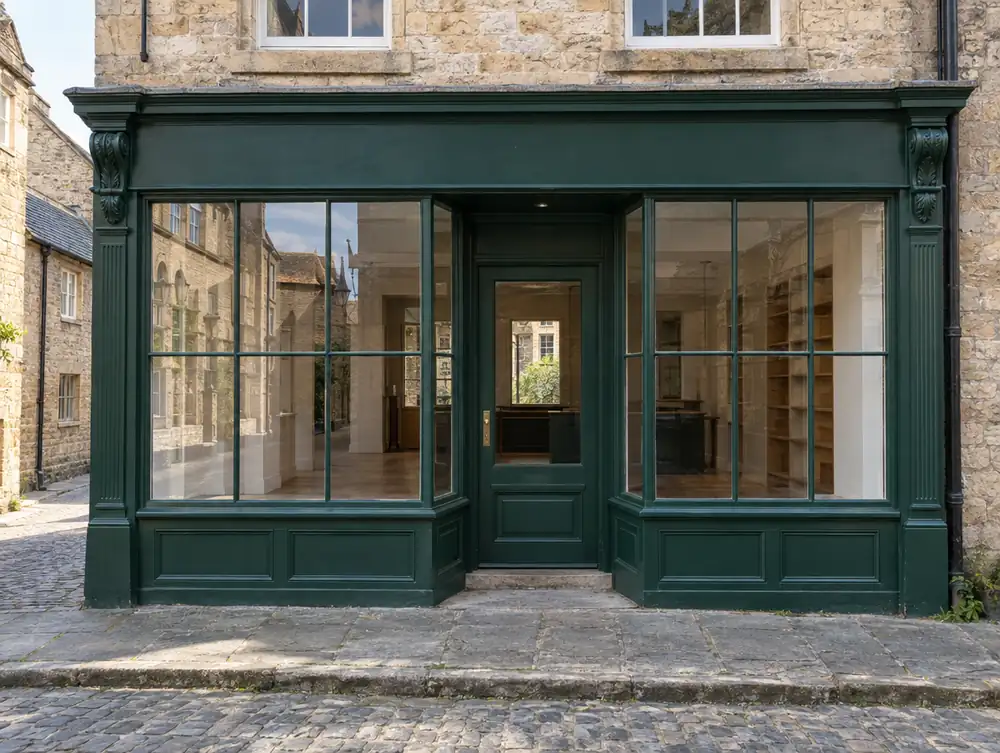
Where should you begin with timber shopfronts in Pimlico?
Where a landlord in Pimlico has set rules for materials or colour, timber is usually an easy conversation. We'd prepare a drawing and paint reference for approval, and adjust the mouldings if the terms ask for something plainer.
A corner plot gives a timber front two faces and one chance to get the turn right. For Pimlico premises on a corner, we'd use a pilaster or a canted bay at the angle, so the cornice wraps round without a clumsy mitre.
Where units share one long run of fascia, breaking the height makes you stand out for the wrong reason. If that describes your Pimlico parade, keep the line and win attention with lettering, lighting and what's in the window.
What sign-off might you need for timber shopfronts in Pimlico?
England has no permitted development route for changing a shopfront. Part 7 Class A of the General Permitted Development Order 2015 excludes creating, altering or replacing one, and it allows no alterations at all on article 2(3) land. That leaves two outcomes for timber shopfronts at premises in the Pimlico area: a planning application, or work that doesn't materially affect the external appearance.
Expect planning and advert applications here to go to Westminster City Council in the normal way. We check what that means for your building when we survey it in Pimlico.
What price should you expect for timber shopfronts in Pimlico?
As a working budget, use £3,995 to £13,995 plus VAT for a typical frontage. Your place inside that range for timber shopfronts depends mostly on how much of the existing frontage can stay and how much has to be put right first.
| Town | Pimlico |
|---|---|
| Area | Greater London |
| Postcode districts | SW1, SW1P, SW1V, SW1W |
| Planning authority | Westminster City Council |
| Building approval | Building Regulations (Approved Documents) |
| Distance from Great Barr | About 105 miles |
| Survey | Free for new work |
Does Westminster City Council publish shopfront guidance?
Yes, Shopfronts, Blinds and Signs - A Guide to their Design (1993). It tells applicants what the council expects from new and altered shopfronts. A few of the things it asks for:
- Roller shutters will not normally be given consent, and internally fitted brick-bond grilles are the preferred solution.
- Large internally lit box signs are generally inappropriate, while externally lit fascias and back-lit or halo-lit letters are accepted.
- Projecting signs need at least 2.6m clearance above the pavement and should sit at fascia level, centred on a pilaster.
Questions about timber shopfronts in Pimlico
Is timber a sensible choice for my Pimlico frontage?
Usually, if you're happy with a repaint every 5 to 7 years. A survey shows how exposed the front is and whether the structure behind it is sound, and we'll tell you if aluminium would serve you better.
Will timber suffer on my Pimlico frontage if it gets a lot of rain?
Not if the details are right. Sloped cills, sealed end grain and plinth blocks keep water moving, and the paint system then only has to deal with the weather, not trapped damp.
What should I budget for looking after a timber front in Pimlico?
A repaint every 5 to 7 years, plus a yearly wash and touch-up of the cills. Door gear needs checking too, since seasonal movement can throw a door out of line.
Do I need listed building consent for a shopfront in the Pimlico area?
Usually yes, if the building is listed. In England the local planning authority decides, and Historic England is notified of Grade I and II* works and specified Grade II works. Like-for-like repair may not need consent, so ask the council before work starts.
What rules apply to a fire exit door through a shopfront in the Pimlico area?
It must open in the direction of escape and can't be locked against immediate use, and a dedicated fire exit can't be a sliding or revolving door. In England that comes from article 14(2) of the Regulatory Reform (Fire Safety) Order 2005, and the duty sits with the responsible person, normally the employer or whoever controls the premises for a business, otherwise the owner. An outward door can clash with section 153 of the Highways Act 1980 where it opens onto the footway, so raise it early.