Does your Pimlico shop need a hands-free entrance? A well-set sliding door gives customers, pushchairs and wheelchairs a clear way in, without anything swinging into the street.
Your survey is where the price gets real, because widths, heights, levels and access are all taken on site in Pimlico.
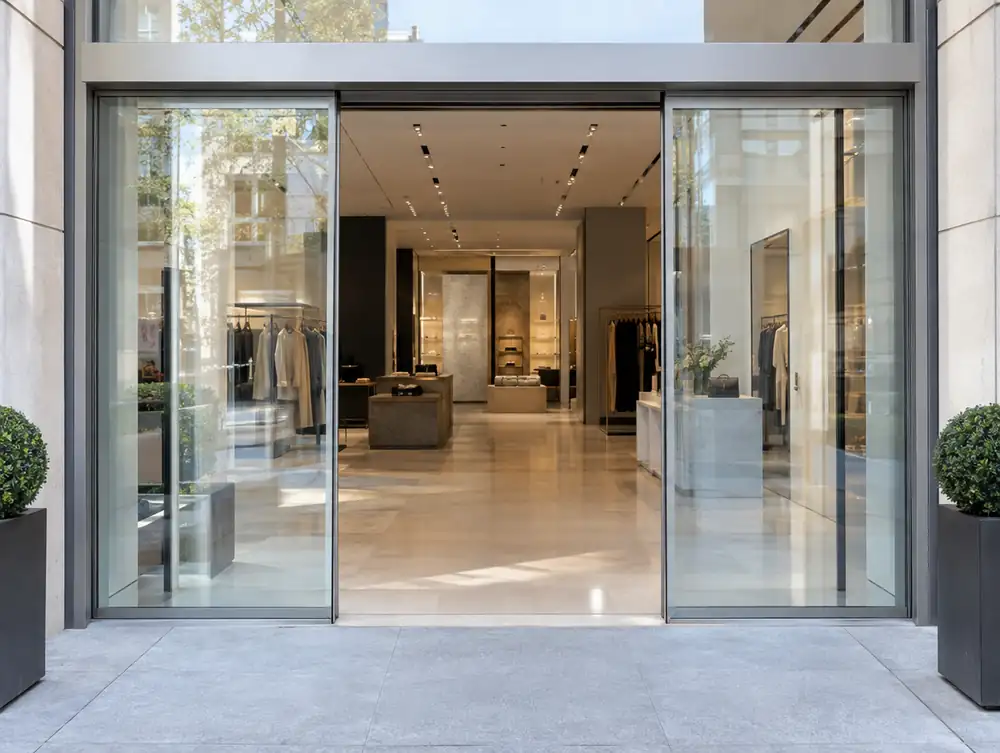
How do you design around the building when planning automatic sliding doors in Pimlico?
Automatic doors suit a night fit in Pimlico, because most of the work is at the head and the opening stays usable in stages. We'd fit the track and leaves out of hours, then commission the door before you open.
A corner unit in Pimlico can often move its entrance to the angle, where two directions of footfall meet. We'd look at a curved or canted door set, and check the wind on both streets before fixing the position.
If there are storeys above the shop, the frontage should feel like the base of the building and not a sign stuck on it. Lining up mullions with the windows overhead is a small move that settles the whole elevation at Pimlico premises.
What might automatic sliding doors cost in Pimlico?
Guide price: £3,895 to £11,995 plus VAT per entrance. Materials, finish and the amount of drawing and coordination involved all move it, and your itemised quotation shows where the money goes on automatic sliding doors.
What permissions should you check for automatic sliding doors in Pimlico?
England has no permitted development route for changing a shopfront. Part 7 Class A of the General Permitted Development Order 2015 excludes creating, altering or replacing one, and it allows no alterations at all on article 2(3) land. That leaves two outcomes for automatic sliding doors at premises in the Pimlico area: a planning application, or work that doesn't materially affect the external appearance.
Pimlico applications for planning permission or advertisement consent are normally handled by Westminster City Council. Our survey includes a check of the position for your address.
| Town | Pimlico |
|---|---|
| Area | Greater London |
| Postcode districts | SW1, SW1P, SW1V, SW1W |
| Planning authority | Westminster City Council |
| Building approval | Building Regulations (Approved Documents) |
| Distance from Great Barr | About 105 miles |
| Survey | Free for new work |
Does Westminster City Council publish shopfront guidance?
Yes, Shopfronts, Blinds and Signs - A Guide to their Design (1993). It tells applicants what the council expects from new and altered shopfronts. A few of the things it asks for:
- Roller shutters will not normally be given consent, and internally fitted brick-bond grilles are the preferred solution.
- Large internally lit box signs are generally inappropriate, while externally lit fascias and back-lit or halo-lit letters are accepted.
- Projecting signs need at least 2.6m clearance above the pavement and should sit at fascia level, centred on a pilaster.
Questions about automatic sliding doors in Pimlico
Can an automatic door work with my Pimlico shop's alarm and locks?
Yes. The door can lock at closing, and it can link to your alarm or access control where the systems allow, with a manual key position as a fallback.
How noisy would an automatic door be at my Pimlico shop?
A healthy door is very quiet, and you'd normally hear only a soft hum. Noise usually means worn rollers or grit in the guide, which a service will put right.
What will people on the street see at my Pimlico entrance?
Ideally, very little. The drive sits behind the fascia, the leaves line up with the screens beside them, and the frame colour matches the rest of your front.
Do I need planning permission to change a shopfront in the Pimlico area?
Usually yes, if the work materially affects the building's external appearance. England's shop permitted development rights exclude creating, altering or replacing a shopfront, so there is no shortcut. A true like-for-like replacement usually needs no application, and the council confirms the position.
Do I need listed building consent for a shopfront in the Pimlico area?
Usually yes, if the building is listed. In England the local planning authority decides, and Historic England is notified of Grade I and II* works and specified Grade II works. Like-for-like repair may not need consent, so ask the council before work starts.