A pharmacy, a showroom and a food shop each ask something different of a door. For Chelsea premises, we size the opening and set the sensors around how your customers arrive.
Expect us to measure the opening, photograph the existing front and check how materials will reach it on the day, at a time you have agreed.
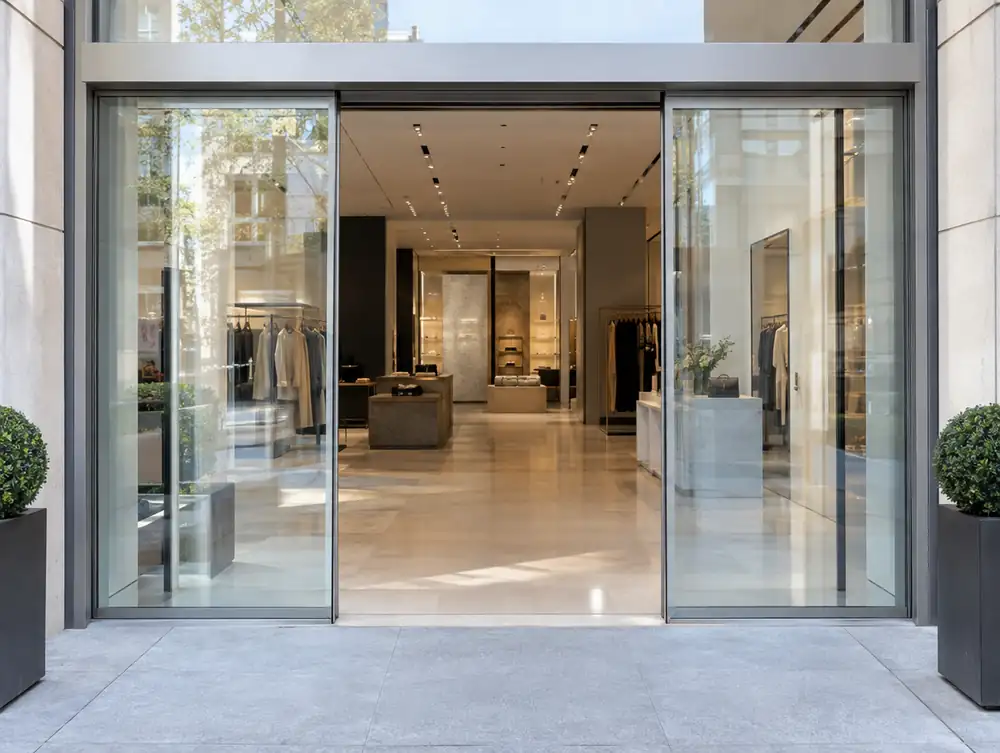
What goes into getting automatic sliding doors right in Chelsea?
For a pharmacy or retail chain with a branch in Chelsea, we'd keep the door type, finish and settings the same as the estate standard. Opening width and head detail then adapt to this particular front.
If your Chelsea entrance catches low sun, infrared sensors can misread the light on the floor. We'd favour radar with a presence sensor set for those conditions, and consider solar control glass in the leaves.
A corner unit has two fronts to think about, and the return elevation often does as much selling as the main one. If that is your layout in Chelsea, carry the fascia and glass line round the corner and treat both faces as one composition.
Which applications might automatic sliding doors in Chelsea involve?
A true like-for-like replacement usually needs no planning permission in England, because the external appearance isn't materially affected. New materials, a different glass line or altered proportions usually do count as material, so for automatic sliding doors at premises in the Chelsea area, an application is then likely. The council confirms which side of that line a job falls on.
Planning and advert applications for Chelsea premises normally go to Royal Borough of Kensington and Chelsea. We check the position for your address at survey.
How much could automatic sliding doors in Chelsea cost you?
As a working budget, use £3,895 to £11,995 plus VAT per entrance. Your place inside that range for automatic sliding doors depends mostly on how much of the existing frontage can stay and how much has to be put right first.
| Town | Chelsea |
|---|---|
| Area | Greater London |
| Postcode districts | SW10, SW3, SW5, SW7 |
| Planning authority | Royal Borough of Kensington and Chelsea |
| Building approval | Building Regulations (Approved Documents) |
| Distance from Great Barr | About 104 miles |
| Survey | Free for new work |
Does Royal Borough of Kensington and Chelsea publish shopfront guidance?
Yes, Shopfront Design Guidelines Supplementary Planning Document (2011). It tells applicants what the council expects from new and altered shopfronts. A few of the things it asks for:
- Stallriser height should not exceed the base of the pilasters, around 450mm, or the fascia depth, whichever is less.
- Box fascias are not to be used, and painted timber is treated as the most appropriate fascia on nineteenth-century buildings.
- External shutters are not acceptable across most of the borough, with internal open-link grilles preferred.
Questions about automatic sliding doors in Chelsea
Will the door keep opening for passers-by in Chelsea?
Not if it is set up properly. We narrow the sensor field on site and test it against real footfall, so only people heading for the door trigger it.
Can an automatic door work with my Chelsea shop's alarm and locks?
Yes. The door can lock at closing, and it can link to your alarm or access control where the systems allow, with a manual key position as a fallback.
How noisy would an automatic door be at my Chelsea shop?
A healthy door is very quiet, and you'd normally hear only a soft hum. Noise usually means worn rollers or grit in the guide, which a service will put right.
Does the Equality Act apply to a shop entrance in the Chelsea area?
Yes. The Equality Act 2010 applies in England, as across Great Britain, and it requires reasonable steps to remove, alter or avoid physical features that disadvantage disabled people. The duty is anticipatory, so it looks at disabled people generally, and a new Services Code replaced the 2011 Code on 5 August 2026.
Do I need listed building consent for a shopfront in the Chelsea area?
Usually yes, if the building is listed. In England the local planning authority decides, and Historic England is notified of Grade I and II* works and specified Grade II works. Like-for-like repair may not need consent, so ask the council before work starts.