New sign, new name or a fascia that has simply faded: any job in Chelsea begins with a measured survey and a look at what sits behind the old panel. Fixings are only as good as the structure they land in.
A survey in Chelsea usually starts outside, looking at the whole elevation before any tape comes out, because the frontage has to answer the building above it.
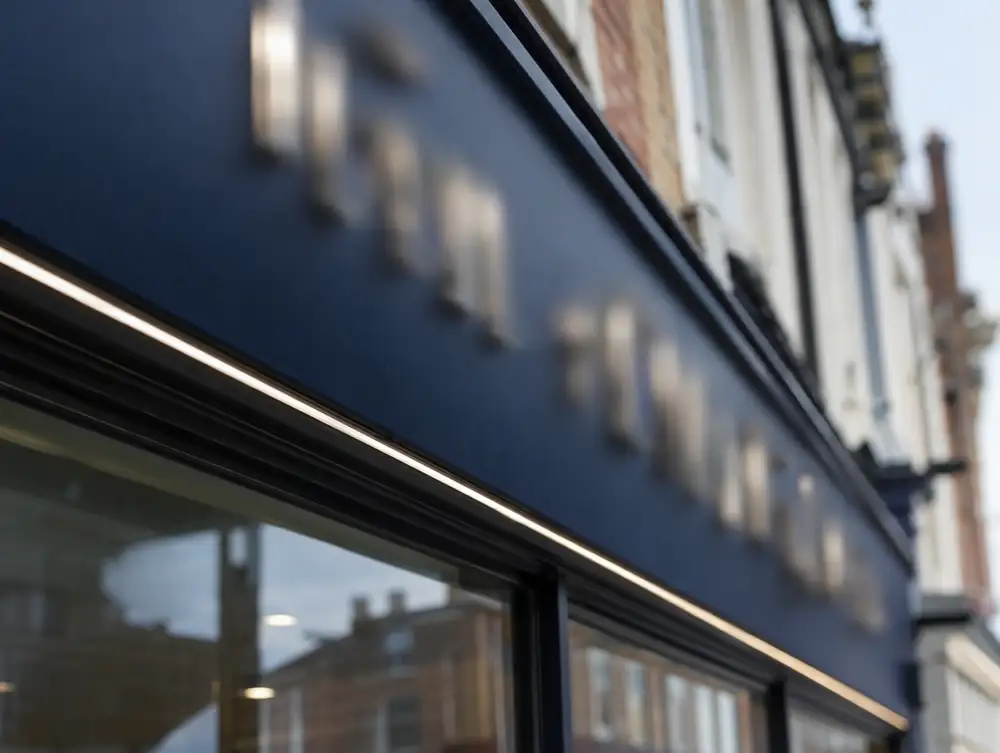
How would we approach fascia signage for your Chelsea premises?
A deep fascia above a low shopfront can often be reduced on the drawing board. If your Chelsea premises have one, we would show you a slimmer panel option, with the ceiling line behind it adjusted to suit.
For brands with strict guidelines, we turn logo artwork into cut files and check the smallest details at full size. If a thin stroke will not survive in metal, we suggest a small change before anything is made.
Where units share one long run of fascia, breaking the height makes you stand out for the wrong reason. If that describes your Chelsea parade, keep the line and win attention with lettering, lighting and what's in the window.
What consents could affect fascia signage in Chelsea?
For fascia signage at premises in the Chelsea area, the deciding question in England is whether the building work materially affects the external appearance. If it does, planning permission is needed, while a true like-for-like replacement usually needs none. The council confirms the position for each site.
In England, signs at premises in the Chelsea area come under the 2007 Advertisement Regulations. An unlit fascia sign generally needs no application under Class 5 of Schedule 3 if it sits on a wall containing a shop window, tops out at 4.6m or the first-floor sill if that is lower, and keeps letters to 0.75m high. Displaying a sign without the consent it needs is a criminal offence, so check before it goes up.
Expect planning and advert applications here to go to Royal Borough of Kensington and Chelsea in the normal way. We check what that means for your building when we survey it in Chelsea.
What should you budget for fascia signage in Chelsea?
Allow £395 to £1,995 plus VAT per sign. Size and specification set most of that figure for fascia signage, and the rest depends on what the survey finds on site.
| Town | Chelsea |
|---|---|
| Area | Greater London |
| Postcode districts | SW10, SW3, SW5, SW7 |
| Planning authority | Royal Borough of Kensington and Chelsea |
| Building approval | Building Regulations (Approved Documents) |
| Distance from Great Barr | About 104 miles |
| Survey | Free for new work |
Does Royal Borough of Kensington and Chelsea publish shopfront guidance?
Yes, Shopfront Design Guidelines Supplementary Planning Document (2011). It tells applicants what the council expects from new and altered shopfronts. A few of the things it asks for:
- Stallriser height should not exceed the base of the pilasters, around 450mm, or the fascia depth, whichever is less.
- Box fascias are not to be used, and painted timber is treated as the most appropriate fascia on nineteenth-century buildings.
- External shutters are not acceptable across most of the borough, with internal open-link grilles preferred.
Questions about fascia signage in Chelsea
Can a new fascia sign in Chelsea be fitted on a closed day?
Yes, we can arrange that, or fit out of hours if that suits you better. Most fascia signs take about a day, so the work can often go into your quietest trading hours.
What artwork do you need for a sign in Chelsea?
Vector files such as AI, EPS or PDF are ideal, along with any brand guidelines. If you only have a low-resolution logo, it can be redrawn, and that time is shown on the quotation.
Will you remove the old sign from my Chelsea premises?
Yes. Taking down the old sign, clearing old fixings and making good are included in the itemised quotation. We tell you what we find behind it before going further.
Do roller shutters need planning permission in the Chelsea area?
Usually yes. Installing or replacing a security grill or shutter on a shopfront is expressly outside England's shop permitted development rights, so the only way to avoid an application is work that doesn't materially affect the appearance. Ask the council before ordering.
Does a new shopfront in the Chelsea area need Building Regulations approval?
Assume yes until building control says otherwise. England has no like-for-like exemption, though registered installers can self-certify replacement windows and doors in non-dwellings. That route doesn't cover structural glass, curtain walling or revolving doors.